










Neetu Yoshi Limited H1 FY27 EBITDA margin fell 610 basis points
Key highlights
- Neetu Yoshi’s H1 FY27 revenue from operations rose 34.0% to Rs 59.15 crore.
- Raw-material expense increased 50.6% to Rs 32.70 crore and reached 55.1% of total income.
- Neetu Yoshi’s EBITDA margin declined 610 basis points to 28.56% in H1 FY27.
- Neetu Yoshi’s Haridwar unit began commercial production on 13 September 2026 with 13,200 MTPA capacity.
powered by IRIS
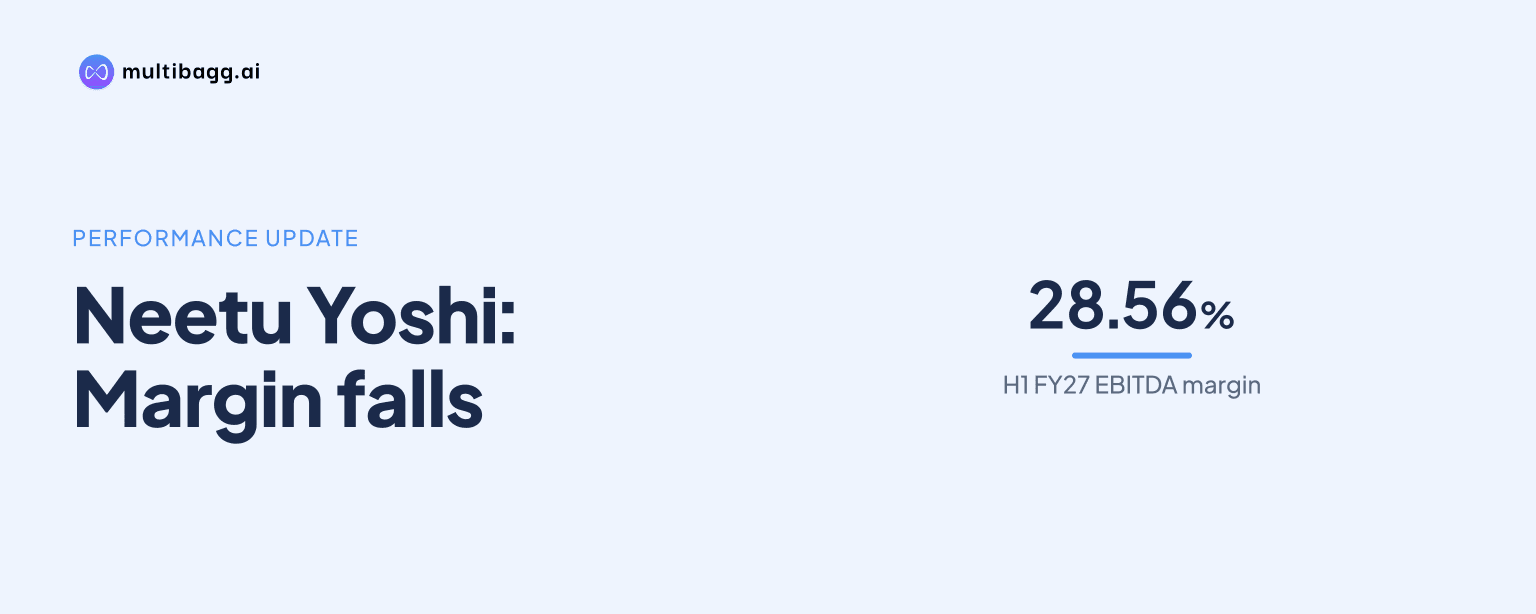
Neetu Yoshi Limited increased revenue from operations by 34.0% to Rs 59.15 crore in H1 FY27, but EBITDA margin fell 610 basis points to 28.56% as raw-material expense rose 50.6% to Rs 32.70 crore and represented 55.1% of total income.
Know Neetu Yoshi inside out
Results, valuation, peers and who's buying, in one view.
Why did Neetu Yoshi’s EBITDA margin fall in H1 FY27?
Neetu Yoshi’s EBITDA margin fell because raw-material costs grew faster than income. Earnings before interest, tax, depreciation and amortisation, or EBITDA, increased 6.5% to Rs 16.96 crore in H1 FY27, while total income rose 29.2% to Rs 59.38 crore. The resulting EBITDA margin was 28.56%, compared with 34.66% in H1 FY26.
Raw-material spending was Rs 32.70 crore in H1 FY27, up Rs 10.98 crore, or 50.6%, from Rs 21.72 crore a year earlier. The presentation says raw material accounted for 55.1% of total income in H1 FY27, versus 47.3% in H1 FY26. That 7.8-percentage-point increase in the input-cost share was the disclosed reason for the lower margin.
Employee benefit expenses also rose faster than income, increasing 39.5% to Rs 3.71 crore from Rs 2.66 crore. Other expenses increased 6.6% to Rs 6.01 crore from Rs 5.64 crore, which was slower than revenue growth. Total expenditure nevertheless climbed 41.3% to Rs 42.42 crore, exceeding the 29.2% increase in total income.
How fast did Neetu Yoshi’s revenue and income grow?
Neetu Yoshi’s revenue from operations grew 34.0% year on year to Rs 59.15 crore in H1 FY27 from Rs 44.15 crore in H1 FY26. This Rs 15.00 crore rise was the principal contributor to total-income growth during the period in the profit and loss statement.
Total income increased by a lower 29.2% to Rs 59.38 crore because other income declined sharply. Other income fell 87.3% to Rs 0.23 crore from Rs 1.81 crore in H1 FY26, a reduction of Rs 1.58 crore. Operating revenue expanded by Rs 15.00 crore, while the smaller other-income line limited the total-income increase to Rs 13.42 crore.
The reported gap between sales and profit growth was substantial. Revenue from operations expanded 34.0%, while EBITDA rose 6.5% and profit after tax, or PAT, increased 4.0%. Neetu Yoshi therefore converted a smaller proportion of H1 FY27 income into both operating profit and net profit than in H1 FY26.
What happened to Neetu Yoshi’s net profit and per-share earnings?
Neetu Yoshi’s PAT rose 4.0% to Rs 12.00 crore in H1 FY27 from Rs 11.54 crore a year earlier, despite the Rs 1.03 crore increase in EBITDA. PAT margin declined 490 basis points to 20.21% from 25.11%, alongside the lower operating margin, higher depreciation and a higher tax charge.
Depreciation increased 49.0% to Rs 1.46 crore from Rs 0.98 crore, while tax increased 29.3% to Rs 3.40 crore from Rs 2.63 crore. Finance costs moved in the opposite direction, declining 85.9% to Rs 0.11 crore from Rs 0.78 crore. Profit before tax consequently rose 8.6% to Rs 15.40 crore from Rs 14.18 crore, faster than PAT but slower than revenue.
Earnings per share, or EPS, were Rs 3.09 in H1 FY27, compared with Rs 3.49 in H1 FY26, a decline of 11.5%. The presentation specifies that EPS is not annualised. The fall in per-share earnings occurred even as PAT increased by Rs 0.46 crore, making EPS a separate reported measure alongside net profit.
Got a follow-up? Ask IRIS
What capacity and product developments followed H1 FY27?
Neetu Yoshi commenced commercial production at its Haridwar facility on 13 September 2026. The facility at Chudiyala, Mohanpur, Bhagwanpur, Haridwar, Uttarakhand, was established using initial public offering proceeds and is designed to manufacture complete bogies and couplers.
The Haridwar unit has installed capacity of 13,200 metric tonnes per annum, or MTPA, compared with 8,087 MTPA before the new facility. The presentation says the new unit alone is more than 2.6 times the old plant’s capacity and supports a larger, more diversified order pipeline across railway and engineering sectors.
Neetu Yoshi also reported product qualifications during H1 FY27. Its Haridwar facility was included in the Research Designs and Standards Organisation, or RDSO, Vendor Directory for freight bogies under the Developmental Vendor category for Constant Contact Side Bearers, with approved annual capacity of 112,200 units in May 2026. In June 2026, Rail Coach Factory, Kapurthala found Neetu Yoshi suitable to make Brake Support for FIAT Bogie, with the qualification valid until 13 April 2030 unless specifications change.
A September 2026 RDSO prototype approval covered Friction Wedge, item ID 3100430, making Neetu Yoshi eligible to supply Indian Railways and associated agencies. The presentation says the component is used across bogies, including the CASNUB 22 RFT, or Raftaar, bogie for faster freight. These approvals broaden procurement eligibility, but the presentation does not quantify related orders or revenue.
Conclusion
The H1 FY27 figures show that Neetu Yoshi’s cost base rose more quickly than income: total expenditure increased 41.3% to Rs 42.42 crore, while EBITDA increased 6.5% to Rs 16.96 crore and PAT increased 4.0% to Rs 12.00 crore. The decline in both EBITDA and PAT margins reflects that difference in growth rates.
Next, management says Neetu Yoshi is focused on optimising capacity utilisation, improving operational efficiencies, expanding product offerings and maintaining prudent financial management. The disclosed operating development to watch is the 13,200 MTPA Haridwar facility, which started commercial production on 13 September 2026; the presentation gives no utilisation target, order value or timetable for its financial contribution.