










LohiaCorp forecasts India raffia machinery at $242m by FY30
Key highlights
- India’s woven-raffia machinery market is projected to rise from $150 million in FY25 to $242 million in FY30F.
- India’s woven-raffia market is forecast to grow from $8.4 billion in FY25 to $14.0 billion in FY30F.
- India’s recycling volume is projected to increase from 9.9 million tonnes in CY23 to 23.7 million tonnes in CY32F.
- LohiaCorp reported Rs 51.8 crore of research and development expense in FY26, equal to 3.0% of revenue.
powered by IRIS
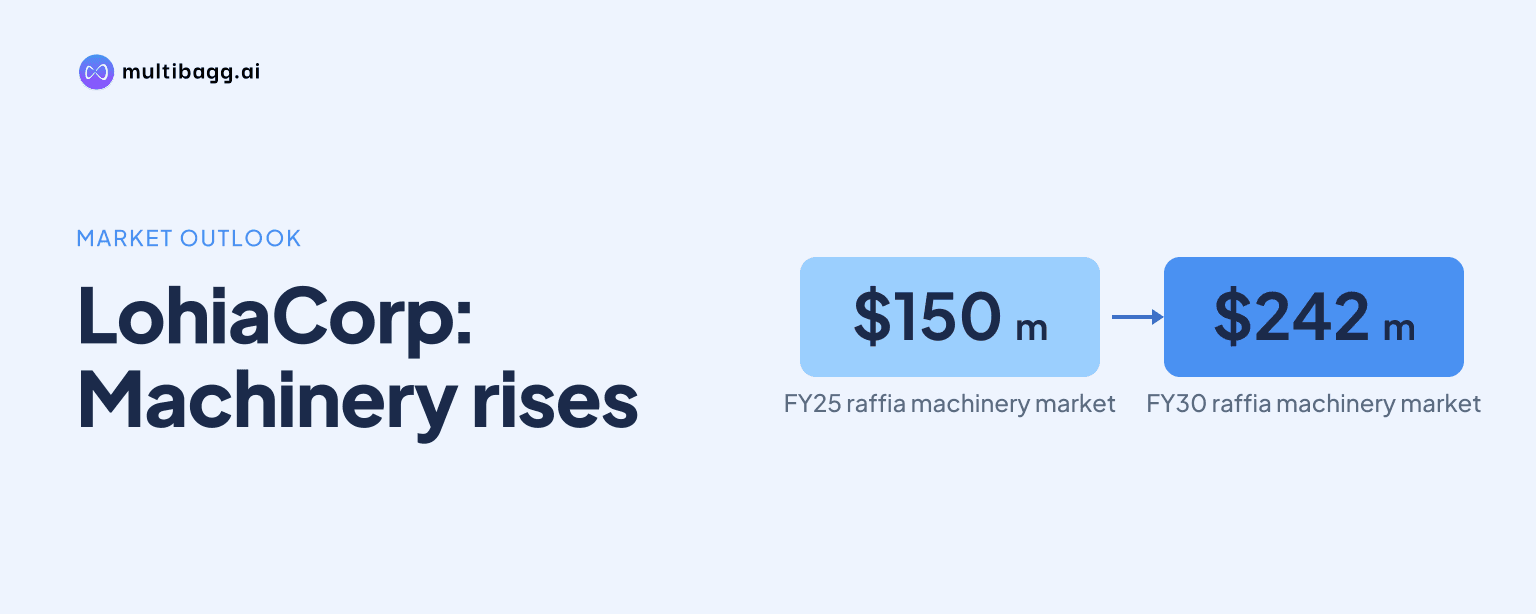
LohiaCorp projects India’s woven-raffia machinery market will reach $242 million in FY30F, up from $150 million in FY25 at a 10.0% compound annual growth rate, while recycling equipment demand is supported by a recycling market projected to reach 23.7 million tonnes by CY32F.
Know Lohia Corp inside out
Results, valuation, peers and who's buying, in one view.
Why is LohiaCorp focused on India’s raffia-machinery market?
LohiaCorp is focused on India because the source projects the domestic woven-raffia machinery market to expand by 10.0% annually from FY25 to FY30F, compared with 5.2% for the global machinery market from CY24 to CY30F. India had 1,500 raffia units, 2,150 tape-extrusion plants and 75,000 looms at the time of the presentation, which frames the installed industrial base served by machinery suppliers.
The market forecast covers machinery used through the woven-raffia production chain, including tape extrusion, circular looms, winders and bag conversion. LohiaCorp’s portfolio runs from tape production, winding and circular weaving through coating, laminating, printing, bag conversion and recycling, giving it products across both fabric-making and post-fabric processing stages.
How fast is India’s woven-raffia market growing?
India’s underlying woven-raffia market is forecast to grow at a 10.6% compound annual growth rate, with value rising from $8.4 billion in FY25 to $14.0 billion in FY30F. Volume is projected to increase from 3,810 kilotonnes in FY25 to 6,030 kilotonnes in FY30F, a gain of 2,220 kilotonnes over the forecast period.
That domestic rate exceeds the 6.3% compound annual growth rate shown for the global woven-raffia market. Global market value is projected to rise from $69 billion in CY24 to $100 billion in CY30F, while volume rises from 26,200 kilotonnes to 39,400 kilotonnes; India’s forecast therefore shows faster percentage growth than the global market in the source data.
Which end markets support LohiaCorp’s machinery demand?
Packaging is the principal end market, accounting for 84% of global woven-raffia market volume in CY24, according to the F&S Report cited by LohiaCorp. The packaging uses listed are cement, fertilisers, chemicals, food grains, shopping bags, leno bags and flexible intermediate bulk containers, or FIBCs.
Non-packaging applications account for the remaining 16% of global industry volume in CY24. These applications include wrapping fabric, geotextiles, ground cover or carpet backing, roof underlayment, ropes and twines, extending machinery demand beyond sacks and bags into technical and agricultural uses.
LohiaCorp’s stated strategy also identifies conversion and processing machines as a segment growing faster than woven-fabric machinery, without providing a separate numerical growth rate. It acquired Sundarlam’s lamination and coating business and established a dedicated Bengaluru unit, while its strategy calls for exports of block-bottom conversion, lamination and printing machines through five international offices and stockists in eight countries.
Got a follow-up? Ask IRIS
Why is recycling a new driver for LohiaCorp?
Recycling is a new demand driver because LohiaCorp identifies increasing use of recycled polypropylene, or rPP, in raffia production and cites advances in extrusion technology intended to preserve strength and ultraviolet resistance. The presentation says major buyers in cement, agriculture and retail are adopting rPP woven sacks and FIBCs, linking material substitution to machinery requirements.
India’s recycling market is projected to increase from $4.2 billion in CY23 to $7.0 billion in CY32F, while its volume is forecast to rise from 9.9 million tonnes to 23.7 million tonnes. The source describes this as a post-consumer-waste opportunity and says integrated shredder, extruder and pelletizer machines can enable one-step recycling of polypropylene and high-density polyethylene, or HDPE, raffia.
The addressable equipment market also extends outside India: the global sorting, washing and extrusion machinery market is projected to grow from $1.5 billion in CY23 to $2.2 billion in CY30F. LohiaCorp’s recycling plan covers machinery for in-house and post-consumer waste, with a stated aim to build a “granule to granule” chain and a pipeline that includes ReclaPro and ReclaMax.
What capabilities does LohiaCorp have for this opportunity?
LohiaCorp combines the recycling plan with existing product coverage across the woven-sack process, from raw material through tape production, winding and circular looms to coating, printing and bag conversion. Its Lohia Internet of Things Gateway has been deployed across Tapeline and Blokomatic machines since 2022, while the company says the Bengaluru Digital Innovation Center has a 16-person team working on smart machines, automation and new Internet of Things hardware prototypes.
Its research and development expense increased from Rs 36.8 crore in FY24 to Rs 51.8 crore in FY26, after Rs 37.1 crore in FY25. Research and development expense represented 3.2% of revenue in FY24, 2.7% in FY25 and 3.0% in FY26; as of March 31, 2026, LohiaCorp reported 251 research and development employees, equal to 12.5% of on-roll manpower.
Manufacturing infrastructure includes six facilities, including two outside India, and 100 computer numerical control machines for in-house production. The Chabepur unit in Kanpur has capacity information of 108,000 tape winders and 240 extrusion lines, while the Panki unit lists 13,800 circular looms, aligning the production base with the tape-extrusion and weaving stages identified in the market forecast.
Conclusion
The presentation’s central finding is that India’s forecast 10.0% annual growth in woven-raffia machinery, from $150 million in FY25 to $242 million in FY30F, exceeds the 5.2% global machinery-market rate. That outlook sits alongside an Indian woven-raffia market expected to reach $14.0 billion and a recycling market projected to reach 23.7 million tonnes by CY32F, creating demand drivers across conventional raffia processing and waste handling.
What to watch next is execution of LohiaCorp’s disclosed plan to extend into conversion and recycling, including ReclaPro and ReclaMax, while expanding international warehousing and distribution. The source does not provide launch dates, sales targets or order projections for those recycling products, so future disclosures on commercialisation and adoption would clarify how the stated market opportunity translates into operations.