










Sanstar reaches 2,350 TPD, derivatives due in FY2026-27
Key highlights
- Sanstar’s installed capacity rose from 1,100 TPD to 2,350 TPD after the 1,250-TPD Dhule unit was commissioned.
- Sanstar has scheduled its Dhule derivatives facility, including dextrose anhydrous, for commissioning in FY2026-27.
- Q2 FY2027 revenue was Rs 218.3 crore, up 11.1% year on year, and gross margin increased to 32.4% from 24.8%.
- Sanstar invested about Rs 7.5 crore in a 3-megawatt Kutch solar plant expected to meet about 40% of that facility’s electricity requirement.
powered by IRIS
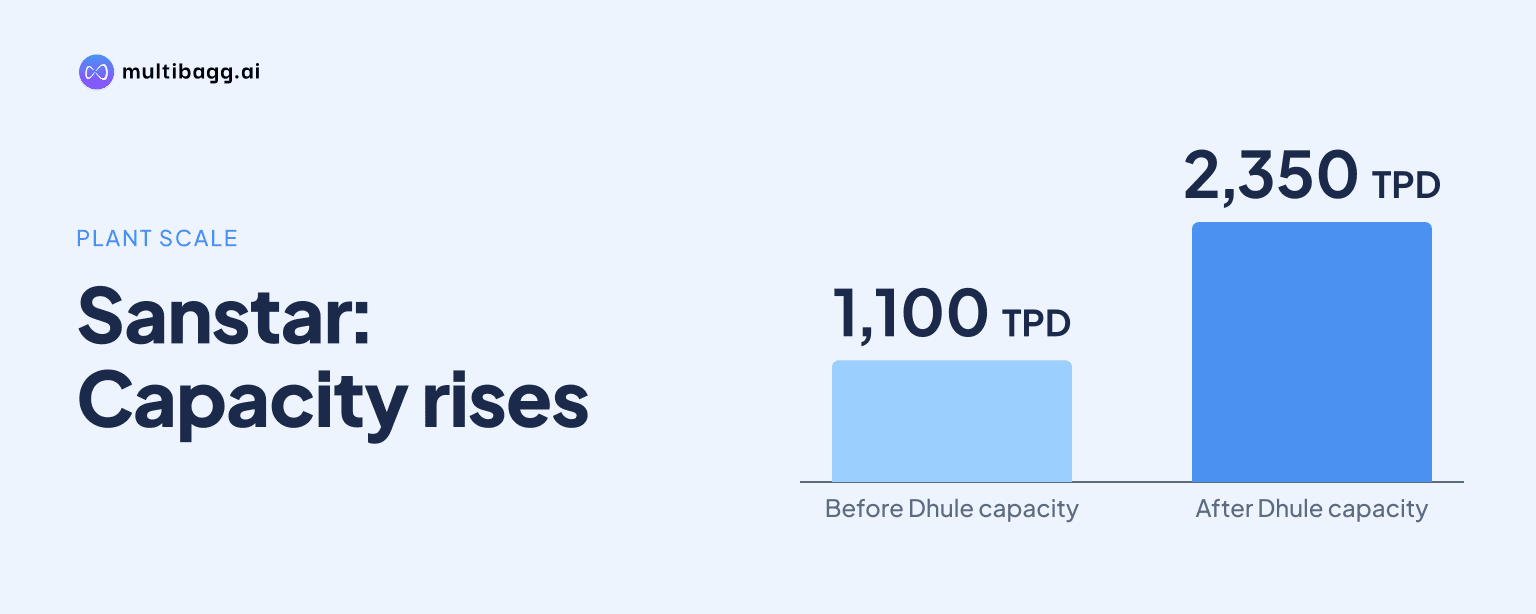
Sanstar Limited has raised installed maize wet-milling capacity from 1,100 tonnes per day (TPD) to 2,350 TPD by commissioning a 1,250-TPD Dhule line, while the site’s derivatives facility remains scheduled for commissioning in FY2026-27. The company allocated Rs 181.6 crore of initial public offering proceeds to the Dhule expansion.
Know Sanstar inside out
Results, valuation, peers and who's buying, in one view.
How did Sanstar reach 2,350 TPD of capacity?
Sanstar reached 2,350 TPD through 350 TPD at Kutch, Gujarat, 750 TPD at its first Dhule, Maharashtra unit and 1,250 TPD at the commissioned second Dhule unit. The 1,250-TPD addition lifted the platform from 1,100 TPD, with Dhule now accounting for 2,000 TPD and Kutch for the remaining 350 TPD.
Dhule represents about 85% of Sanstar’s 2,350-TPD installed base and has 210 acres of land, with the presentation citing four-times expansion potential at the existing plant area. The site has stated annual advanced maize wet-milling capacity of 247,500 metric tonnes, while Kutch has annual maize-crushing capacity of 115,500 metric tonnes and 42 acres available for future expansion.
What will Sanstar’s Dhule derivatives facility add?
Sanstar plans to commission the Dhule derivatives facility in FY2026-27, adding maltodextrin powder, liquid glucose, dried glucose solids, liquid dextrose, dextrose monohydrate and dextrose anhydrous to its stated portfolio. The presentation identifies dextrose anhydrous as an upcoming product to be made through the ongoing expansion.
The commissioned 1,250-TPD unit and the derivatives facility are separate stages of the Dhule project: wet milling is operational, while derivatives processing is pending. Sanstar did not disclose a separate derivatives capacity, commissioning date within FY2026-27, or investment amount for that facility.
The derivative range is intended for food, pharmaceutical and fermentation applications. Sanstar’s existing wet-milling portfolio also includes native starch for food, personal care, paper, pharmaceutical and industrial uses, plus modified starches such as yellow dextrin, white dextrin, oxidized starch, cationic starch and pregel starch.
What infrastructure supports Sanstar’s larger platform?
Sanstar sources 30% of its maize requirements directly from local farmers around Dhule and procures the remaining 70% through mandis, local stock houses and traders. Dhule also has 50,000 metric tonnes of maize-storage silos, supporting the 2,000-TPD manufacturing location.
Both facilities use Supervisory Control and Data Acquisition, or SCADA, automation. Dhule is 275 kilometres from Hazira Port and 410 kilometres from Nhava Sheva, while Kutch is 100 kilometres from Mundra Port and 55 kilometres from Kandla Port; the presentation says exports contributed 34% of revenue and reached 34 countries.
Sanstar commissioned a 3-megawatt captive solar plant at Kutch during Q2 FY2027 after an investment of about Rs 7.5 crore. Management expects the plant to meet about 40% of Kutch’s electricity requirement and generate annual power-cost savings of around Rs 3 crore; Dhule separately has 3.5 megawatts of solar capacity and a 1.6-megawatt biogas plant.
Got a follow-up? Ask IRIS
Has the capacity expansion appeared in Sanstar’s FY2027 results?
Sanstar reported revenue from operations of Rs 218.3 crore in Q2 FY2027, up 11.1% from Rs 196.4 crore in Q2 FY2026. Gross profit increased to Rs 70.8 crore and the gross margin rose to 32.4% from 24.8%, while management cited stable plant operations, higher manufacturing capacity, efficiencies and wider product availability.
Earnings before interest, tax, depreciation and amortisation, or EBITDA, excluding other income, was Rs 8.3 crore in Q2 FY2027, compared with Rs 1.4 crore a year earlier but Rs 15.4 crore in Q1 FY2027. Profit after tax was Rs 5.9 crore, above Rs 0.6 crore in Q2 FY2026 but below Rs 9.2 crore in Q1 FY2027, showing year-on-year improvement and a sequential decline.
For H1 FY2027, revenue rose 15.9% to Rs 424.4 crore from Rs 366.1 crore in H1 FY2026. EBITDA excluding other income rose to Rs 23.7 crore from Rs 0.4 crore, profit after tax increased to Rs 15.1 crore from Rs 0.3 crore, and gross margin expanded to 32.9% from 24.5%.
What risks and financial changes does Sanstar disclose?
Sanstar says native-starch pricing is under short-term pressure because Chinese exports into South East Asia have contributed to excess supply in India. Management also described the native-starch market as competitive because of global pricing dynamics in Q2 FY2027, while the presentation gives no pricing, utilisation or derivatives-revenue target.
Investment activity rose alongside the expansion. Sanstar reported Rs 204.1 crore of investing cash outflow in H1 FY2027, attributed to capacity expansion and strategic-growth initiatives, compared with operating cash inflow of Rs 23.4 crore. Total debt was Rs 30.8 crore at H1 FY2027 versus Rs 19.9 crore in FY2026, and net debt moved to Rs 11.7 crore from net cash of Rs 3.7 crore.
Conclusion
Sanstar has completed the wet-milling capacity increase that took its installed base from 1,100 TPD to 2,350 TPD, concentrated in the 2,000-TPD Dhule complex. H1 FY2027 revenue rose to Rs 424.4 crore and gross margin reached 32.9%, while the company continued to report competitive conditions in native starch.
The next disclosed milestone is commissioning of the Dhule derivatives facility in FY2026-27, including dextrose anhydrous. Management says it will focus on improving plant utilisation, increasing value-added product contribution, managing costs and expanding renewable-energy use; progress on those plans remains the key matter to watch.