










Sanstar more than doubles capacity to 2,350 TPD with Dhule
Key highlights
- Sanstar’s installed maize-processing capacity increased from 1,100 TPD to 2,350 TPD after the new Dhule facility was commissioned.
- Dhule facility 2 has 1,250 TPD capacity and is listed for wet milling and derivatives in FY2026-27.
- Q2 FY2027 consolidated revenue was Rs 218.3 crore, up 11.1% year on year, while gross margin reached 32.4%.
- Sanstar commissioned a 3-MW Kutch solar plant that management expects to meet about 40% of that facility’s electricity needs.
powered by IRIS
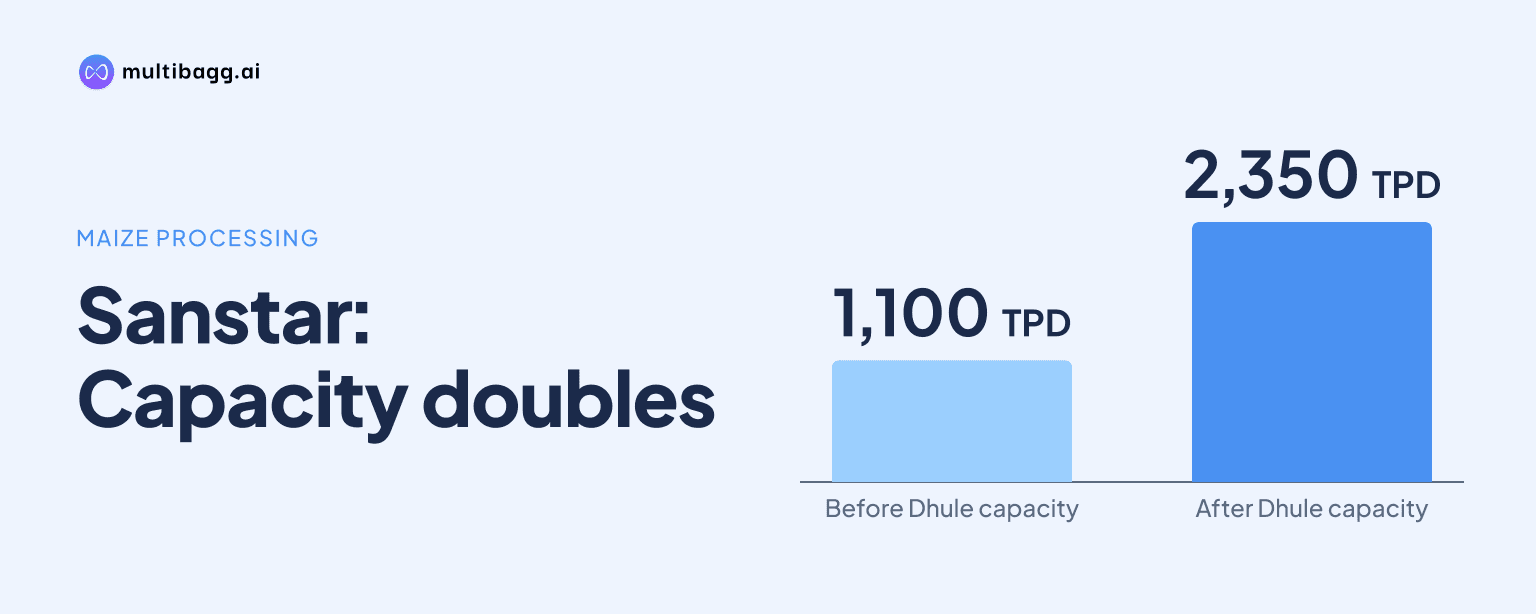
Sanstar Limited said its newly commissioned Dhule facility lifted installed maize-based specialty-products processing capacity from 1,100 tonnes per day (TPD) to 2,350 TPD as of its 6 November 2026 results release. The 1,250-TPD Dhule unit is listed as a wet-milling facility with derivatives capability in FY2026-27.
Know Sanstar inside out
Results, valuation, peers and who's buying, in one view.
How much maize-processing capacity does Sanstar have now?
Sanstar has total installed capacity of 2,350 TPD across three wet-milling facilities, according to its 6 November 2026 earnings presentation. This compares with 1,100 TPD before commissioning of the new Dhule facility, an increase of 1,250 TPD that takes capacity to more than twice its former level.
The capacity is split between Kutch in Gujarat and two sites in Dhule, Maharashtra. Kutch has 350 TPD, the first Dhule facility has 750 TPD, and the second Dhule facility has 1,250 TPD. The new 1,250-TPD unit alone exceeds Sanstar’s previous total installed capacity of 1,100 TPD.
What does the new Dhule facility add to Sanstar’s product range?
Sanstar lists derivatives capability at Dhule facility 2 in FY2026-27 alongside the unit’s 1,250-TPD wet-milling capacity. Its derivatives range includes maltodextrin powder, liquid glucose, liquid dextrose, dextrose monohydrate, dextrose anhydrous and dried glucose solids.
The company identifies food, pharmaceutical and fermentation applications for derivatives products. It separately lists native starch applications in food, personal care, paper, pharmaceuticals at Dhule 2 and industrial uses, while modified starch products are identified for industrial uses and food applications at Dhule 2.
Sanstar also lists yellow dextrin, oxidized starch, white dextrin, cationic starch and pregel starch within its modified-starch portfolio. Co-products from its operations include gluten, fibre, maize steep liquor, enriched protein and germ, with stated applications in animal nutrition and food.
Management said on 6 November 2026 that it would seek to increase the contribution of value-added products during the second half of FY2027. That is a stated objective, rather than an output forecast, because the presentation does not disclose utilisation rates, derivatives volumes or revenue from the new 1,250-TPD Dhule unit.
Got a follow-up? Ask IRIS
Has higher capacity appeared in Sanstar’s FY2027 financial results?
Sanstar reported consolidated revenue from operations of Rs 218.3 crore in Q2 FY2027, up 11.1% from Rs 196.4 crore in Q2 FY2026. Gross profit rose 45.3% to Rs 70.8 crore, while gross margin increased to 32.4% from 24.8% in the comparable quarter.
Management said benefits from higher manufacturing capacity were becoming visible in Q2 FY2027, alongside stable plant operations, improved operating efficiencies and a wider product portfolio. It also said the native-starch market remained competitive because of global pricing dynamics, so the reported improvement was attributed to several factors rather than capacity alone.
On a half-year basis, revenue was Rs 424.4 crore in H1 FY2027, compared with Rs 366.1 crore in H1 FY2026, a 15.9% increase. H1 gross profit rose to Rs 139.7 crore from Rs 89.8 crore, and gross margin increased to 32.9% from 24.5%.
What other operating changes accompany Sanstar’s expanded capacity?
Sanstar commissioned a 3-megawatt (MW) captive solar power plant at Kutch during Q2 FY2027, with an investment of approximately Rs 7.5 crore. Management expects the plant to meet about 40% of the Kutch facility’s electricity requirement and generate annual power-cost savings of around Rs 3 crore.
The Kutch solar project adds to existing solar- and biogas-based power capacity at Dhule, according to management. The commissioning of the 3-MW plant is a reported event, while the estimated 40% electricity coverage and annual Rs 3 crore savings are management expectations.
Raw maize sourcing is split between local farmers, accounting for 30%, and distributors, accounting for 70%, in Sanstar’s presentation. The company does not disclose maize procurement volumes, inventory days or the effect of the new Dhule capacity on raw-material costs.
Exports provided another operating measure in Q2 FY2027. Export revenue was Rs 75.5 crore, up 17.1% from Rs 64.5 crore in Q2 FY2026 and 4.5% from Rs 72.3 crore in Q1 FY2027; H1 FY2027 export revenue reached Rs 147.8 crore.
Conclusion
Sanstar’s Dhule expansion raised its disclosed installed processing capacity from 1,100 TPD to 2,350 TPD, with the 1,250-TPD addition bringing wet-milling capacity and listed derivatives capability. Q2 FY2027 revenue increased 11.1% year on year and gross margin reached 32.4%, while management attributed operating gains to expanded capacity, stable operations, efficiencies and a wider portfolio.
Next, investors can watch Sanstar’s execution of its stated second-half FY2027 priorities: improving facility utilisation, increasing value-added product contribution and expanding domestic and export presence. The presentation provides no capacity-utilisation or derivatives-revenue target, while management expects the new Kutch solar plant to cover about 40% of that site’s electricity needs and save around Rs 3 crore annually.