










Sanstar Q2 gross margin reaches 32.4% as revenue rises 11%
Key highlights
- Sanstar's Q2 FY27 gross margin was 32.4%, up 760 basis points from 24.8% in Q2 FY26.
- Q2 FY27 revenue from operations increased 11.1% year on year to Rs 218.3 crore.
- Q2 FY27 gross profit increased 45.3% year on year to Rs 70.8 crore.
- Sanstar commissioned a 3 megawatt Kutch solar plant with expected annual savings of around Rs 3 crore.
powered by IRIS
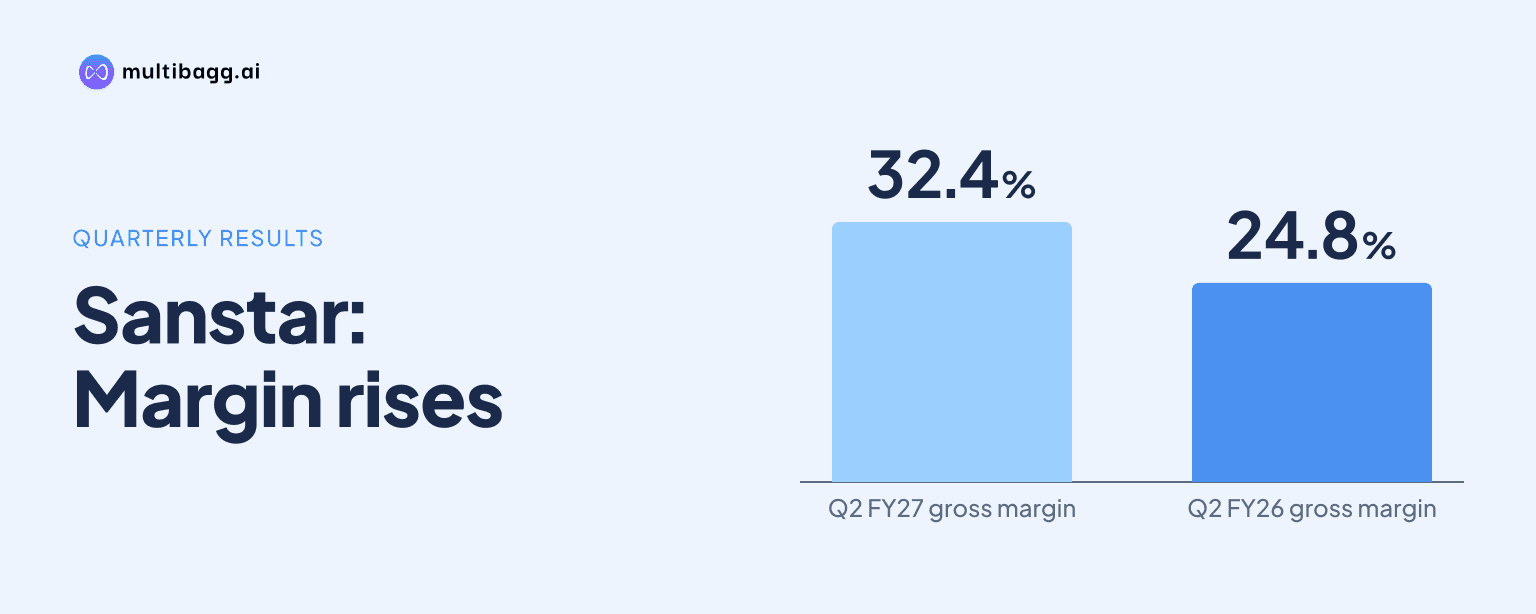
Sanstar Limited reported a Q2 FY27 gross margin of 32.4%, up 760 basis points year on year, as revenue from operations increased 11.1% to Rs 218.3 crore; gross profit rose 45.3% to Rs 70.8 crore, while EBITDA margin declined to 3.8% from 7.5% in Q1 FY27.
Know Sanstar inside out
Results, valuation, peers and who's buying, in one view.
How did Sanstar perform in Q2 FY27?
Sanstar reported higher revenue and substantially faster gross-profit growth in Q2 FY27, with revenue from operations rising to Rs 218.3 crore from Rs 196.4 crore a year earlier and gross profit reaching Rs 70.8 crore from Rs 48.7 crore. The difference in growth rates, 11.1% for revenue and 45.3% for gross profit, lifted the gross margin to 32.4% from 24.8%.
EBITDA, or earnings before interest, tax, depreciation and amortisation, was Rs 8.3 crore in Q2 FY27, compared with Rs 1.4 crore in Q2 FY26. Profit after tax, or PAT, was Rs 5.9 crore versus Rs 60 lakh a year earlier, and earnings per share rose to Rs 0.29 from Rs 0.03. These year-on-year gains occurred despite Q2 EBITDA being below the Rs 15.4 crore recorded in Q1 FY27.
Why did Sanstar's gross margin expand?
Sanstar's management attributed the Q2 FY27 gross-margin expansion to improved operating efficiencies, a larger manufacturing scale and a wider product portfolio. Management said stable plant operations and the benefits of higher manufacturing capacity were becoming visible, while also noting that the native starch market remained competitive because of global pricing dynamics.
Gross margin was 32.4% in Q2 FY27, compared with 24.8% in Q2 FY26 and 33.4% in Q1 FY27. This means the margin improved 760 basis points year on year but eased 100 basis points from the preceding quarter. Gross profit still increased 2.7% sequentially, from Rs 68.9 crore in Q1 FY27 to Rs 70.8 crore in Q2 FY27, as revenue increased 5.9%.
For H1 FY27, the financial-performance table shows gross margin of 32.9% against 24.5% in H1 FY26, while gross profit increased 55.4% to Rs 139.7 crore. Management's commentary cites a 25.4% H1 FY26 gross margin instead, creating a difference between the tabulated prior-period margin and the narrative comparison.
Why did Sanstar's EBITDA margin fall from Q1 FY27?
Sanstar's EBITDA margin fell to 3.8% in Q2 FY27 from 7.5% in Q1 FY27, as EBITDA declined 46.0% sequentially to Rs 8.3 crore despite higher revenue and gross profit. Sanstar reported the sequential movement but did not provide a separate quantified breakdown of costs or other factors behind the lower margin.
Profit before tax, or PBT, declined 36.4% quarter on quarter to Rs 8 crore from Rs 12.6 crore. PAT also declined 36.4%, to Rs 5.9 crore from Rs 9.2 crore, and PAT margin decreased to 2.7% from 4.5%. On a year-on-year basis, PBT increased from Rs 90 lakh and PAT increased from Rs 60 lakh in Q2 FY26.
The half-year figures show EBITDA of Rs 23.7 crore in H1 FY27, compared with Rs 40 lakh in H1 FY26, and an EBITDA margin of 5.6% against 0.1%. The H1 FY27 margin was therefore higher than the prior-year period even though Q2 EBITDA and its margin were below Q1 FY27 levels.
Got a follow-up? Ask IRIS
What did exports contribute to Sanstar's Q2 FY27 revenue?
Sanstar generated export revenue of Rs 75.5 crore in Q2 FY27, up 17.1% year on year from Rs 64.5 crore and 4.5% quarter on quarter from Rs 72.3 crore. Export growth exceeded Sanstar's 11.1% growth in total Q2 revenue, although the company did not disclose export profitability or a separate export margin.
Management said steady demand from overseas customers and Sanstar's established international-market presence supported export turnover in the quarter. It also cited improved geopolitical conditions and easing regional uncertainties as factors supporting shipments and market activity, which are management's assessment rather than quantified operating measures.
For H1 FY27, export revenue reached Rs 147.8 crore, while total revenue from operations was Rs 424.4 crore. Sanstar said its second-half priorities include strengthening domestic and export-market presence, raising manufacturing-facility utilisation and increasing the contribution of value-added products.
What capacity and energy measures has Sanstar added?
Sanstar commissioned a 3 megawatt captive solar power plant at Kutch, Gujarat, during Q2 FY27, with an investment of approximately Rs 7.5 crore. Management expects the plant to meet about 40% of the Kutch facility's total electricity requirement and generate annual power-cost savings of around Rs 3 crore.
The Kutch project adds to solar- and biogas-based power capacity at Sanstar's Dhule operations. The stated mechanism is lower power costs through captive renewable generation, but Sanstar presents the expected annual savings as a forward-looking estimate rather than a Q2 FY27 reported saving.
Sanstar also said its recently commissioned Dhule facility increased total installed processing capacity from 1,100 tonnes per day to 2,350 tonnes per day. Its facility listing identifies 350 tonnes per day at Kutch, 750 tonnes per day at one Dhule unit and 1,250 tonnes per day at a second Dhule unit, all using wet milling processes.
Conclusion
Sanstar's Q2 FY27 figures show a gap between gross-profit expansion and operating-profit conversion: gross profit grew 45.3% year on year, while EBITDA was Rs 8.3 crore and its margin was 3.8%, down from Rs 15.4 crore and 7.5% in Q1 FY27. Exports, at Rs 75.5 crore, grew faster than total revenue during the quarter.
The next disclosures will show whether Sanstar can improve utilisation of its expanded 2,350-tonnes-per-day capacity and raise the contribution of value-added products, as management has outlined for the second half of FY2027. Management's expectation that the 3 megawatt Kutch solar plant can cover about 40% of that facility's electricity use and save around Rs 3 crore annually is another stated outcome to monitor.