










LT Foods H1 revenue rises 22% as EBITDA margin decreases
Key highlights
- LT Foods’ consolidated H1 FY27 revenue increased 22% to Rs 6,414 crore.
- H1 FY27 EBITDA margin declined to 11.2% from 11.7% as brand investment rose almost 29% to Rs 139 crore.
- Basmati and specialty-rice revenue rose 27% to Rs 5,764 crore and represented 90% of consolidated revenue.
- Working-capital days declined to 143 from 174, while net cash was Rs 247 crore.
powered by IRIS
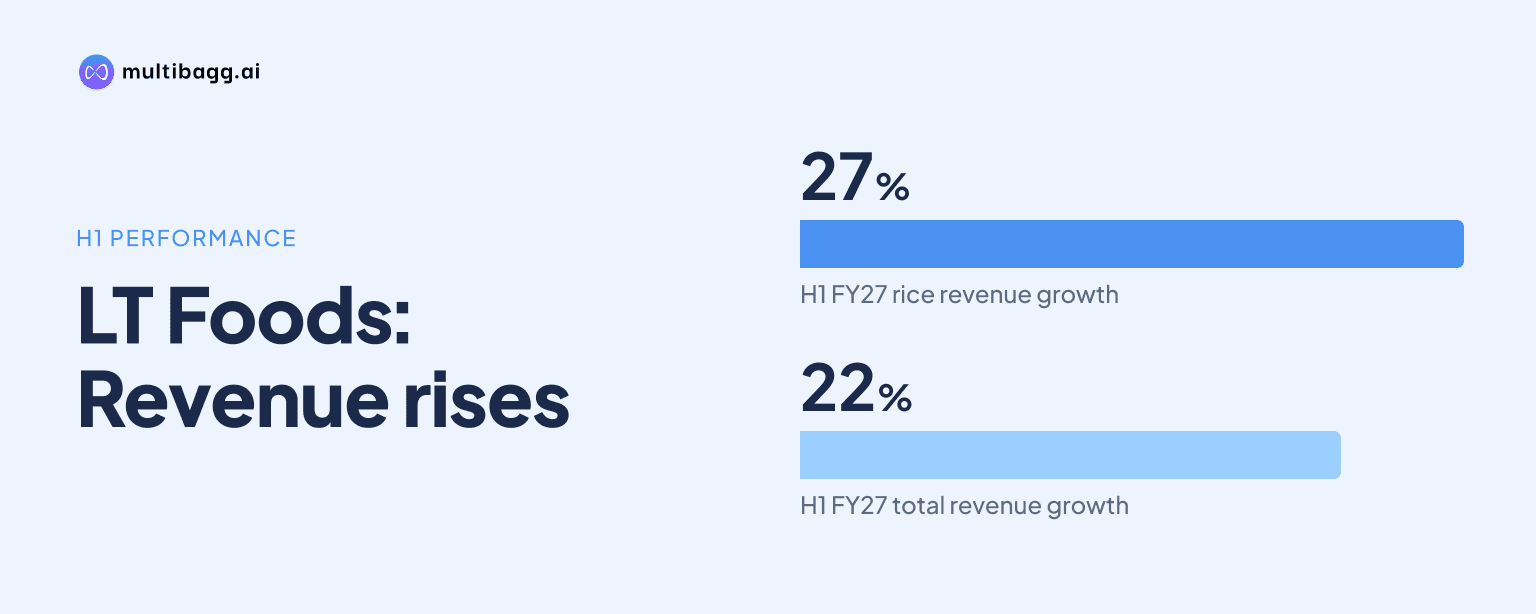
LT Foods reported consolidated revenue of Rs 6,414 crore in H1 FY27, up 22% from H1 FY26, while earnings before interest, tax, depreciation and amortisation (EBITDA) margin declined to 11.2% from 11.7% as shipment costs increased and brand investments rose almost 29% to Rs 139 crore.
Know L T Foods inside out
Results, valuation, peers and who's buying, in one view.
Why did LT Foods’ H1 FY27 EBITDA margin decrease despite higher revenue?
LT Foods’ EBITDA margin decreased by 50 basis points to 11.2% in H1 FY27 because higher shipment costs and increased brand investment outweighed the benefit of revenue growth. Consolidated EBITDA rose 17% to Rs 721 crore, but this was slower than the 22% revenue increase to Rs 6,414 crore, while gross profit rose 15% to Rs 2,087 crore.
Brand investments reached Rs 139 crore in H1 FY27, almost 29% above the previous-year half, according to management. LT Foods also continued to invest in its health and convenience portfolio before the commissioning of ready-to-heat capacity in the United States, which management said weighed on quarterly margins.
The Q2 FY27 result showed the same trend. Revenue increased 17% year on year to Rs 3,253 crore and EBITDA rose 13% to Rs 358 crore, but EBITDA margin was 11.0%, compared with 11.4% in Q2 FY26 and 11.5% in Q1 FY27. Advertisement spending increased by Rs 25 crore from Q1 FY27 to 2.5% of revenue, from 1.8%.
How did freight costs affect LT Foods’ profitability?
Higher freight costs reduced LT Foods’ Q2 FY27 gross margin and EBITDA margin, with shipping cost as a share of revenue rising by almost 40 basis points across major markets. Q2 gross margin fell to 32.5% from 34.2% in Q2 FY26, while EBITDA margin declined to 11.0% from 11.4%.
Part of the gross-margin change reflected a related-party shipment-term revision from cost, insurance and freight, or CIF, to free on board, or FOB. Freight under the new FOB arrangement is included in cost of goods sold rather than other expenditure, and management said that classification change is EBITDA-neutral. The underlying increase in shipping costs, however, affected EBITDA.
In the Middle East, supply disruptions constrained inventory flow despite strong volume growth supported by deeper market penetration, private-label partnerships and branded products. Management said alternate routing, spend optimisation and price increases were being used to mitigate higher landed costs, although the full impact was expected in subsequent quarters.
Europe also faced raw-material and freight pressure in H1 FY27. In the United Kingdom, lower-than-planned mainstream and industrial volumes and elevated operating costs affected performance; management said price-recovery initiatives were expected to help offset freight and logistics inflation while the business works on volumes, inventory management and operating efficiency.
Got a follow-up? Ask IRIS
Which businesses and markets drove LT Foods’ H1 FY27 growth?
LT Foods’ basmati and specialty-rice business drove H1 FY27 growth, with revenue rising 27% to Rs 5,764 crore and volume increasing 11% year on year. The segment accounted for 90% of consolidated revenue, recorded a 33% gross margin and delivered a 12% EBITDA margin.
India grew 24% with volume up 10% and represented 29% of consolidated revenue. North America was the largest geography at 50% of revenue and grew 21%, or 13% on a normalized basis after adjusting for Golden Star not being fully consolidated in Q1 FY26. Middle East and rest-of-world revenue grew 25% and accounted for 9%, while Europe contributed 12%.
Mature markets comprising India, the United States and rest of world generated a 15% EBITDA margin in the basmati and specialty-rice business, above the segment’s 12% margin. In Q2 FY27, the business posted 11% volume growth and 21% value growth year on year; management also said H1 value growth of 26% against 11.5% volume growth reflected an almost 13% increase per tonne.
The organic and ingredient business recorded lower revenue of Rs 520 crore in H1 FY27, compared with Rs 583 crore in H1 FY26, as Nature Bio Foods continued its business remodelling. The segment retained a 34% gross margin and posted a 6% EBITDA margin, while Q2 EBITDA improved sequentially to Rs 22 crore from Rs 10 crore in Q1 FY27.
How did LT Foods improve working capital and cash generation?
LT Foods reduced working-capital days to 143 in H1 FY27 from 174 in the prior-year half, led by inventory days declining to 159 from 187. Trade-payable days also fell to 26 from 29, meaning the working-capital improvement occurred despite lower supplier-credit days.
LT Foods ended H1 FY27 with net cash of Rs 247 crore. Return on capital employed increased to 22.4% from 22.0%, return on equity was 15.7%, and interest coverage was 13.8 times. Management said capital allocation and working-capital discipline remain priorities as it funds brand, capacity and distribution investment.
Standalone revenue increased 14% to Rs 2,417 crore in H1 FY27, while EBITDA grew 34% to Rs 223 crore and EBITDA margin improved to 9.2% from 7.9%. Standalone PAT increased by Rs 24 crore to Rs 134 crore from Rs 108 crore, although the Q2 standalone margin moderated to 8.3% amid higher spending, including brand investment.
As of September 26, LT Foods held 82,000 tonnes of paddy inventory at an average rate of Rs 43 and 260,000 tonnes of rice inventory at an average rate of Rs 60. Management said inventory was sufficient for its business plan, while noting crop 2026 prices were 22% to 25% higher on average depending on variety and that it was covered for its crop-2025 plan.
Conclusion
LT Foods combined 22% H1 FY27 revenue growth with a reduction in working-capital days to 143, led by the Rs 5,764 crore basmati and specialty-rice business. However, the 50-basis-point decline in EBITDA margin to 11.2% shows that freight costs and planned brand and convenience-food investment rose faster than operating profit during the half.
The next disclosures to watch are the effect of Middle East alternate routing and price increases, UK price-recovery actions and the commissioning of the United States ready-to-heat facility. Management has also identified improved organic-food profitability, convenience-food scale, value-chain efficiency and continued working-capital discipline as priorities after H1 FY27.