










LT Foods expects pricing reset after 25% paddy cost rise
Key highlights
- LT Foods said new-crop basmati prices opened about 25% above last year, with an initial variety up 35%.
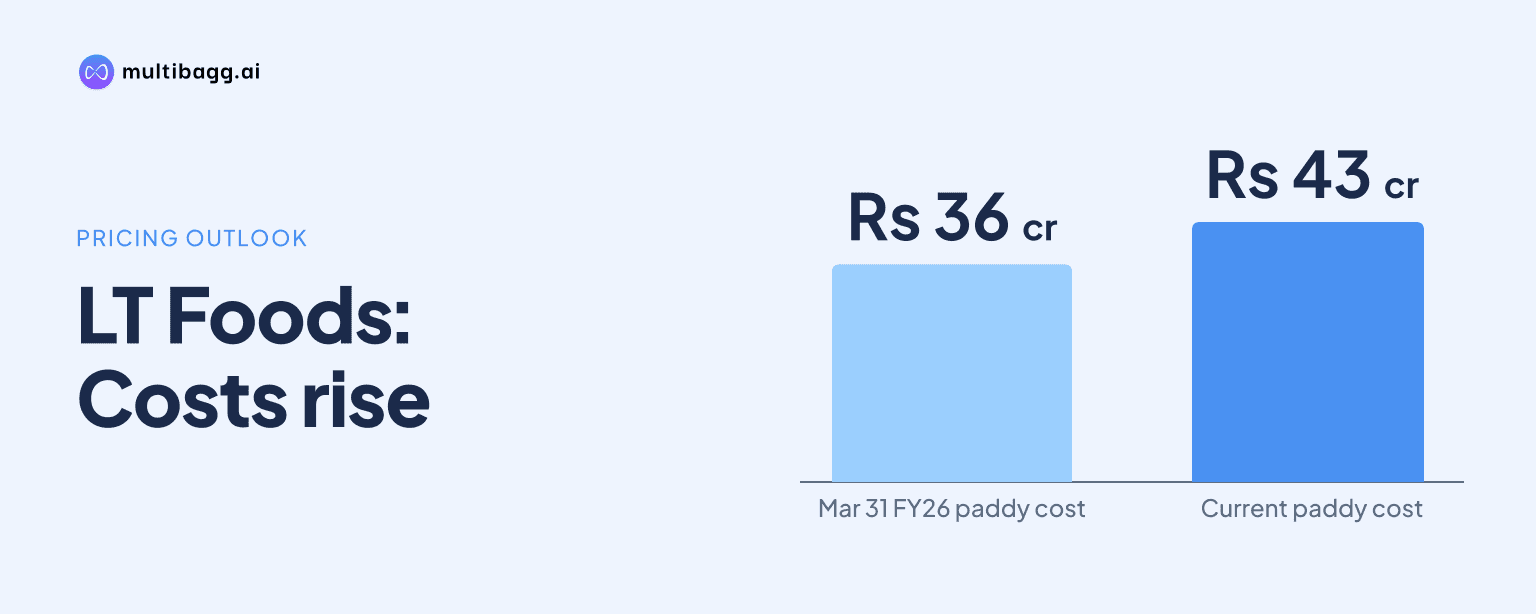
- Current paddy cost was about Rs 43 per kg, compared with Rs 36 per kg as of 31 March FY26.
- Daawat’s average realization was around Rs 80 per kg in October, almost 8% above the first quarter.
- LT Foods said freight had a 0.4% consolidated impact while advertising spend is planned at 2.3% of full-year revenue.
powered by IRIS
LT Foods Limited expects finished-product pricing to reset as new-crop basmati paddy prices opened about 25% above last year, with material costs representing roughly 70% of product cost. Management said the increase will be passed through as inventory from the crop that began arriving in the first week of September is sold.
Know L T Foods inside out
Results, valuation, peers and who's buying, in one view.
Why are LT Foods’ basmati costs rising?
LT Foods said the new basmati crop opened at prices averaging about 25% above last year, after the prior crop had no carryover and combined Indian and export demand grew 4% to 5%. Management added that the initial variety had opened 35% higher, but its working expectation across varieties was roughly a 25% year-on-year increase. This is an input-cost change rather than a disclosed company-wide procurement bill or a volume forecast.
The company quantified the movement in its inventory inputs: current paddy cost was about Rs 43 per kg and rice cost about Rs 60 per kg, versus Rs 36 per kg and Rs 54 per kg respectively as of 31 March FY26. That means paddy cost rose Rs 7 per kg over the comparison point, while rice cost rose Rs 6 per kg. Management said LT Foods’ portfolio includes basmati, Jasmine rice and organic food, so its inventory model is not based on basmati alone.
LT Foods also said basmati requires ageing according to the standard needed for each brand and that there is “no shortcut” in that process. This matters for timing: higher-cost paddy arriving from the first week of September does not necessarily appear immediately in every finished pack. Management said the required ageing was sufficiently covered, indicating that the company intends to preserve brand-specific ageing requirements while transitioning to the new crop.
How will LT Foods pass higher paddy costs to consumers?
LT Foods plans to pass on the higher cost as the new crop is used and finished-product pricing is reset proportionately. Management said material cost is roughly 70% of the product cost, but did not specify a single percentage increase for all brands, grades or countries. It said that in India, some new-crop product had already been sold at higher prices and that the increase was very well accepted.
The company’s comments point to a phased process rather than an immediate, uniform change. When asked whether the higher cost would be passed through as inventory was sold in the second half, management said it was confident of passing it on, citing previous periods of rising costs. The transcript does not provide a formal timetable, a price-list date, or a target gross-margin outcome from the new crop.
Current realizations show that some price movement was already occurring. LT Foods said its average realization for Daawat, across grades and brands, was around Rs 80 per kg in October, almost 8% above the first quarter. Its most premium product was selling at Rs 250 per kg, compared with around Rs 220 per kg at the same time last year, a stated increase of about 15% for that product.
Got a follow-up? Ask IRIS
Will higher basmati prices reduce demand for LT Foods products?
LT Foods said it has not seen demand sensitivity when prices rise in specialty rice, based on more than 50 years in the business and prior experience of passing through duty-related increases. Management contrasted the approximately 10 million-tonne global basmati market with the roughly 500 million-tonne global rice market, placing basmati at about 2% of total rice consumption. Its view was that this specialty positioning has limited the demand effect of price rises.
Management cited Middle East freight as a recent test of that assessment, saying sharp increases had not affected demand in that market. The company did not disclose a demand-elasticity figure, shipment volume data, or a market-by-market consumer-price increase, so the statement is management’s operating observation rather than a quantified forecast for the new crop cycle.
The Middle East represented 9% to 10% of LT Foods’ business, according to management, while Europe represented 12% of revenue mix in another disclosure on the call. The company said it was passing freight through in some markets, taking time in the Middle East, and not passing it through in Europe. That contrast shows that the ability to transfer costs can differ by geography even where management does not expect a demand effect.
What could affect LT Foods’ margins during the pricing reset?
LT Foods said that historically, when paddy prices rise and input costs increase, it normally passes the increase to consumers, with the margin profile moving by either plus or minus 1 percentage point. Management therefore did not promise that a 25% increase in paddy prices would produce a corresponding margin expansion. The disclosed mechanism is pass-through, while the eventual margin effect can vary around that historical range.
Freight remains one offset while the company adjusts pricing. Management said the consolidated impact from freight was 0.4%, as LT Foods was passing through some cost and absorbing some cost. It also said the war-related impact was concentrated in the Middle East, which contributed 9% to 10% of business, and management did not expect an impact on margins in the coming quarters on that basis.
Advertising is another near-term cost item. Management said advertising spend was almost 2.5% to 2.6% of revenue in the quarter, but expected it to be 2.3% for the full year, compared with 2.1% last year. Separately, it said return on capital employed, or ROCE, was around 23% in the first half and that mature basmati markets already generated earnings before interest, tax, depreciation and amortisation, or EBITDA, margins above 15%.
Conclusion
LT Foods is entering the new basmati cycle with paddy at about Rs 43 per kg, up from Rs 36 per kg as of 31 March FY26, and management’s expectation of an average 25% crop-price increase. Its stated response is a proportional reset in finished-product pricing as new inventory is used, supported by management’s view that specialty-rice demand has remained resilient through past pass-throughs.
Investors should watch the pace at which higher-cost crop reaches sales after the crop began arriving in the first week of September, and whether the approximately 8% October improvement in Daawat realization continues. Other disclosed variables are the 0.4% consolidated freight impact, the 2.3% full-year advertising-spend plan, and the extent to which price pass-through keeps margins within management’s historical range of plus or minus 1 percentage point.