










LT Foods to Own Kameda LT Foods Fully for ₹1.12 Crore
Key highlights
- LT Foods will acquire Kameda Seika’s full 49% stake in Kameda LT Foods for ₹1.12 crore.
- The acquisition covers 2,80,26,726 equity shares of Kameda LT Foods.
- LT Foods’ holding in Kameda LT Foods will rise from 51% to 100% after completion.
- The transaction is expected to close by December 31, 2026, subject to applicable filings.
powered by IRIS
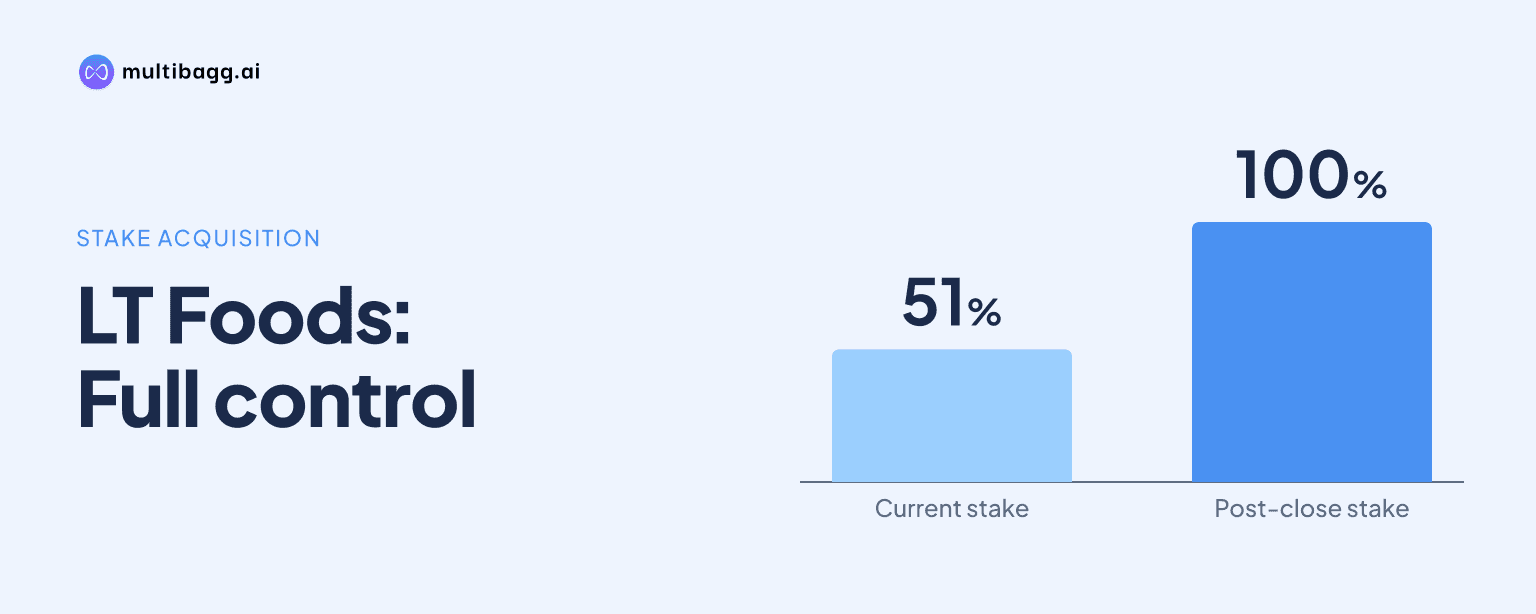
LT Foods Limited will acquire Kameda Seika Co., Ltd.’s 49% stake in Kameda LT Foods (India) Private Limited for ₹1.12 crore, raising its ownership from 51% to 100% by the planned completion date of December 31, 2026. The transaction gives LT Foods full control of the rice-based snack business and its premium roasted snack portfolio.
Know L T Foods inside out
Results, valuation, peers and who's buying, in one view.
What has LT Foods agreed to acquire from Kameda Seika?
LT Foods has entered into a Share Purchase Agreement with Kameda Seika Co., Ltd. to buy the Japanese partner’s entire 49% equity stake in Kameda LT Foods (India) Private Limited, or KLT. The agreement was executed on September 16, 2026, according to the company’s disclosure under the SEBI Listing Regulations.
The proposed purchase covers 2,80,26,726 equity shares, representing 49% of KLT’s equity share capital. LT Foods currently owns 51% of KLT. Once the transaction is completed, KLT will become a wholly owned subsidiary of LT Foods rather than a jointly owned entity.
The stated acquisition cost is ₹1.12 crore. The company has described the deal as an acquisition of the complete stake held by Kameda Seika in the existing joint venture. The transaction remains subject to applicable requirements and regulatory filings, including customary filings under the Foreign Exchange Management Act framework.
When is the Kameda LT Foods transaction expected to close?
LT Foods expects to complete the acquisition by December 31, 2026. The announced timeline follows the signing of the Share Purchase Agreement on September 16, 2026, and is contingent on the required filings and other applicable conditions.
The disclosure does not provide a separate operating or financial forecast for KLT following the buyout. It also does not specify any changes to manufacturing capacity, distribution arrangements, employees, or product pricing after closing. The confirmed outcome is the planned change in ownership from a 51:49 joint venture structure to full ownership by LT Foods.
What business does Kameda LT Foods operate in India?
KLT manufactures and sells rice-based snack products in India. Its disclosed portfolio includes Kaki Kari, KRiSPY HOPU and Okaki. The company primarily operates in India and is positioned in the roasted, gluten-free snack category referenced in the transaction material.
The venture was established in 2017 between LT Foods and Kameda Seika. The joint-venture structure combined LT Foods’ presence in the Indian food market with Kameda Seika’s association with rice-based snacks. The current transaction will end that shared ownership arrangement if it closes as planned.
Rice-based snacks form a distinct part of the wider packaged-food market, where companies sell products across different formats, flavours and channels. The disclosure identifies KLT’s products and ownership structure but does not provide its revenue, profitability, market share, production volumes, or brand-wise sales figures. Those measures therefore cannot be inferred from the announced consideration.
Got a follow-up? Ask IRIS
Why does full ownership matter for LT Foods?
Full ownership would allow LT Foods to consolidate KLT as a wholly owned subsidiary and take complete operational control of the business. The company has specifically said the transaction will increase its shareholding to 100%, which removes the minority partner from the ownership structure.
For investors, the key financial fact is the relatively limited stated purchase consideration of ₹1.12 crore for the 49% stake. However, the company has not disclosed the valuation methodology, KLT’s recent financial performance, or anticipated earnings contribution from the subsidiary. The announced price should therefore be read as the cost of the stake purchase, not as a stand-alone indicator of the brand’s sales potential or enterprise value.
The buyout also provides LT Foods with direct control over decisions relating to the Indian snack venture after completion. But the disclosure does not announce a new product launch, a change in branding, a capacity expansion, or a revised strategy for KLT. Any operational changes beyond the ownership transition have not been confirmed.
How could the deal affect LT Foods investors and the snack business?
The immediate effect of the agreement is corporate consolidation: LT Foods is set to move from majority ownership to complete ownership of KLT. Investors can monitor the completion of the transaction by the stated December 31, 2026 deadline and any subsequent disclosures on the subsidiary’s financial contribution or operating plans.
For KLT’s customers and trade partners, the disclosure indicates continuity in the company’s India-focused rice-snack operations, while ownership shifts entirely to LT Foods. There is no announced change to the products named in the filing, including Kaki Kari, KRiSPY HOPU and Okaki.
The transaction is also relevant to the consumer-food and FMCG segment because it places a niche snack operation fully within LT Foods. Still, the available information does not establish the deal’s effect on LT Foods’ consolidated revenue, margins, cash flows, or share price. Those outcomes would depend on subsequent company disclosures and reported financial results.
Conclusion
LT Foods has agreed to acquire Kameda Seika’s entire 49% interest in KLT for ₹1.12 crore, which would lift its holding from 51% to 100%. The deal gives LT Foods complete ownership of an India-focused business that manufactures and sells rice-based snacks, including Kaki Kari, KRiSPY HOPU and Okaki.
The next confirmed milestone is the proposed completion by December 31, 2026, subject to applicable regulatory requirements and filings. Investors should watch for confirmation of closing and for any later disclosures on KLT’s financial performance, operational plans, product portfolio, or contribution to LT Foods’ consolidated results.