










Lumino cuts working-capital cycle to 66 days by September
Key highlights
- Lumino's overall working-capital cycle fell to 66 days in September 2026 from about 73 days in March.
- Lumino's EPC working-capital cycle improved to 111 days from 120 days, a nine-day reduction.
- Lumino reported Rs 56 crore of operating cash flow in September 2026 after Rs 68 crore of trade-payable and trade-acceptance payments.
- Lumino realised Rs 215 crore of the Rs 230 crore in March receivables that were outstanding beyond six months.
powered by IRIS
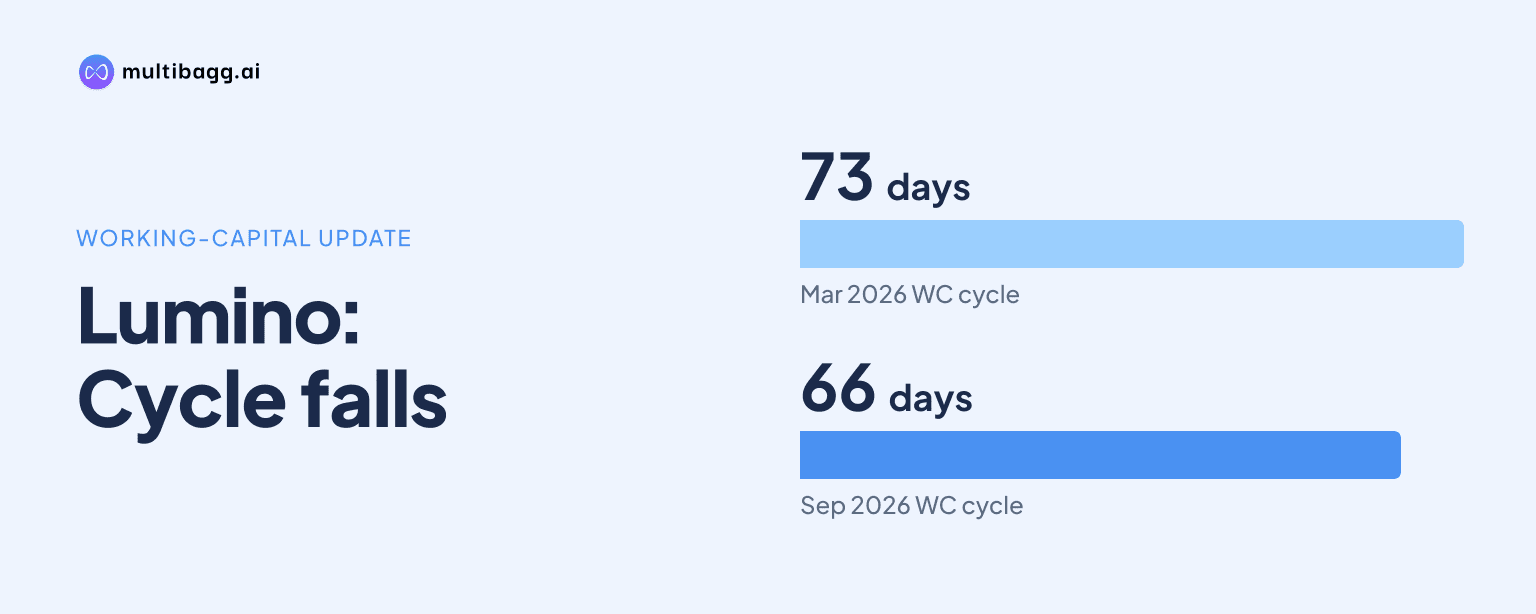
Lumino Industries reduced its working-capital cycle to 66 days in September 2026 from about 73 days in March, while its engineering, procurement and construction (EPC) cycle declined by nine days to 111 days. Lumino reported Rs 56 crore of operating cash flow in September 2026 and expects retention-money collections from completed EPC projects to improve cash flow in H2.
Know Lumino Industries inside out
Results, valuation, peers and who's buying, in one view.
How much did Lumino's working-capital cycle improve?
Lumino's overall working-capital cycle improved by seven days, falling from about 73 days in March to 66 days as of September 2026. Management disclosed the reduction while answering questions on September receivables, trade acceptances and operating cash flow, and said it expected working capital to improve further.
The improvement occurred in both operating segments, although their cycles remained materially different. EPC working capital declined from 120 days to 111 days, a nine-day reduction, while manufacturing working capital moved from about 50 days in March to 46 days in September. Management said products contributed 70% of revenue and EPC contributed 30%.
The segment difference reflects the length of their order cycles. Management said manufacturing orders normally have a turnaround time of three to four months, whereas EPC orders have a turnaround time of around three years. This means EPC cash collection is linked to project milestones over a longer period than product sales.
What was Lumino's operating cash flow in September 2026?
Lumino reported operating cash flow of Rs 56 crore in September 2026, compared with Rs 63 crore in September 2025. Management said the September 2026 figure included Rs 68 crore paid towards trade payables and trade acceptances from initial public offering proceeds.
Management said operating cash flow would have been Rs 125 crore without the Rs 68 crore payment. The company used that comparison to explain why the reported Rs 56 crore did not fully reflect its collection performance, while acknowledging that the payment reduced the cash-flow figure for the period.
Lumino said its focus was to complete projects on time and receive cash on time. Management said order booking was not the current constraint, estimating the total order book, including L1 tenders, at about Rs 3,400 crore, of which EPC would account for around Rs 2,200 crore.
Why does Lumino's EPC business retain more cash?
Lumino's EPC payment structure retains 10% of contract value with the project authority until the contract is completed, management said. The company said it generally receives 60% when material is supplied and 30% after the material is erected, with the final 10% treated as retention money.
That payment mechanism explains why EPC working capital remained at 111 days in September 2026 despite improving by nine days from 120 days. Cash conversion in EPC therefore depends on material supply, erection, completion of the project and the authority's release of retained amounts.
Lumino said it had collected most of its older receivables. At March, total debtors were about Rs 900 crore, including around Rs 230 crore outstanding for more than six months. By the date of the call, management said it had realised Rs 215 crore of the Rs 230 crore balance and that only limited receivables remained overdue beyond six months.
Lumino also cited collections from the West Bengal Electricity Board. Management said the outstanding amount had been approximately Rs 140 crore, of which Rs 138 crore had been received, leaving about Rs 2 crore outstanding. These receipts are separate from the retention-money recovery management expects from completed EPC projects in H2.
Got a follow-up? Ask IRIS
What does Lumino expect from H2 cash collections?
Lumino expects operating cash flow to improve further in H2, with management saying both EPC and manufacturing should contribute but that EPC should provide most of the improvement. Management identified retention money from completed EPC projects as the main expected source of cash returning to the business.
Management did not give a rupee target for H2 operating cash flow or a target for further working-capital-day reduction. Its stated plan is to improve realisations, reduce the working-capital cycle and complete projects on time, allowing project-linked retention amounts to be released.
The scale and duration of the EPC order book remain relevant to that plan. Management put the EPC order book at around Rs 2,200 crore within the approximately Rs 3,400 crore total, including L1 tenders, and said EPC execution is spread over around three years. The resulting collection schedule depends on the timing of project execution and completion milestones.
How do manufacturing operations affect Lumino's cash conversion?
Lumino's manufacturing working-capital cycle declined to 46 days in September 2026 from about 50 days in March, a four-day improvement. Management said manufacturing orders normally turn around in three to four months, substantially sooner than the roughly three-year execution period for EPC orders.
Manufacturing revenue was Rs 831 crore in H1, with conductors contributing 65% and cables contributing 35%. Lumino produced about 13,781 metric tonnes in H1 FY27, compared with about 15,800 metric tonnes in H1 FY26, as management said it shifted towards value-added products including high-temperature low-sag (HTLS) and AL-59 conductors.
Management said both segments should support H2 operating-cash-flow improvement, but identified EPC retention money as the larger expected contributor. Manufacturing's 46-day working-capital cycle and shorter order turnaround provide a different collection profile from EPC's 111-day cycle.
Conclusion
Lumino's September 2026 disclosures indicate that working-capital improvement came from both segments, while the larger reduction occurred in EPC. Collections of Rs 215 crore from Rs 230 crore of receivables overdue by more than six months also show that the company has reduced a disclosed pool of older debtors.
The next measure to watch is whether H2 delivers the retention-money collections management expects from completed EPC projects. Management has not provided a rupee target for H2 operating cash flow or a further days target, but it has identified timely project completion, realisations and retention recovery as the mechanisms for further cash-flow improvement.