










Mallcom says investment and under-absorption compress margins
Key highlights
- H1 FY27 revenue was Rs 253 crore, down 3%, while EBITDA rose 5% to Rs 29 crore and margin reached 11.43%.
- Q2 FY27 domestic revenue rose 23% year on year to Rs 69 crore, while international revenue was Rs 74 crore.
- Sanand generated Rs 13 crore in H1 FY27 turnover; management targets at least Rs 25 crore in the second half.
- Mallcom plans about Rs 20 crore of FY27 capital expenditure through internal accruals without additional borrowing.
powered by IRIS
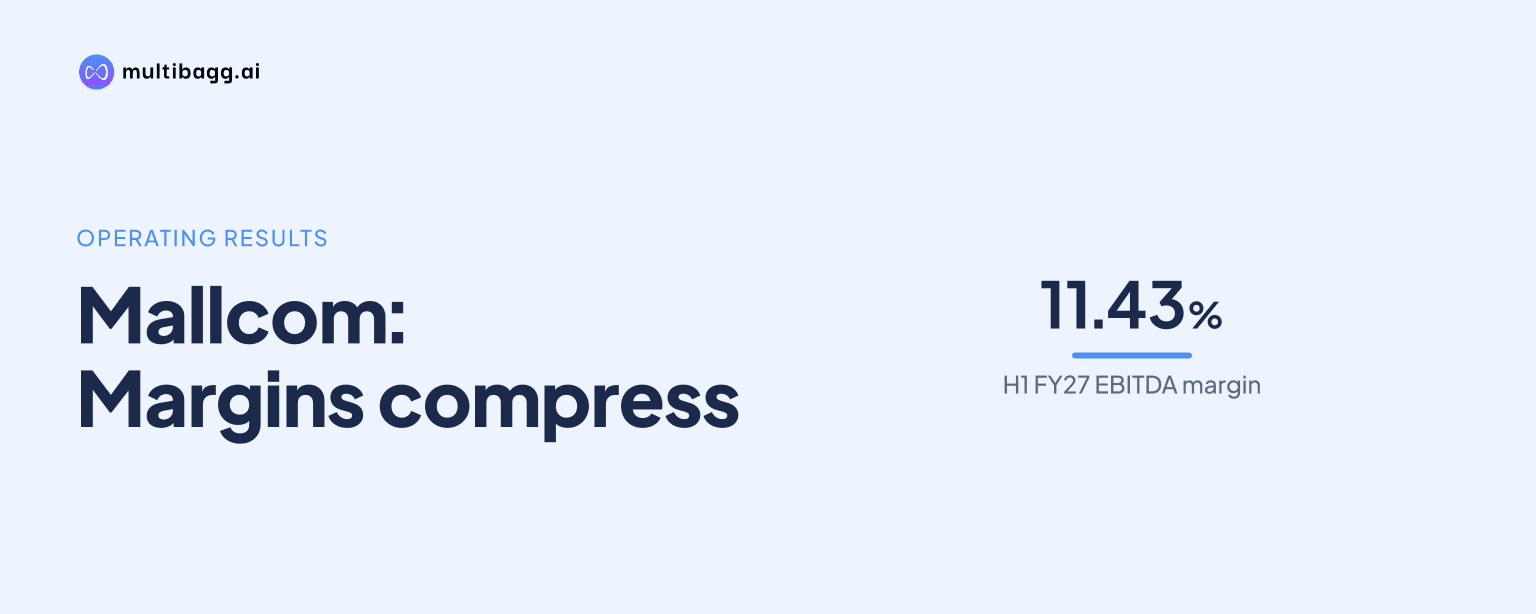
Mallcom (India) Limited said in H1 FY27 that its 11.43% earnings before interest, tax, depreciation and amortisation, or EBITDA, margin reflected investment-related costs and incomplete volume absorption rather than a domestic-export sales mix effect. Mallcom reported Rs 29 crore of H1 EBITDA on Rs 253 crore of operating revenue and said both channels carry similar margins.
Know Mallcom (India) inside out
Results, valuation, peers and who's buying, in one view.
Why does Mallcom say its margins compressed?
Mallcom says margin compression resulted from market-related pricing pressure alongside costs from investments made over the past two years, not from a structural change in its business mix. In H1 FY27, operating revenue declined 3% year on year to Rs 253 crore, while EBITDA rose 5% to Rs 29 crore. The resulting EBITDA margin increased 93 basis points to 11.43%, as savings in material costs and better sales realisations offset increases in employee, manufacturing, marketing, operating and administrative expenses.
The Q2 FY27 outcome shows that the cost equation can improve even with modest revenue growth. Operating revenue increased 3% year on year to Rs 143 crore, EBITDA rose 54% to Rs 15 crore and EBITDA margin expanded 350 basis points to 10.61%. Management initially described sequential margin pressure as linked to lower unit sales realisations, but later clarified that quarter-on-quarter realisation had not fallen; it said the issue was a mix of costs rising without a further improvement in realisation.
Are Mallcom's domestic and export margins different?
Mallcom says domestic and export sales have similar margins, so management rejected the view that weaker exports are the principal explanation for the lower 10%-11% margin range. Domestic revenue grew 23% year on year to Rs 69 crore in Q2 FY27, while international revenue was Rs 74 crore. For H1 FY27, domestic revenue increased 18% to Rs 130 crore and international revenue was Rs 123 crore, leaving the two channels nearly equal in revenue contribution.
That does not mean export conditions have had no bearing on profitability. Mallcom said export prices are often fixed for about a year, depending on product category, which creates a lag in passing through cost changes. Management said raw-material prices had become smoother and more predictable by the period under review, and it expects price revisions for many customers during 2027, while recognising that customers must remain competitive in their own markets.
Mallcom also distinguished the margin question from demand conditions in Europe and the United States. Management said Europe, its biggest market, had experienced weak demand amid economic disruption, while US tariff issues had also affected trade. It said export order booking was becoming healthier and logistics issues that affected both Q1 and Q2 FY27 were improving, but it did not present a different channel-margin profile as the reason for the H1 EBITDA margin of 11.43%.
Got a follow-up? Ask IRIS
What costs must Mallcom absorb as volumes rise?
Mallcom identifies additional employee, marketing and depreciation costs as the principal expenses that higher production and sales volumes need to absorb. Management said it had added land, buildings and plant and machinery, raising depreciation from earlier levels. It also referred to investment over the past two years and said productivity and volume growth should spread those costs across a larger revenue base, improving profitability over time.
The company’s capacity plans illustrate why under-absorption is central to its explanation. Mallcom said its existing manufacturing infrastructure provides visibility to support about Rs 1,000 crore of revenue without proportionate incremental capital investment. At Sanand, the facility generated Rs 13 crore of turnover in H1 FY27 after initial employee and productivity issues; management is targeting at least Rs 25 crore in the second half and Rs 40 crore for the facility’s first year.
Management has not provided a date for a return to the 13%-14% EBITDA margin range raised by an analyst. It said reaching that level would take time because improving raw-material conditions alone would not be enough: better sales realisations and higher volumes are also needed. Mallcom characterised the lower margin as temporary, while noting that market disturbances had created some export-side pricing pressure as well.
What volume plans could improve Mallcom's margins?
Mallcom has maintained its FY27 revenue target of Rs 600 crore, which management said implies a better second half than the first two quarters. The company described Rs 600 crore as its target and said it was hopeful of getting close to it, but made achievement conditional on market support. Its production facilities are ready for this expansion, according to management, making sales conversion rather than immediate manufacturing availability the key variable.
Exports are one potential contributor to the planned volume increase. Rohit Mall said export revenue of Rs 75 crore a quarter was the bare minimum the company could expect and should improve from there. He attributed the outlook to healthier order booking, easing logistics constraints and stabilising trade conditions, while also stating that customer development in original equipment manufacturer, or OEM, markets typically takes three to five years because buyers have established supply chains.
Mallcom is also continuing capacity spending despite its existing infrastructure. It plans to add three more lines at Sanand after starting with three lines, and management said the expansion is intended to support an initial Rs 100 crore turnover objective for that unit. Separately, the third construction phase at Chandipur is set to add about 50,000 square feet for garments and footwear operations, while planned FY27 capital expenditure is about Rs 20 crore and is intended to be funded through internal accruals rather than additional borrowing.
Conclusion
Mallcom’s explanation is that its margin outcome is primarily a volume and cost-absorption issue: H1 FY27 revenue fell 3% to Rs 253 crore, but EBITDA still increased 5% to Rs 29 crore and margin reached 11.43%. The comparable domestic and export margins cited by management make channel mix a less direct explanation, although export pricing, fixed-price contracts and weaker overseas demand can still affect the pace of recovery.
The next test is whether volume targets convert into production and sales in H2 FY27. Management has retained the Rs 600 crore FY27 revenue target, expects at least Rs 25 crore of Sanand turnover in the second half after Rs 13 crore in H1, and plans price revisions for many customers during 2027. Investors will also be watching whether the planned Rs 20 crore FY27 capital expenditure and added Sanand lines are absorbed without new borrowing, as management expects.