










Manba Finance targets 30%-35% AUM growth with festive lending
Key highlights
- Manba Finance added Rs 120 crore of new AUM in October and expects a similar contribution in November.
- Manba onboarded more than 100 dealers in Karnataka within its first 60 days of operations.
- MSME loan-against-property disbursements are targeted to rise from Rs 2 crore-Rs 2.5 crore per month to Rs 5 crore by January.
- Manba’s new lending products carry management-disclosed IRRs of 27% to 32%, while its Rs 100 crore preferential issue is expected to close by November 6.
powered by IRIS
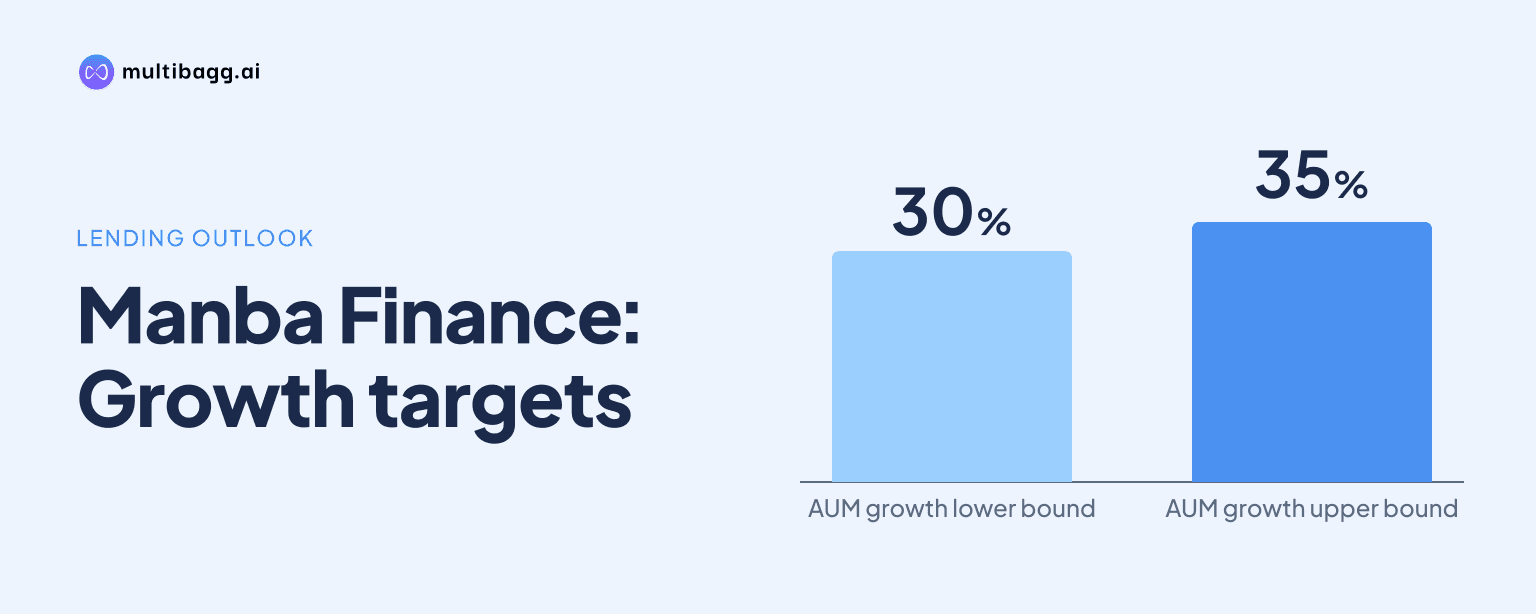
Manba Finance is targeting 30% to 35% assets under management (AUM) growth in FY27, supported by Rs 120 crore of new AUM added in October, management said. It expects festive two-wheeler lending, dealer additions in newer states, and further disbursements in MSME loan against property and small-business products to lift second-half growth.
Know Manba Finance inside out
Results, valuation, peers and who's buying, in one view.
Can Manba reach its 30%-35% AUM growth target?
Manba said it expects to achieve 30% to 35% AUM growth in FY27, with October and November representing its principal seasonal lending months. Management said it had achieved 20% growth in the first half and also expects a 30% to 35% growth outcome in FY28, without providing an absolute AUM target.
An analyst said AUM had risen by about Rs 98 crore in the first half, from roughly Rs 1,700 crore to nearly Rs 1,800 crore, and estimated that Rs 400 crore to Rs 450 crore of additional AUM would be needed in H2 FY27. Management did not reconcile that comparison with its stated 20% first-half growth, but cited the timing of Dusshera on October 22 and Diwali on November 8 as reasons for a larger second-half contribution.
Management said the Rs 120 crore October addition was measured after the month’s rundown and that it expects an equal contribution in November. That is a management expectation, rather than a reported November result, and makes festive loan demand central to delivery of the FY27 target.
What will drive Manba’s second-half AUM growth?
Manba’s plan relies on deeper penetration in Madhya Pradesh, Uttar Pradesh and Karnataka, alongside MSME lending, small-business branches and business correspondent (BC) partners. Management said these newer state markets and products can supplement the established two-wheeler lending cycle, particularly after festive demand in October and November.
Karnataka operations began in August, and Manba said it had onboarded more than 100 dealers in the first 60 days. Management expects additional penetration in Madhya Pradesh, Uttar Pradesh and Karnataka by December, while Karnataka’s main season generally falls in January. Maharashtra and Gujarat, by comparison, have been operating markets for more than seven to eight years, including more than 10 years in Maharashtra.
The MSME loan-against-property product has ticket sizes of Rs 8 lakh to Rs 25 lakh. Management said monthly disbursements had begun at Rs 2 crore to Rs 2.5 crore and are targeted to reach Rs 5 crore by January. The target depends on the product scaling beyond its current initial run rate.
For small-business loans, Manba added three branches in the previous two months and plans two more during the current quarter. Management expects the resulting five to six branches to add Rs 3 crore to Rs 4 crore of disbursement, while seven BC partners are active and three more are under discussion and due diligence.
Got a follow-up? Ask IRIS
How are new products changing Manba’s lending mix?
Manba is adding used two-wheeler, top-up, personal, small-business and MSME lending products with disclosed internal rates of return (IRR) ranging from 27% to 32%. Management said these products are intended to diversify the lending mix beyond core two-wheeler finance, although personal lending is being expanded gradually because it is unsecured.
Used two-wheeler lending has added more than 100 dealers in the past six months, according to management. It said the product generates a 27% to 28% IRR, including processing fees and lower payouts. Management has appointed a dedicated business head as it increases activity in a used two-wheeler market it said has matured over the past two to three years.
Top-up and personal loans were described as carrying about 32% IRR. Management said top-up loans remain secured because they are offered to existing customers with continuing hypothecation of the two-wheeler, while personal loans are unsecured. It has onboarded a few direct selling agents for personal loans but said it is proceeding cautiously.
Small-business loans have an average ticket size of Rs 5 lakh, a yield of about 28% and non-performing assets of 3% to 4%, management said. The product is three years old. In contrast, the electric three-wheeler battery-replacement product was introduced only two months ago, is restricted to existing customers and will be tested for at least 18 months before any scale-up.
What funding and operating capacity supports Manba’s expansion?
Manba said its Rs 100 crore preferential issue was expected to close by November 6, after principal approvals from the National Stock Exchange and BSE. Management said the stated 24.69% capital adequacy ratio excluded the proposed capital and that the funds, combined with profit after tax, could support growth for four to six quarters.
Management also expects borrowing costs to decline as about Rs 600 crore of older, higher-rate borrowings run off by March 31. It said new borrowing was being raised at about 50 basis points lower than rates available since September and estimated that replacing older funding could have an overall 25-basis-point effect in the third to fourth quarter.
Manba spends about Rs 2 crore annually on technology and has a team of about 28 people. In the latest six months, management said a technology-led change reduced disbursement turnaround from about 3.5 to four days to about 1.5 to two days. It expects same-day disbursement by the end of the year.
Operating expenses rose 28% from September 2025 to September 2026 as Manba expanded locations and hired sales staff, including in Karnataka. Management said it added almost 16 offices in the past year and argued that net interest margin, average cost and credit-cost measures had shown improved quarter-to-quarter operating efficiency, though it did not provide the underlying figures.
Conclusion
Manba’s FY27 AUM objective depends on a concentrated second-half plan: Rs 120 crore of AUM added in October, expected festive demand in November, expansion in three newer states and incremental disbursement from MSME, small-business and BC channels. The strategy also broadens lending beyond two-wheelers through products with management-disclosed IRRs of 27% to 32%.
The next disclosed milestones are November festive lending, further state penetration by December, Karnataka’s January season and the target for MSME loan-against-property disbursements to reach Rs 5 crore a month by January. Management also expects the Rs 100 crore capital raise to close by November 6 and roughly Rs 600 crore of older borrowings to run off by March 31.