










Manba Finance expects borrowing costs to fall by March-end
Key highlights
- Manba Finance expects to repay Rs 600 crore of higher-rate borrowings by March-end.
- New funding raised after the rating upgrade is costing about 50 basis points less than September rates.
- Management expects the overall borrowing cost to decline by about 25 basis points in the third to fourth quarter.
- Manba is targeting 30% to 35% AUM growth and plans to increase MSME LAP disbursements to Rs 5 crore a month by January.
powered by IRIS
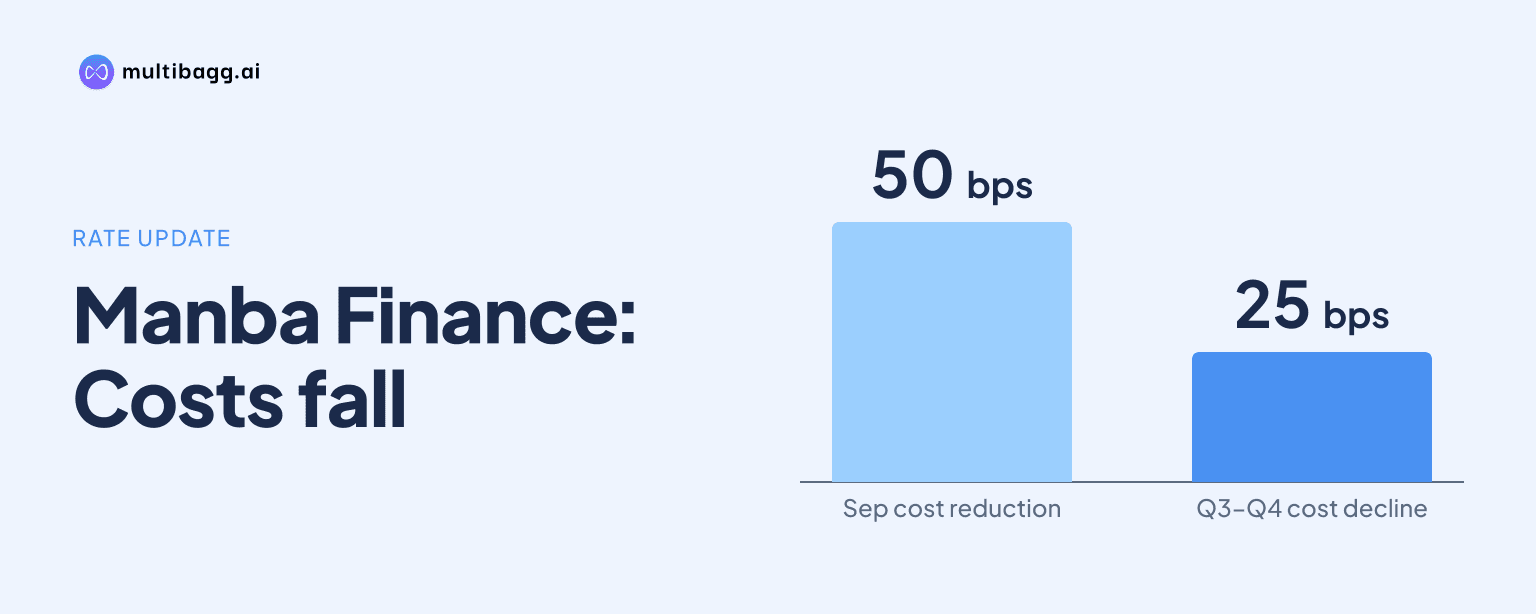
Manba Finance expects the repayment of Rs 600 crore of older, higher-rate borrowings by March-end, together with cheaper new funding after its rating upgrade, to reduce its overall borrowing cost by about 25 basis points in the third to fourth quarter. Management said new funds were already being raised around 50 basis points below September rates.
Know Manba Finance inside out
Results, valuation, peers and who's buying, in one view.
How will Manba lower its borrowing costs?
Manba expects to lower borrowing costs as about Rs 600 crore of debt contracted at old sanction rates runs off by 31 March. Management said this borrowing book was raised before 2025 at higher rates, so its repayment should reduce the share of expensive legacy facilities within total finance costs.
The second mechanism is the pricing of incremental debt. Management said the rating upgrade had already allowed Manba to raise funds at about 50 basis points below the rates at which it had borrowed since September. A basis point is one-hundredth of a percentage point, meaning the reported reduction on newly raised funding is about 0.50 percentage points.
Management also referred to a 25-basis-point increase in the Reserve Bank of India repo rate, but said Manba was still obtaining funds at a lower cost. It expects the rating upgrade to support a 50- to 75-basis-point reduction in lenders' rates, which management said could leave incremental borrowing about 25 basis points cheaper even after the policy-rate increase.
When should Manba's lower funding cost appear?
Manba expects the combined effect to reduce its overall cost of borrowing by about 25 basis points in the third to fourth quarter. The timing depends partly on the Rs 600 crore legacy book being repaid by March-end, because those facilities remain in the funding mix until they run down.
Management distinguished between the lower rates on new loans and the expected change in the overall borrowing cost. The reported 50-basis-point reduction applies to current fund raising versus September rates, while the estimated 25-basis-point effect reflects both cheaper replacement funding and the gradual exit of higher-cost debt.
Manba did not disclose its current blended cost of funds, the interest rates on the Rs 600 crore of legacy borrowings, or a quarter-by-quarter cost-of-funds target. The third-to-fourth-quarter reduction is therefore management's expectation rather than a reported company-wide reduction already recorded.
What does the funding outlook mean for Manba's margin?
Manba said lower-cost funding should help protect net interest margin, or NIM, despite the repo-rate increase. An analyst on the call said NIM was 12.3%, below management's earlier 13% to 14% guidance range, and management responded that the rating upgrade was expected to reduce funding costs going forward.
The eventual margin outcome will also reflect changes in Manba's lending mix. Management said used two-wheeler loans earn an internal rate of return, or IRR, of 27% to 28%, while top-up loans generate around 32% IRR. It said small-business loans and micro, small and medium enterprise loan against property, or MSME LAP, products also offer 27% to 28% IRR.
Management described top-up loans as secured because the hypothecation on the customer's two-wheeler continues, whereas personal loans are unsecured and are being increased gradually. Used two-wheeler loans had added more than 100 dealers in the preceding six months, but Manba did not quantify the share of those products in its total loan book or provide a revised NIM target.
Got a follow-up? Ask IRIS
What growth plans could increase Manba's funding needs?
Manba maintained its confidence in 30% to 35% growth in assets under management, or AUM, supported by festive-season volumes, new products and geographic expansion. Management said October alone was adding Rs 120 crore of new AUM after the month's run-down, and it expected a similar addition in November.
That outlook compares with the first-half position raised by an analyst, who said AUM had increased by about Rs 98 crore from roughly Rs 1,700 crore to nearly Rs 1,800 crore. Management attributed the expected second-half acceleration to the timing of Dussehra on 22 October and Diwali on 8 November, which it described as major business months.
Manba began operations in Madhya Pradesh, Uttar Pradesh and Karnataka in August, and said it had onboarded 100 dealers in Karnataka. Management expects further penetration in those states by December, while Karnataka's season generally falls in January and is expected to contribute to AUM growth.
MSME LAP is another planned source of growth. Management said ticket sizes range from Rs 8 lakh to Rs 25 lakh, monthly disbursements had begun at Rs 2 crore to Rs 2.5 crore, and it expects them to reach Rs 5 crore a month by January. In small-business loans, Manba added three branches in the prior two months and planned two more during the quarter, with five to six new branches expected to add Rs 3 crore to Rs 4 crore of disbursements.
What operating costs could offset Manba's funding gains?
Manba said operating expenses rose 28% between September 2025 and September 2026 because it expanded locations and recruited sales staff in Karnataka during the season. Management said it had added almost 16 offices in the preceding year and argued that year-on-year expense growth should be considered alongside increases in disbursements and AUM.
Technology spending is another recurring cost. Manba said its technology team has about 28 people and annual spending is around Rs 2 crore. Over the six months discussed on the call, it introduced HTP disbursement and changed its DV flow, reducing disbursement turnaround time from about 3.5 to four days to around 1.5 to two days.
Management expects disbursements to reach same-day completion by the end of the year and said it is using artificial intelligence tools for management information systems, reporting and projections. It did not disclose a cost-to-income target or quantify savings from the faster process, so the financial effect of those operational changes remains unspecified.
Conclusion
Manba's expected reduction in borrowing cost rests on the March-end repayment of Rs 600 crore of pre-2025, higher-rate debt and the lower pricing of new funding after its rating upgrade. Management expects these factors to lower the overall borrowing cost by about 25 basis points in the third to fourth quarter, while reporting that current new funding is about 50 basis points cheaper than September levels.
The next items to watch are whether the legacy borrowing book is repaid by March-end and whether new funding continues at the lower rates management described. Management also plans to lift MSME LAP monthly disbursements to Rs 5 crore by January, add two small-business branches during the quarter and build business in Karnataka during its January season.