










Manba Finance expands higher-yield lending, slows personal loans
Key highlights
- Top-up loans carry the highest stated IRR at about 32%, while used two-wheeler and small-business loans generate 27% to 28%.
- Manba Finance added more than 100 used two-wheeler dealers in the preceding six months.
- The company added 3 small-business branches in the prior 2 months and planned 2 more during the quarter.
- Monthly MSME LAP disbursements of Rs 2 crore to Rs 2.5 crore are expected to reach Rs 5 crore by January.
powered by IRIS
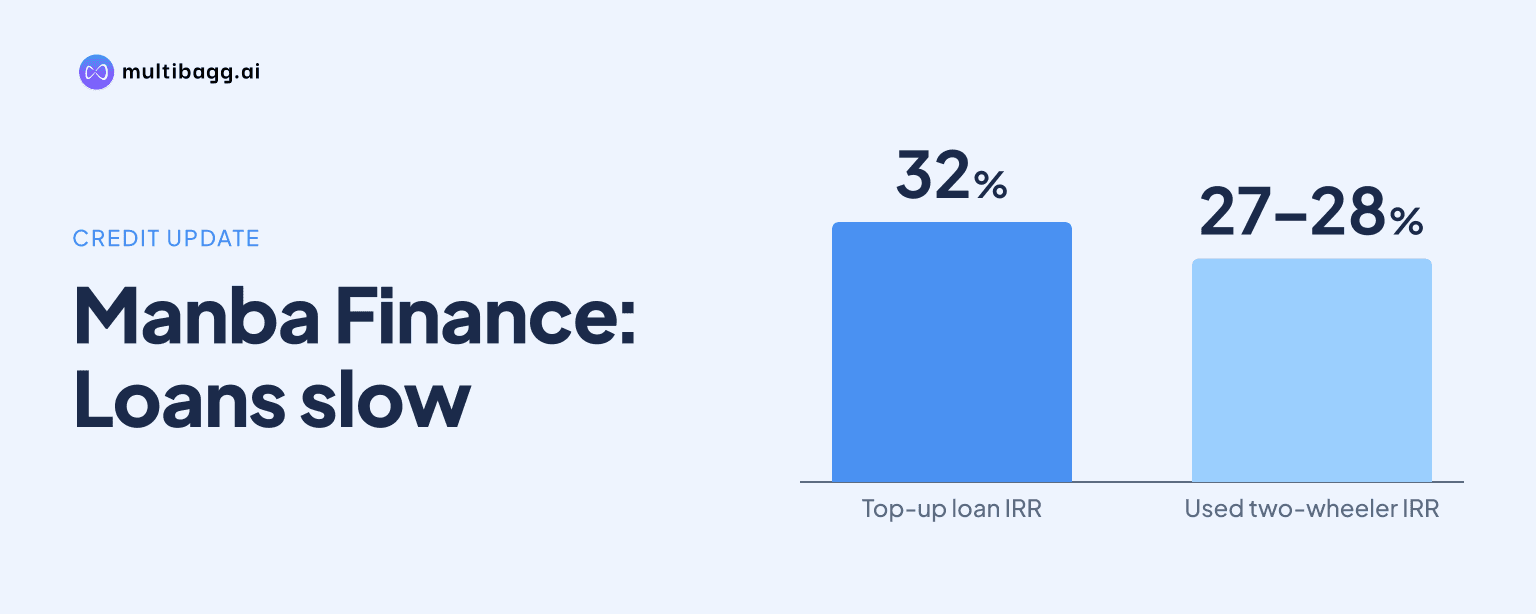
Manba Finance Limited is expanding used two-wheeler, top-up and small-business lending, where management cited internal rates of return of 27% to 32%. Manba Finance is proceeding slowly with personal loans because they are unsecured, whereas its top-up loans are made to existing customers with continuing hypothecation over their two-wheelers.
Know Manba Finance inside out
Results, valuation, peers and who's buying, in one view.
Which Manba Finance products have the highest stated returns?
Manba Finance said top-up loans generate an internal rate of return, or IRR, of about 32%, the highest return cited in the call, while used two-wheeler and small-business loans generate 27% to 28% IRR. Management said top-up loans are secured because they are offered to its own customers and the lender's hypothecation over the financed two-wheeler remains in place.
Personal loans have an IRR similar to top-up loans, according to management, but differ in their security structure. Manba Finance has onboarded a few direct selling agents, or DSAs, for personal loans, but said it would build the unsecured product slowly and gradually. The 32% figure is a product-level indication rather than guidance for the overall lending yield.
Management said the combination of used two-wheelers, top-ups, personal loans and small-business lending is improving Manba Finance's lending mix. The call did not disclose the current assets-under-management share of any of these products, so the effect of the 27% to 32% IRR products on the company's consolidated yield cannot be calculated from the information provided.
Why is Manba Finance expanding personal loans gradually?
Manba Finance is expanding personal loans gradually because they are unsecured, unlike top-up loans that retain hypothecation over a customer's two-wheeler. Management explicitly made that distinction while saying personal loans have an IRR similar to the roughly 32% return cited for top-ups. It did not disclose a personal-loan portfolio size, disbursement target or delinquency measure.
The more cautious personal-loan rollout contrasts with the security mechanism in the top-up product. Top-ups are extended to Manba Finance's existing customers, while the continuing charge over the vehicle remains with the lender. Management said it had engaged a few DSAs for personal loans, indicating that distribution has begun but without a disclosed target for volume or product share.
The different pacing shows that management is considering collateral as well as the stated yield. While both top-ups and personal loans have a similar IRR, Manba Finance did not provide comparative credit-cost data for the two categories. The call therefore supports a distinction in product structure and rollout speed, not a conclusion about their relative portfolio outcomes.
Got a follow-up? Ask IRIS
How is Manba Finance growing used two-wheeler and business lending?
Manba Finance is growing used two-wheeler lending through dealer coverage and a dedicated business head, adding more than 100 dealers in the preceding six months. Management said the used two-wheeler market has become more mature over the past two to three years as institutional players entered the segment. It cited 27% to 28% IRR, along with processing fees and lower payouts, for this product.
Management said the used two-wheeler product should contribute to Manba Finance's overall yield as it is extended to more locations. However, it did not disclose the used-vehicle loan-book size, its share of assets under management or a future portfolio target. The dealer addition is therefore the disclosed measure of distribution expansion rather than a quantified growth forecast.
Small-business loans also generate a stated 27% to 28% IRR and have an average ticket size of Rs 5 lakh, according to management. The product has operated for three years, and management said non-performing assets, or NPAs, have been 3% to 4% so far. It said disbursements are being increased year by year.
Distribution plans extend to both small-business loans and micro, small and medium enterprise loan against property, or MSME LAP. Manba Finance said it added three small-business branches in the prior two months and planned two more during the quarter; the resulting five to six branches were expected to add Rs 3 crore to Rs 4 crore of small-business disbursement. Monthly MSME LAP disbursements were Rs 2 crore to Rs 2.5 crore, with management expecting Rs 5 crore by January.
What credit measures does Manba Finance disclose for its lending mix?
Manba Finance said new-to-credit, or NTC, borrowers represent about 40% of its total book, and management described their repayment behaviour as broadly similar to other customers. Its stated control is a 75% loan-to-value, or LTV, cap for NTC customers, requiring a 25% customer contribution toward the vehicle purchase. Management added that customers with credit scores above 750 perform somewhat better than the broader customer group.
The company also said it does not onboard customers who have defaulted with another lender. That screening policy is relevant to the expansion of multiple products, including unsecured personal loans, although the call did not say whether the 75% LTV restriction applies outside NTC vehicle lending. The security approach differs by product, with top-ups retaining vehicle hypothecation and personal loans having no stated collateral.
Management reported a bounce rate of 18% to 20%, while saying 7% to 8% of customers remain in a bounced status over the loan tenure. It explained that the bounce measure changes as some customers make payment after an initial bounce. These figures are distinct from NPAs, which management disclosed at 3% to 4% specifically for the three-year-old small-business product.
Conclusion
Manba Finance is broadening its lending mix through products with stated IRRs of 27% to 28% in used two-wheelers and small-business loans and about 32% in top-ups. Its central product distinction is security: top-ups retain two-wheeler hypothecation, while unsecured personal loans are being introduced gradually through a limited group of DSAs.
The next disclosed milestones are two additional small-business branches during the quarter and management's expectation that monthly MSME LAP disbursements will reach Rs 5 crore by January. For personal loans, the unresolved issue is the pace of scaling, as Manba Finance gave no target for disbursements, portfolio share or delinquencies in the unsecured product.