










Mangalam Drugs and Organics Reports ₹15.57 Crore Default
Key highlights
- Mangalam Drugs reported ₹15.57 crore in overdue cash-credit facilities with two banks.
- Bank of Maharashtra was owed ₹9.51 crore, with the default starting on October 17, 2025.
- Bank of Baroda was owed ₹6.06 crore, with the default starting on October 20, 2025.
- Mangalam Drugs has submitted a restructuring proposal to its lending banks.
powered by IRIS
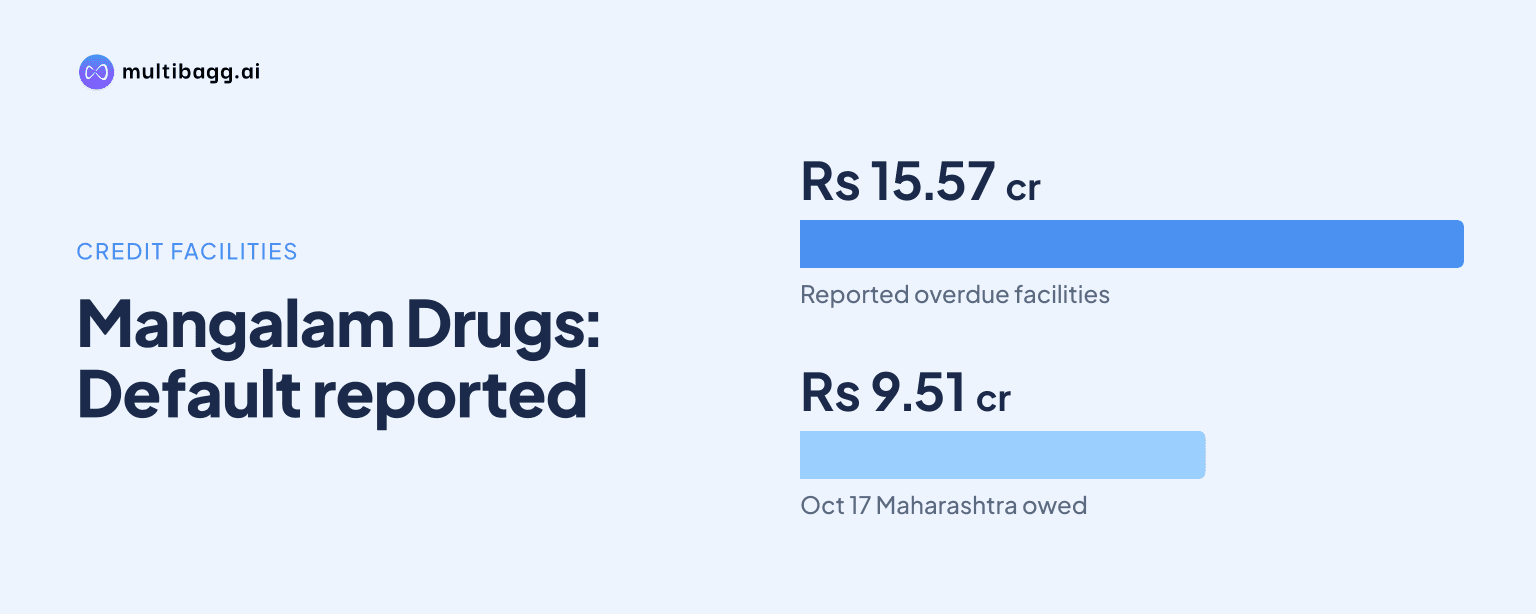
Mangalam Drugs and Organics Limited has reported ₹15.57 crore of overdue cash-credit borrowings, with ₹9.51 crore due to Bank of Maharashtra and ₹6.06 crore to Bank of Baroda, following defaults that began in October 2025. The continued disclosure matters because both working-capital accounts have remained overdue beyond the 30-day reporting threshold under SEBI rules.
Know Mangalam Drugs and Organics inside out
Results, valuation, peers and who's buying, in one view.
What did Mangalam Drugs disclose about its loan defaults?
Mangalam Drugs disclosed subsequent defaults on cash-credit facilities provided by Bank of Maharashtra and Bank of Baroda. The company reported the information under Regulation 30 of the SEBI (Listing Obligations and Disclosure Requirements) Regulations, 2015, which requires listed entities to disclose debt defaults that extend beyond 30 days.
The overdue amount on the Bank of Maharashtra cash-credit account was ₹9.51 crore, or ₹95.119 million. The default on this account, identified in the disclosure as cash-credit account number 60383561246, began on October 17, 2025.
The overdue amount on the Bank of Baroda cash-credit account was ₹6.06 crore, or ₹60.608 million. The filing stated that the default on this facility, account number 04170500000243, started on October 20, 2025.
Together, the two overdue balances total ₹15.57 crore, based on the amounts in the latest disclosure. The aggregate has been described across company-related updates as approximately ₹15.57 crore to ₹15.58 crore, reflecting minor changes in reported balances across reporting dates.
Which banks and facilities are affected?
The defaults relate to revolving cash-credit facilities with Bank of Maharashtra and Bank of Baroda. Cash-credit facilities are working-capital lines that allow a company to draw funds for operating needs within an approved borrowing limit, subject to conditions set by the lender.
Mangalam Drugs' disclosures indicate that the balances remained in excess of sanctioned drawing power for more than 30 days. This is the condition that triggered the default disclosures. The company has not reported a new lender or a different borrowing facility in the information provided.
The Bank of Maharashtra exposure represents the larger portion of the overdue amount. It accounts for about 61% of the combined default, while the Bank of Baroda facility accounts for the balance. These proportions are calculated from the disclosed overdue amounts.
How did the borrowing stress develop?
The current default is part of a series of disclosures made by Mangalam Drugs since the defaults began in October 2025. Earlier reports showed lower overdue amounts, including combined defaults of ₹7.65 crore in disclosures linked to the initial period of stress.
By March 2026, disclosed overdues were ₹7.07 crore with Bank of Maharashtra and ₹4.47 crore with Bank of Baroda. In April 2026, the company reported ₹9.52 crore due to Bank of Maharashtra and ₹6.06 crore due to Bank of Baroda, taking the total to about ₹15.58 crore.
The company had attributed financial stress in an earlier update to discontinued US Aid funding and lower orders for tuberculosis, HIV and malaria treatments. That disclosure also said it had requested loan restructuring and planned to submit a restructuring proposal to lenders by mid-December 2025.
The information provided states that Mangalam Drugs has submitted a restructuring proposal to its banks and is making arrangements to clear overdue amounts. The latest default disclosure does not give a timeline for lender approval, repayment, or closure of the outstanding balances.
Got a follow-up? Ask IRIS
What does the default mean for investors and operations?
The continuing default places attention on Mangalam Drugs' working-capital position and its ability to operate within bank drawing limits. Cash-credit facilities are generally used to support day-to-day funding needs, so sustained excess utilisation is a relevant financial-risk disclosure for shareholders and lenders.
For investors, the reported figure is an overdue borrowing amount rather than a new borrowing announcement. The company has continued to make periodic disclosures on the status of the two accounts, including updates in March, April, June, August and September 2026. This reporting pattern shows that the issue remained unresolved through the latest cited filing.
The company also reported financial results for the quarter ended June 30, 2026, on August 12, 2026. However, the provided information does not include revenue, profit, cash-flow, or balance-sheet figures from those results. Therefore, the direct effect of the defaults on reported financial performance cannot be quantified from the available data.
The earlier reference to reduced orders for treatment categories linked to TB, HIV and malaria provides context for the pressure on operations. But no current order-book figure, customer response, or lender decision has been disclosed in the supplied information.
Why are repeated default disclosures significant?
Repeated disclosures make the duration of the default as important as the amount. The Bank of Maharashtra account has been overdue since October 17, 2025, while the Bank of Baroda account has been overdue since October 20, 2025. Both have therefore remained in default for several months.
SEBI's disclosure framework is intended to ensure that investors receive information when listed companies default on debt obligations beyond the prescribed period. Mangalam Drugs has identified these updates as subsequent intimations, indicating that they are continuations of the same borrowing issue rather than separate newly reported defaults.
The company has also experienced management changes during 2026. Jeevan Mukund Dalvi was appointed chief financial officer effective February 6, 2026, while Shweta Patel was appointed company secretary and compliance officer effective April 1, 2026. The supplied disclosures do not link these appointments to the bank-default matter.
Conclusion
Mangalam Drugs has reported outstanding cash-credit defaults of ₹15.57 crore across Bank of Maharashtra and Bank of Baroda. The amounts have remained overdue since October 2025, making the matter a material indicator of continued working-capital stress and a key disclosure for shareholders tracking the company's financial obligations.
The next development to watch is progress on the restructuring proposal and the company's stated arrangements to clear the overdue balances. Investors will also look for subsequent regulatory filings to determine whether either lender has accepted a restructuring plan, whether the overdue amounts change, or whether the defaults are cured.