










Happy Forgings Promoter Holding Stands at 78.44% in September
Key highlights
- Happy Forgings reported promoter ownership of 78.44% as of September 30, 2026, versus 78.46% in June 2026.
- Happy Forgings reported FY26 net sales of ₹1,546.30 crore and operating profit of ₹470.60 crore.
- The draft IPO included a fresh issue of up to ₹500 crore and an offer for sale of up to 8,054,910 shares.
- Happy Forgings' promoter stake was 3.44 percentage points above the 75% minimum public shareholding threshold.
powered by IRIS
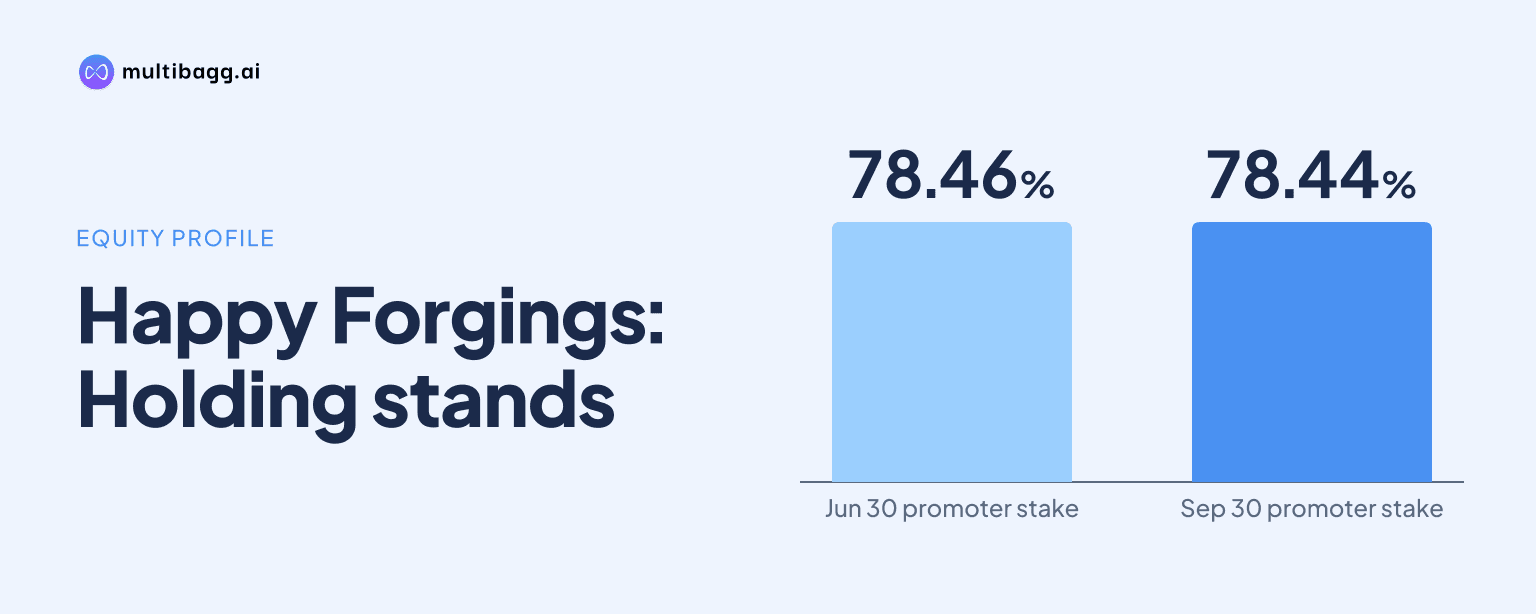
Happy Forgings Limited reported promoter ownership of 78.44% as of September 30, 2026, compared with 78.46% in June 2026, leaving its promoter stake above the 75% level relevant to minimum public shareholding requirements.
Know Happy Forgings inside out
Results, valuation, peers and who's buying, in one view.
What does Happy Forgings' September shareholding pattern show?
Happy Forgings Limited reported that Indian promoters held 78.44% of its equity as of September 30, 2026. The public held 4.26%, while the remaining 17.30% was classified as others in the company’s shareholding data. A separate disclosure identifies institutions at 17.30%, public shareholders at 3.49%, and others at 0.77%, with the promoter holding unchanged at 78.44%.
The company submitted its shareholding pattern to BSE on October 10, 2026. The filing showed only a marginal movement in promoter ownership from 78.46% at the end of June 2026 to 78.44% at the end of September 2026. Public ownership increased from 4.12% to 4.26% over the same period.
This ownership structure is significant because listed companies are generally required to maintain at least 25% public shareholding. The available company update notes that promoter ownership remains above 75% and that pending promoter dilution to meet minimum public shareholding norms may remain a potential supply overhang.
Happy Forgings manufactures complex, safety-critical, heavy forged and precision-machined components. Its shareholding disclosures therefore matter to investors assessing both the company’s ownership concentration and the potential route through which public float could increase.
How did Happy Forgings' IPO structure change its ownership base?
Happy Forgings' draft offer documents described an initial public offering comprising a fresh issue of up to ₹500 crore and an offer for sale of up to 8,054,910 equity shares. Before the proposed offer, promoters and promoter group entities collectively held 88.24% of the company, while India Business Excellence Fund - III held 11.76%.
The offer-for-sale component was to include shares sold by promoter Paritosh Kumar Garg (HUF) and India Business Excellence Fund - III. The draft papers stated that these selling shareholders would cumulatively sell up to 8,054,910 shares. India Business Excellence Fund - III is a buyout fund managed by Motilal Oswal Private Equity.
The company proposed to use net proceeds from the fresh issue for prepayment of certain borrowings, purchase of equipment, plant and machinery, and general corporate purposes. The draft documents also stated that spending on general corporate purposes would not exceed 25% of gross proceeds, in line with SEBI ICDR regulations.
The documents named JM Financial, Axis Capital, Motilal Oswal Investment Advisors and Equirus Capital as book-running lead managers. The equity shares have a face value of ₹2 each.
What is known about the IPO allotment and listing information?
The available report states that Happy Forgings' IPO allotment was expected to be finalised on the day of that report and that the shares were expected to list on December 27. However, the supplied information does not provide the final allotment outcome, subscription figures, issue price, grey market premium, or the year attached to the proposed listing date.
As a result, investors should distinguish between the reported expectation of allotment and any subsequently confirmed exchange or registrar communication. An allotment status is typically confirmed through the registrar’s platform and through the relevant stock exchange notices after the basis of allotment is finalised.
The source material also does not provide a confirmed listing price or post-listing performance. Therefore, no conclusion can be drawn from the information provided about how the IPO traded on its listing day or how the issue was valued at the final offer price.
Got a follow-up? Ask IRIS
How has Happy Forgings' financial performance developed?
Happy Forgings' reported financial data shows net sales rising from ₹1,196.50 crore in FY23 to ₹1,546.30 crore in FY26. Operating profit increased from ₹340.90 crore to ₹470.60 crore over the same period, while profit before tax rose from ₹280.00 crore to ₹401.90 crore.
The financial data also shows raw-material consumption of ₹631.80 crore in FY26, employee costs of ₹136.70 crore and other expenses of ₹307.30 crore. Interest expense stood at ₹10.50 crore in FY26, compared with ₹7.50 crore in FY25.
The supplied analyst estimates project net sales of ₹1,824.70 crore for FY27 and ₹2,171.40 crore for FY28. These are estimates rather than reported financial results. Projected operating profit is ₹586.40 crore for FY27 and ₹709.50 crore for FY28.
Why does promoter ownership matter for Happy Forgings investors?
Promoter ownership matters because Happy Forgings' 78.44% promoter stake is above the 75% ceiling associated with the minimum public shareholding requirement. A future increase in public float could occur through one or more permitted routes, but the supplied information does not identify a specific dilution plan, size, timing or method.
For investors, a higher public float can affect the volume of shares available for trading. It can also be relevant to index eligibility, institutional participation and market liquidity, although the source does not provide evidence of any immediate change in these areas for Happy Forgings.
The ownership figure should also be viewed with the company’s operating profile. Happy Forgings is a manufacturer serving a component-intensive industrial segment, and its financial performance is influenced by revenue growth, raw-material costs, employee expenses, capital expenditure and borrowing costs. The IPO documents identified debt prepayment and equipment purchases as intended uses of fresh-issue proceeds, linking capital allocation to its manufacturing operations.
Conclusion
Happy Forgings' September 2026 disclosure shows that promoter ownership remained largely stable at 78.44%, down marginally from 78.46% in June. The figure is important because it exceeds the 75% level tied to minimum public shareholding norms, while the company’s reported FY26 net sales reached ₹1,546.30 crore and operating profit reached ₹470.60 crore.
Investors should watch for any company or exchange disclosure on promoter stake dilution, as well as future quarterly financial results and updates on capital expenditure or borrowing reduction. The supplied IPO-related material identifies December 27 as the expected listing date, but it does not provide a confirmed allotment outcome, subscription data, GMP or final listing performance.