










Happy Forgings directs 70% of Rs 500 crore to machining
Key highlights
- Happy Forgings approved Rs 500 crore of phased FY2028-FY2029 capex, with Rs 350 crore allocated to machining.
- Machining utilisation was 77% in H1 FY2027, and management expects it to approach 90% by Q4 FY2027.
- Combined projects are expected to increase machining capacity to 1,16,000 metric tons and forging capacity to 2,17,000 metric tons.
- Happy Forgings reported H1 FY2027 revenue of Rs 950 crore, up 29.9%, and EBITDA of Rs 294 crore, up 35.5%.
powered by IRIS
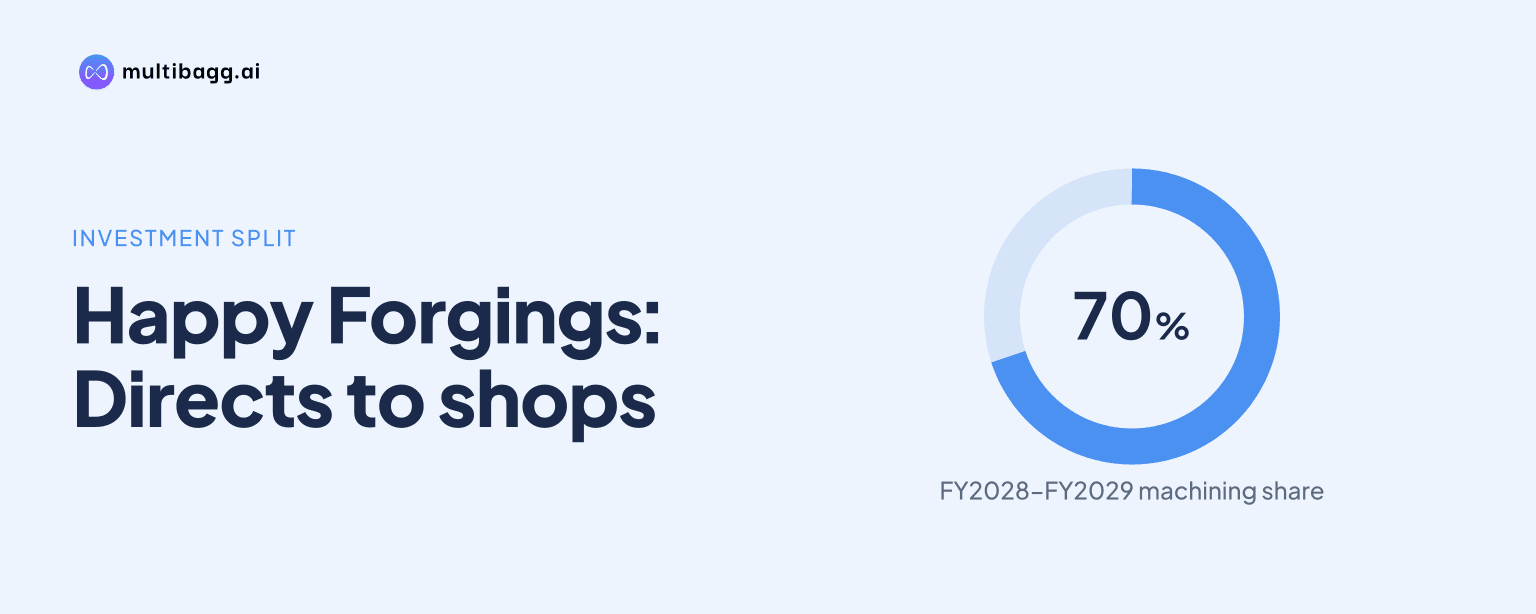
On November 6, 2026, Happy Forgings Limited said its board approved Rs 500 crore of additional capital expenditure, with 70% allocated to machining as management expects machining utilisation to approach 90% by Q4 FY2027. The phased FY2028 and FY2029 programme will serve passenger vehicles, industrial applications and commercial-vehicle exports.
Know Happy Forgings inside out
Results, valuation, peers and who's buying, in one view.
Why is Happy Forgings adding Rs 500 crore of capacity?
Happy Forgings is adding capacity because its machining lines were nearing a constraint: utilisation was about 80% in the preceding quarter and management expects it to reach close to 90% by Q4 FY2027. Managing Director Ashish Garg said the company needs the capacity for programmes already in production and for products under development, supported by its order book and demand visibility.
The new Rs 500 crore programme will be implemented in phases across FY2028 and FY2029. Management said the company acquired land about six months before the November 2026 call, meaning the approved outlay is principally for manufacturing equipment rather than a land purchase.
Machining was already used more heavily than forging in H1 FY2027. Happy Forgings reported 77% machining utilisation against 60% forging utilisation, with installed machining capacity of 82,000 metric tons and forging capacity of 1,58,000 metric tons.
How will Happy Forgings spend the new expansion budget?
Happy Forgings will spend 70% of the Rs 500 crore programme, or Rs 350 crore, on machining facilities and the remaining 30%, or Rs 150 crore, on forging capacity. Management said the forging investment will mainly fund small press lines, where demand is high and current utilisation is at peak levels.
The machining investment is intended to support leading-series generator sets, export commercial vehicles and passenger-vehicle requirements. Management said the emphasis on machining reflects the need to support both running programmes and product-development activity before utilisation reaches the projected Q4 FY2027 level.
A 4,000-ton press line commissioned for a North American passenger-vehicle customer began ramping up in Q1 and Q2 FY2027. Management projected Rs 80 crore to Rs 100 crore of sales from that line, although it said a substantial portion of Q2 FY2027 shipments was in transit under delivered-at-place terms and should be recognised from Q3 FY2027.
What capacity will Happy Forgings have after expansion?
Happy Forgings expects the separate heavy-components project and the newly approved programme together to add 59,000 metric tons of forging capacity and 34,000 metric tons of machining capacity within the next two to two-and-a-half years. That would increase forging capacity to around 2,17,000 metric tons and machining capacity to around 1,16,000 metric tons.
The company strengthened its forging operations before approving the new plan, commissioning a forging press in Q1 FY2027 and an additional hammer in Q2 FY2027. The capacity additions therefore supplement a forging base that had 60% utilisation in H1 FY2027, while directing more new spending towards the machining lines that operated at 77%.
Got a follow-up? Ask IRIS
Which markets will Happy Forgings serve with the new capacity?
Happy Forgings said the new facilities will primarily address passenger vehicles, industrial products and export-related commercial vehicles. Passenger vehicles accounted for 9% of H1 FY2027 revenue, up from 5% in H1 FY2026, and management said segment revenue almost doubled from the prior-year period through domestic wallet-share gains and execution of earlier export orders.
Industrials contributed 16% of H1 FY2027 revenue, compared with 13% in H1 FY2026, and grew by more than 50%, according to management. It linked this growth opportunity to heavy forgings and demand for backup power generators for data centres, while also citing gas engines, oil and gas, energy and wind applications for its fungible forging lines.
Exports accounted for roughly 50% of Happy Forgings' current order book, management said. The company also secured about Rs 95 crore of export orders in the preceding quarter, mainly for Asian markets, while the new capacity includes provision for North American passenger-vehicle programmes expected to begin from the end of FY2027 and during FY2028.
How does the plan fit with Happy Forgings' heavy-components project and funding?
Happy Forgings is separately developing a Rs 650 crore ultra-heavy component facility, including a 20-megawatt captive solar power plant, that is expected to be completed and commence operations in Q4 FY2028. Management said the heavy project and the new Rs 500 crore programme together account for the planned 59,000-metric-ton forging and 34,000-metric-ton machining capacity additions.
Within the Rs 650 crore heavy-components project, management said about Rs 500 crore is for heavy-sector and high-horsepower capability, including roughly Rs 300 crore for a hammer line. That line can forge components weighing from 300 kilograms to 3 tons, and management described it as fungible rather than limited to data-centre applications.
Management said approximately Rs 250 crore of machining lines for heavy data-centre applications are sold out against Rs 300 crore of secured orders. It also cited nearly Rs 1,000 crore of orders under discussion and said it aims to close close to Rs 500 crore by the end of FY2027, subject to demonstrating capability in cold trials expected in January and February.
Happy Forgings plans to fund the Rs 500 crore expansion through internal accruals and debt. At the end of H1 FY2027, it had about Rs 350 crore in cash and liquid reserves, while net debt to equity was 0.08 times and total outside liabilities to net worth were 0.21 times.
The company incurred around Rs 378 crore of expenditure in H1 FY2027 and generated operating cash flow of about Rs 124 crore. Chief Financial Officer Pankaj Kumar Goyal said cash flow was temporarily affected by higher receivables and Rs 35 crore of advance payments to raw-material suppliers, and management expects working-capital movements to normalise over the full year.
Conclusion
The Rs 500 crore approval shifts Happy Forgings' investment towards machining before management's projected utilisation level of close to 90% in Q4 FY2027. The expansion aligns with a changing revenue mix, in which passenger vehicles rose to 9% of H1 FY2027 revenue from 5% a year earlier and industrials increased to 16% from 13%.
The next milestones are execution of the phased FY2028-FY2029 expansion and commissioning of the Rs 650 crore heavy-components facility in Q4 FY2028. Management also plans cold trials in January and February and aims to close close to Rs 500 crore of further heavy-component orders by the end of FY2027.