










Happy Forgings Q2 FY27 Revenue Rises 32.7% to Rs 501 Crore
Key highlights
- Happy Forgings reported Q2 FY27 revenue of Rs 501 crore, up 32.7% year on year.
- Q2 FY27 net profit rose 32.8% year on year to Rs 98 crore.
- H1 FY27 revenue reached Rs 950 crore, a 29.9% year-on-year increase.
- Happy Forgings approved Rs 500 crore of CapEx for FY28-FY29 and disclosed about Rs 300 crore in annual data-centre orders through 2033.
powered by IRIS
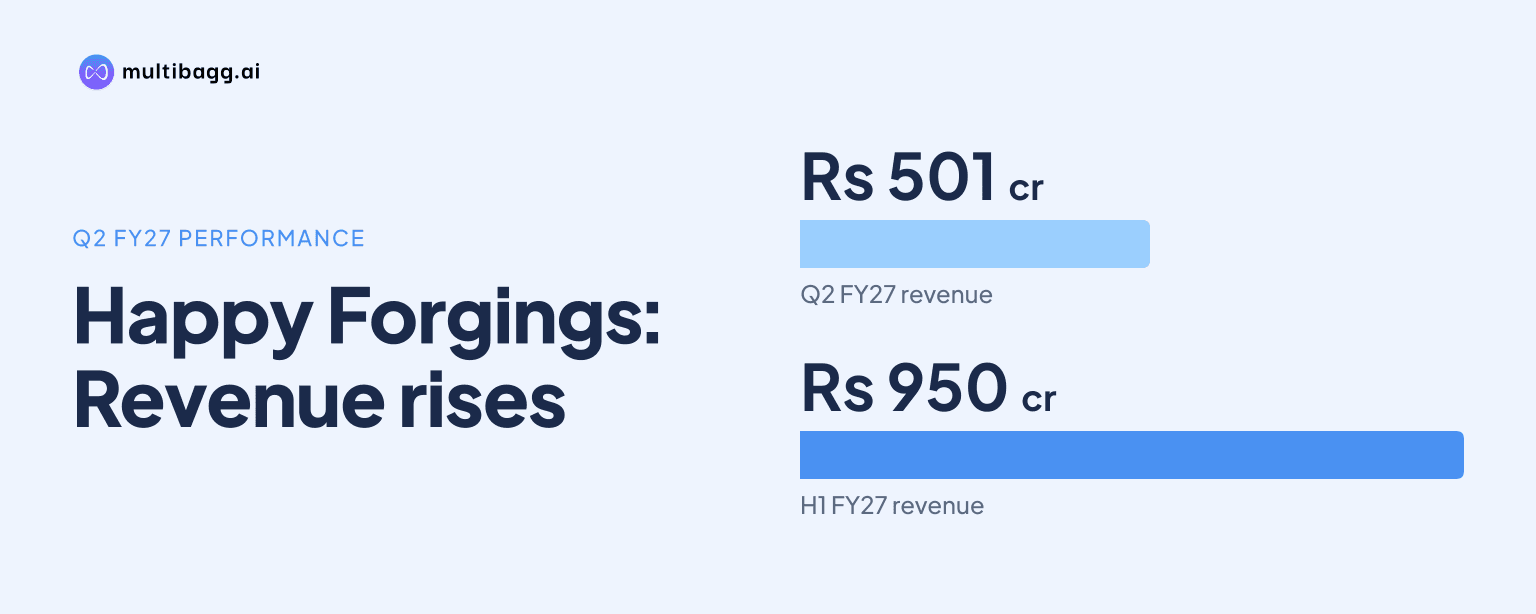
Happy Forgings Ltd reported Q2 FY27 revenue from operations of Rs 501 crore, a 32.7% year-on-year increase, supported by higher volumes and realisations. The company also approved Rs 500 crore of additional capital expenditure for FY28 and FY29 while securing about Rs 300 crore in annual data-centre orders through 2033.
Know Happy Forgings inside out
Results, valuation, peers and who's buying, in one view.
How did Happy Forgings perform in Q2 FY27?
Happy Forgings delivered revenue from operations of Rs 501 crore in Q2 FY27, compared with the corresponding quarter a year earlier, reflecting 32.7% growth. Quarterly volume expanded 24.8%, while realisations increased 6.3%, indicating that both shipment growth and pricing or product-mix factors supported the increase.
Net profit for the quarter was Rs 98 crore, up 32.8% year on year. EBITDA stood at Rs 153 crore, while the reported EBITDA margin was 30.6% in the investor presentation. The company’s results indicate that profit growth broadly kept pace with revenue growth during the quarter.
For the first half of FY27, revenue reached Rs 950 crore, up 29.9% year on year. Management said H1 growth was supported by 24% volume growth and improved realisations, with profitability rising faster than revenue as margins improved.
What drove the company’s revenue growth?
Happy Forgings attributed its Q2 and H1 performance to growth across end markets and geographies. The management said opportunities were opening across its business segments in India and overseas, while recently secured business and demand momentum were expected to support the company’s full-year volume guidance.
The company operates in forging and machining, supplying components to industrial and automotive-linked applications. Its reported volume growth of 24.8% in Q2 was the main contributor to the revenue increase, while the 6.3% improvement in realisations provided additional support.
Management did not provide a numerical FY27 revenue forecast in the disclosed call excerpts. It said FY27 profitability margins were expected to remain near FY26 levels, despite the higher revenue base and ongoing expansion plans.
What is included in Happy Forgings’ Rs 500 crore expansion?
Happy Forgings’ board approved Rs 500 crore of additional capital expenditure for FY28 and FY29. About 70% of the allocation is planned for machining capacity and the remaining 30% for small forging press lines.
The expansion is intended to serve business opportunities in the company’s existing and developing product areas. Management later clarified that the programme also addresses heavier 19-litre to 60-litre gensets and requirements from Indian and global original equipment manufacturers expanding engine production in India.
The proposed spending comes after a period of volume-led growth. Higher machining capacity can support the company’s ability to supply more value-added finished components, while new forging presses can increase production capacity for relevant component categories. The company did not disclose a commissioning schedule for individual projects in the available material.
Got a follow-up? Ask IRIS
What do data-centre orders mean for Happy Forgings?
Happy Forgings has secured about Rs 300 crore of annual orders linked to data centres through 2033. The disclosed information points to a multi-year order stream, providing visibility over a longer period than a typical annual order cycle.
Management connected part of its capacity expansion to heavier gensets, which are relevant to power-backup applications. Data-centre infrastructure requires dependable backup power systems, and the order flow adds another end-market to the company’s business mix.
The annual order figure should be viewed alongside the company’s current scale. At Rs 300 crore a year, the disclosed data-centre orders are meaningful relative to H1 FY27 revenue of Rs 950 crore, although the source does not specify the timing of revenue recognition, customer names, margins, or product-level order execution.
How do the results affect investors and industry operations?
The Q2 results provide investors with concrete evidence of revenue, volume and profit growth, while the Rs 500 crore capital-expenditure decision signals planned capacity additions beyond FY27. The company’s stated expectation that FY27 margins will remain near FY26 levels is relevant because expansion projects can require investment before additional capacity starts contributing to sales.
For operations, the planned 70:30 split between machining and small forging presses indicates a greater allocation towards machining. This may support the company’s strategy to address demand from domestic and global OEMs as well as genset-related applications. However, the available disclosures do not quantify the capacity to be added or the financial returns expected from the programme.
The earnings call on November 6, 2026 included 19 questions from eight analysts, according to the event summary. The level of questioning reflected investor focus on demand conditions, capital expenditure, margins and the company’s ability to translate secured business into future production.
Conclusion
Happy Forgings reported a strong Q2 FY27, with revenue rising 32.7% to Rs 501 crore and net profit increasing 32.8% to Rs 98 crore. Volume expansion, better realisations and growth across markets supported the result, while long-duration data-centre orders add disclosed order visibility through 2033.
The next developments to watch are the execution of the Rs 500 crore FY28-FY29 capital-expenditure programme, the company’s ability to maintain margins near FY26 levels, and progress in supplying heavier genset and OEM-related demand. The available disclosures do not provide project commissioning dates or a revised full-year financial target.