










Happy Forgings H1 revenue rises 30% as mix broadens across segments
Key highlights
- Happy Forgings' H1 FY2027 revenue rose 29.9% to Rs 950 crore.
- H1 FY2027 PAT increased 35.8% to Rs 189 crore and EBITDA margin reached 30.9%.
- Industrial revenue grew well above 50%, off-highway grew over 50%, and passenger-vehicle revenue almost doubled in H1 FY2027.
- Happy Forgings disclosed Rs 650 crore of ultra-heavy-component capex and a further Rs 500 crore for machining and forging capacity.
powered by IRIS
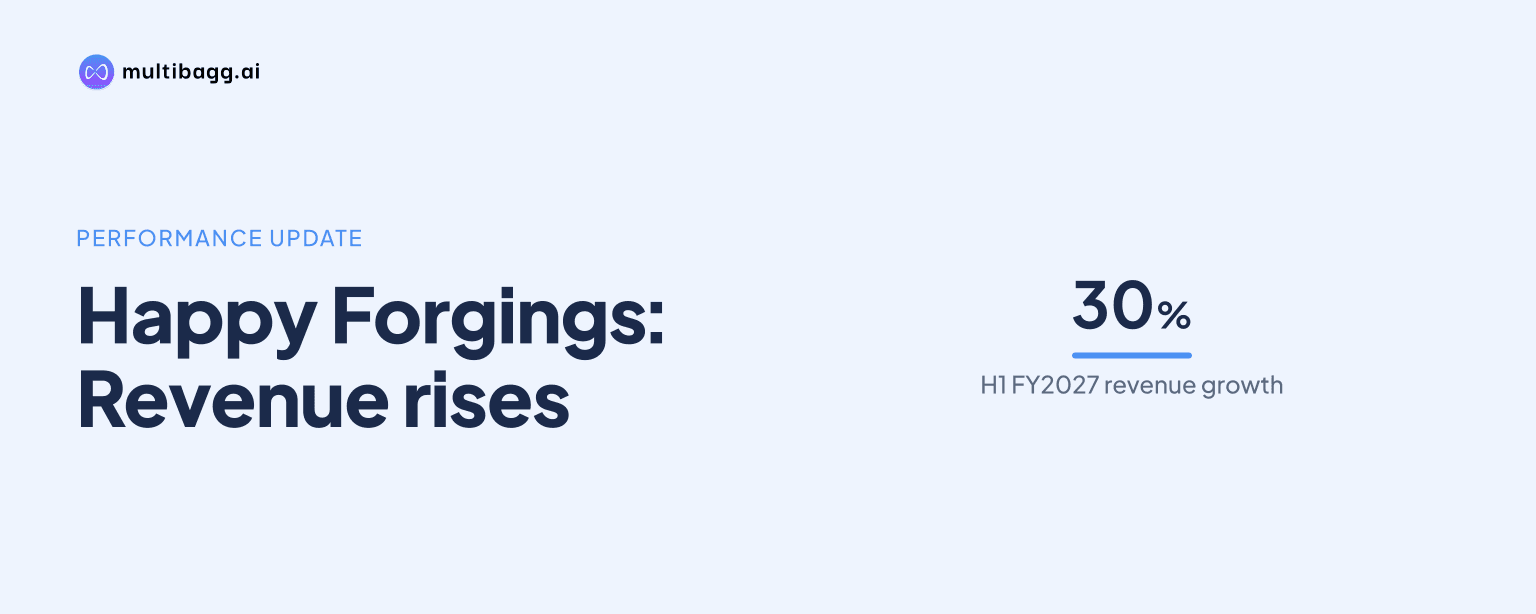
Happy Forgings Limited increased H1 FY2027 revenue by 29.9% year on year to Rs 950 crore, as industrial, off-highway and passenger-vehicle operations grew faster than its two largest segments. Finished-goods volume rose 24%, realizations increased 4.8% to Rs 260 per kg, and profit after tax advanced 35.8% to Rs 189 crore.
Know Happy Forgings inside out
Results, valuation, peers and who's buying, in one view.
How did Happy Forgings perform in H1 FY2027?
Happy Forgings delivered Rs 950 crore of revenue from operations in H1 FY2027, up 29.9% from the corresponding period, with the increase split between 24% higher finished-goods volume and a 4.8% increase in realizations. Management attributed the revenue progression to demand across end markets, broader industry diversification and a rising contribution from customers outside its 10 largest accounts.
The second quarter accounted for Rs 501 crore of revenue, surpassing the Rs 500 crore quarterly milestone and growing 32.7% year on year. Q2 FY2027 volume expanded 24.8% and realizations rose 6.3% to Rs 267 per kg, compared with the H1 FY2027 realization of Rs 260 per kg, reflecting raw-material pass-throughs, conversion-cost price increases and a favourable product mix.
The earnings increase exceeded revenue growth in H1 FY2027: EBITDA rose 35.5% to Rs 294 crore and PAT increased 35.8% to Rs 189 crore. Gross profit grew 33.5% to Rs 577 crore, while management said it maintained profitability at or above FY2026 levels despite higher raw-material prices and other cost pressures.
Which Happy Forgings segments grew faster than its core businesses?
Happy Forgings' industrial, off-highway and passenger-vehicle businesses outgrew commercial vehicles and farm equipment in H1 FY2027, and each increased its revenue share. Commercial vehicles and farm equipment remained the two largest businesses at a combined 63% of H1 revenue, but that was down from a combined 71% a year earlier.
Happy Forgings' commercial-vehicle revenue grew in the high teens, but its share declined by 4 percentage points because other lines grew faster. Domestic commercial-vehicle revenue increased in the mid-20s, broadly matching medium and heavy commercial vehicle, or MHCV, production and sales growth in India, while exports were subdued because longer shipment times increased sales in transit.
Happy Forgings' farm-equipment revenue grew more than 20%, with domestic growth in the high teens and export growth supported by higher sales to key customers. Industrial revenue rose well above 50% and reached 16% of revenue, aided by domestic and export demand; management linked its outlook to heavy-forging investment and demand for backup power generators for data centres in the energy sector.
Off-highway revenue also grew more than 50%, lifting its contribution to 12% as domestic construction equipment benefited from project awards in roads, highways and infrastructure, while export demand came from construction and mining equipment. Passenger-vehicle revenue almost doubled and its share rose to 9%, with domestic gains tied to market demand and higher wallet share, and export gains tied to orders secured earlier.
Got a follow-up? Ask IRIS
Did Happy Forgings improve margins despite higher input costs?
Happy Forgings improved H1 FY2027 margins despite management citing higher raw-material prices and shipment costs as near-term pressures. Gross margin increased 161 basis points, where one basis point equals one-hundredth of a percentage point, to 60.8%; EBITDA margin rose 127 basis points to 30.9%; and PAT margin expanded 86 basis points to 19.9%.
The Q2 FY2027 outcome was broadly stable year on year, with gross margin up 52 basis points to 60.8%, EBITDA margin at 30.6% and PAT margin at 19.5%. Management said sequential moderation in quarterly margins reflected cost headwinds, while price pass-through, negotiated conversion-cost increases and product mix supported realizations.
Happy Forgings also raised machining's contribution to 90% in H1 FY2027 from 88% in H1 FY2026, a change management identified as part of its emphasis on higher-value-added machining operations. Return on equity rose to 17.1% and return on capital employed reached 19.6%, which management linked to operational leverage, value addition and more efficient capital use.
What capacity and orders will shape Happy Forgings' next phase?
Happy Forgings has disclosed a Rs 650 crore ultra-heavy-component project and a further Rs 500 crore programme for machining and forging expansion. The ultra-heavy facility and its 20-megawatt captive solar plant are scheduled to commence operations in Q4 FY2028, while the additional programme is to be phased across FY2028 and FY2029.
The company had forging capacity of 1,58,000 metric tons and machining capacity of 82,000 metric tons in H1 FY2027, with utilisation at 60% and 77%, respectively. It commissioned a new forging press in Q1 FY2027 and an additional hammer in Q2 FY2027; management said the Rs 500 crore programme directs 70% to machining and 30% to forging, particularly smaller press lines.
Together, the projects are intended to add 59,000 metric tons of forging capacity and 34,000 metric tons of machining capacity, taking totals to about 2,17,000 metric tons and 1,16,000 metric tons within two to two-and-a-half years. Management said machining utilisation had reached 80% in the prior quarter and was expected to approach 90% by Q4, while the expansion is aimed at generator sets, commercial-vehicle exports and passenger vehicles.
Happy Forgings said about 50% of its order book was for exports and that it secured nearly Rs 95 crore of export orders in the preceding quarter, mainly for Asia. A 4,000-ton press commissioned for a North American passenger-vehicle customer began ramping in Q1 and Q2 FY2027, although management said sales on delivered-at-place terms were largely in transit; it projected Rs 80 crore to Rs 100 crore of sales from that facility.
Conclusion
Happy Forgings' H1 FY2027 results show that growth was not confined to commercial vehicles and farm equipment: industrial and off-highway each grew more than 50%, while passenger-vehicle revenue almost doubled. That mix shift accompanied 29.9% revenue growth to Rs 950 crore, a 35.5% increase in EBITDA to Rs 294 crore and an H1 EBITDA-margin increase to 30.9%.
The next disclosed milestones are the expected ramp in machining utilisation towards 90% by Q4, the planned Q4 FY2028 start of the ultra-heavy-component facility, and management's expectation that discussions with original equipment manufacturers for data-centre, gas-engine and wind components could become orders in early FY2028. Management also said full-year FY2027 profitability margins may remain roughly similar to FY2026 despite raw-material and shipment-cost pressure.