










Mangalam Drugs and Organics reports Unit 2 WHO GMP compliance
Key highlights
- Mangalam Drugs Unit 2 was assessed as operating at an acceptable level of compliance with WHO GMP Guidelines.
- Mangalam Drugs completed Unit 2's expansion and modernisation in August 2016 at a stated cost of ₹30 crore.
- The EU-related written confirmation for Unit 2 was dated 5 June 2020 and was valid until 10 June 2023.
- A financial-results extract is labelled for the quarter and half year ended 30 September 2026, but contains no financial figures.
powered by IRIS
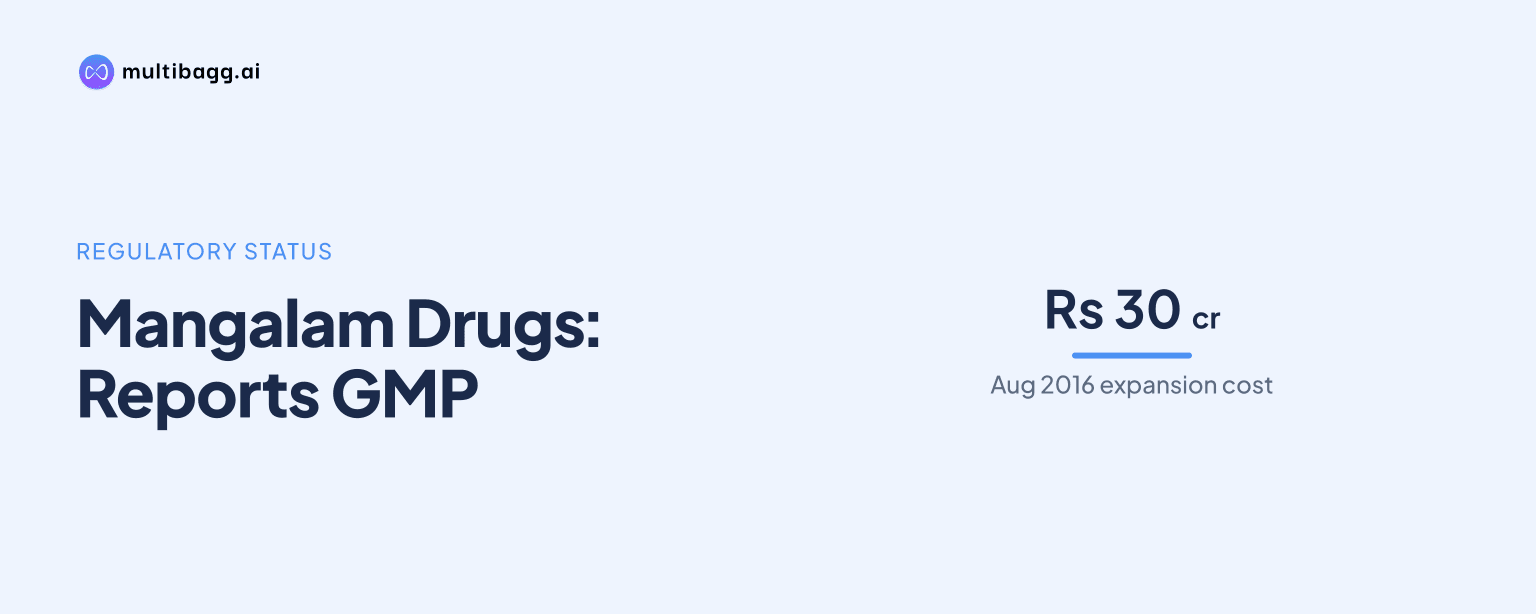
Mangalam Drugs and Organics Limited's Unit 2 at Vapi was considered to operate at an acceptable level of compliance with World Health Organization Good Manufacturing Practices guidelines after an inspection of the site, its personnel and records. The finding is relevant because Unit 2 makes active pharmaceutical ingredients for malaria and anti-retroviral medicines.
Know Mangalam Drugs and Organics inside out
Results, valuation, peers and who's buying, in one view.
What did the WHO GMP inspection find at Unit 2?
The inspection report found that Mangalam Drugs' Unit 2 was operating at an acceptable level of compliance with WHO GMP Guidelines. The assessment covered inspected areas, people met during the inspection, documents reviewed and observations set out in the inspection report.
Unit 2 is located at Plot No. 1203, Third Phase GIDC, Vapi, Valsad, Gujarat, 396195. The report identifies the facility as one of the company's two manufacturing units in Vapi. It also notes that both Unit 1 and Unit 2 are relevant to WHO prequalification and should be inspected consecutively because they work under the same corporate quality management system.
The connection between the two sites is operational as well as administrative. According to the report, raw materials and intermediates are transferred between Unit 1 and Unit 2. This makes the quality controls and documentation at both facilities relevant when assessing manufacturing processes for regulated pharmaceutical markets.
How did Mangalam Drugs expand Unit 2?
Mangalam Drugs completed the expansion and modernisation of Unit 2 in August 2016 at a stated total cost of ₹30 crore. The company said trial operations at the expanded Vapi facility began at the end of August 2016.
The company described Unit 2 as a facility for active pharmaceutical ingredients, or APIs, used in anti-malaria and anti-retroviral medicines. Artemether and lumefantrine are listed in the material provided in connection with the site's anti-malaria API activities.
The expansion was presented as part of the company's effort to increase capacity and support regulated-market filings. Mangalam Drugs stated at the time that it would file Drug Master Files for products manufactured at the Vapi facility with the WHO. The supplied material does not provide product-wise filing dates, approvals or subsequent commercial volumes.
Which regulatory documents apply to Unit 2?
Mangalam Drugs received an Indian written confirmation for Unit 2 for active substances exported to the European Union for human medicinal products. The confirmation was issued by the Central Drugs Standard Control Organisation's International Cell under the requirements referenced in Article 46b(2)(b) of EU Directive 2001/83/EC.
The written confirmation was dated 5 June 2020 and stated that it remained valid until 10 June 2023. It applied to the Vapi Unit 2 address listed in the document. A past validity date should not be read as evidence of a current EU confirmation, as no renewal or extension is included in the supplied material.
The WHO inspection finding and the EU written confirmation address different regulatory contexts. The WHO document records an inspection-based GMP assessment, while the written confirmation relates to an EU import requirement for active substances from India. Both documents nevertheless underline the importance of site-specific quality systems for API manufacturing.
Got a follow-up? Ask IRIS
What financial and market information is available?
The materials refer to a historical revenue target of ₹300 crore for FY17, announced alongside the Unit 2 expansion, but they do not state whether the target was achieved. They also contain a headline saying Mangalam Drugs expected 30% to 40% topline growth for FY12, without a base revenue figure, actual outcome or publication date in the extracted text.
A separate extract is labelled as standalone and consolidated unaudited financial results for the quarter and half year ended 30 September 2026. However, no revenue, profit, margin, debt, cash flow or share-price figures appear in the supplied extract. The document also says the results were approved on 13 February 2024, which conflicts with the stated 2026 reporting period.
For investors, the available evidence therefore supports an operational and compliance update rather than a current earnings conclusion. The ₹30 crore expansion is a historical capital expenditure figure, while the ₹300 crore revenue figure is a historical target. Neither figure establishes the company's present financial performance.
Why does Unit 2 matter to pharmaceutical operations?
Unit 2 matters because it serves API categories used in malaria and anti-retroviral treatment supply chains. Manufacturing sites that make these products require quality systems, controlled transfers of materials and documentation capable of supporting regulatory review in relevant markets.
The inspection report's reference to shared quality management and transfers between the two Vapi units means that site operations cannot be viewed entirely in isolation. For customers and procurement teams, the reported WHO GMP compliance finding is relevant to the site's manufacturing controls. But the supplied information does not disclose customer contracts, order volumes, capacity utilisation or product-level sales.
Conclusion
The available documents show that Mangalam Drugs' Unit 2 in Vapi was assessed as operating at an acceptable level of compliance with WHO GMP Guidelines and had previously received an EU-related written confirmation valid until 10 June 2023. The site was expanded at a stated cost of ₹30 crore and produces APIs for malaria and anti-retroviral medicines.
The next material disclosures to watch are updated regulatory-status documents for Unit 2 and complete financial results for the period ended 30 September 2026. Investors would also need verified information on revenue, profitability, capacity use and any renewed EU confirmation before drawing conclusions about the financial effect of the facility's compliance position.