










GRE Renew Enertech Limited H1 Revenue Rises 217%, Margin Falls
Key highlights
- GRE Renew reported H1 FY27 consolidated revenue of ₹138.7 crore, up 216.7% year on year.
- GRE Renew's H1 FY27 PAT was ₹9.1 crore, up 127.5% year on year.
- GRE Renew's EBITDA margin fell 349 basis points to 9.52% in H1 FY27.
- GRE Renew reported a ₹220.3 crore order book and expects 70%-80% conversion in H2 FY27.
powered by IRIS
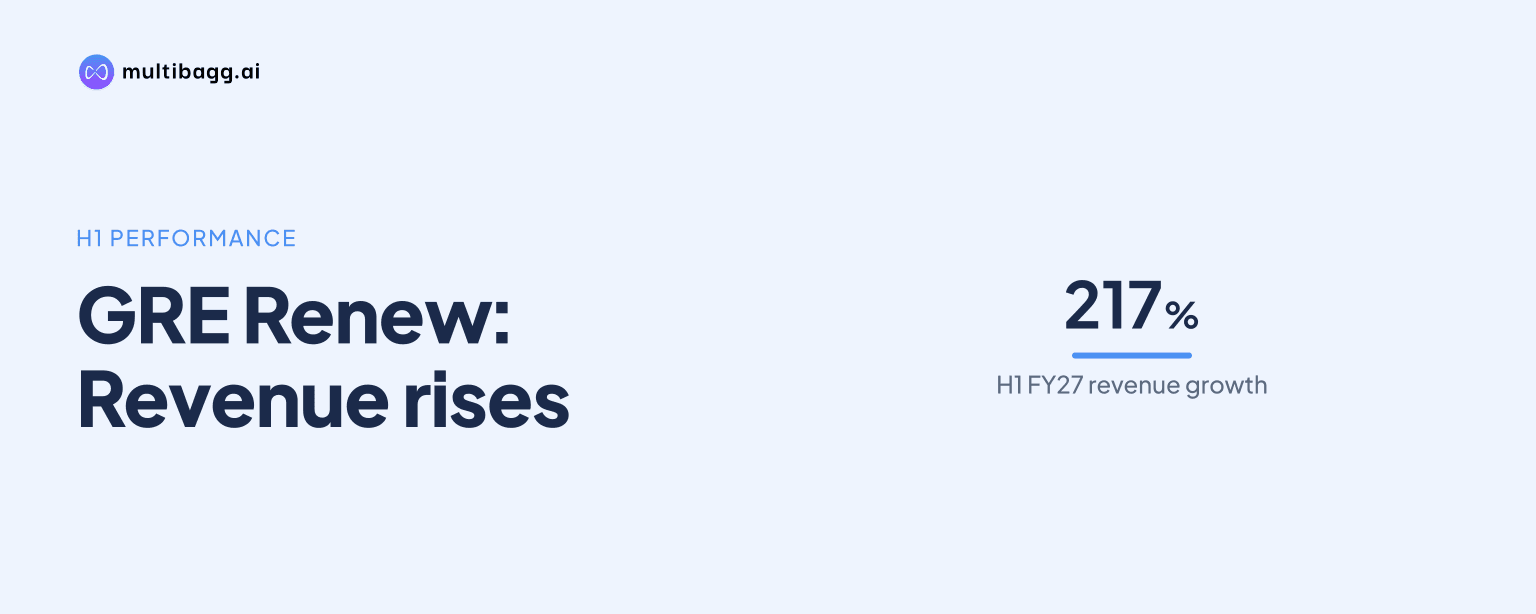
For H1 FY27, GRE Renew Enertech Limited reported consolidated revenue of ₹138.7 crore, up 216.7% year on year, while PAT margin fell to 6.56% from 9.13%. The growth was led by solar EPC work, but a low-margin 50 MW and 65 MWp project reduced profitability metrics during the half year ended September 30, 2026.
Know GRE Renew Enertech inside out
Results, valuation, peers and who's buying, in one view.
What were GRE Renew's H1 FY27 financial results?
GRE Renew reported revenue of ₹138.7 crore for H1 FY27, compared with growth of 216.7% from the corresponding period a year earlier. Profit after tax was ₹9.1 crore, up 127.5% year on year. The figures were presented to investors during the company's H1 FY27 results discussion held on November 13, 2026.
Solar EPC generated about ₹129 crore, rising about 228% year on year and accounting for roughly 93% of total revenue. This establishes EPC execution as the central contributor to the half-year performance, while income from the renewable energy service company, or RESCO, business remained comparatively small.
Why did GRE Renew's profit margins decline?
GRE Renew said the margin contraction reflected a low-margin 50 MW and 65 MWp EPC project. Although the project supported revenue growth, its economics reduced the PAT margin to 6.56% from 9.13% in the prior-year period. EBITDA margin also declined by 349 basis points to 9.52%.
The earnings-call summary described management's position as balanced to defensive, with the margin decline characterised as temporary. However, the company did not provide quantified financial projections for FY27 or FY28. This leaves the reported project mix and future execution as the available indicators of whether margin performance improves.
One EPC project represented about 48% of H1 revenue. That level of project concentration helps explain the strong half-year revenue increase, but it also means that the profitability of a large individual contract had a meaningful influence on overall margins.
Got a follow-up? Ask IRIS
What is GRE Renew's order book and execution outlook?
GRE Renew disclosed an order book of ₹220.3 crore and said it expects 70% to 80% of it to convert during H2 FY27. The company did not provide a quantified revenue-growth or earnings target for either FY27 or FY28 during the call.
The company cited battery energy storage systems, hybrid projects and commercial and industrial rooftop solar as areas of demand visibility. But it did not specify the expected contribution from these opportunities, and its entry into the battery energy storage systems segment has no disclosed timetable.
GRE Renew's solar portfolio exceeds 197 MW. The portfolio and order book provide context for its EPC activity, but the available call disclosures do not state project-wise execution schedules, expected margins or the value of future orders beyond the reported order book.
What should investors assess after the H1 FY27 update?
Investors can assess GRE Renew's results through the contrast between rapid revenue growth and lower profitability. Revenue rose more than three times year on year, while PAT grew at a slower rate than sales because the reported margin fell. The mix of EPC projects, especially the margin profile of major contracts, is therefore material to the company's financial performance.
Receivables were also identified as an area requiring attention. The call summary referred to a sharp increase in receivables and described management's explanation as vague, without providing a detailed numerical breakdown. The company also noted that 75% debt funding is associated with projects, which places focus on leverage and cash-flow management alongside revenue execution.
The BSE filing dated November 14, 2026 provided the audio recording of the November 13 conference call. The filing itself did not contain financial results or forward guidance, so the investor presentation and call discussion remain the primary disclosed sources for the H1 FY27 operating details.
Conclusion
GRE Renew delivered substantial H1 FY27 revenue and profit growth, led by solar EPC execution. Yet the decline in EBITDA and PAT margins shows that higher revenue did not translate proportionately into profitability, principally because of a low-margin EPC project. The concentration of revenue in EPC and in a major project adds importance to contract economics and execution quality.
The next disclosed operating marker is H2 FY27 order-book conversion, with management expecting 70% to 80% of the ₹220.3 crore order book to convert in that period. Investors will also watch for greater clarity on receivables, debt-funded project exposure, margin normalisation and the timing of any battery energy storage systems entry.