










GRE Renew trackers claim 19-19.5 lakh units per MW output
Key highlights
- GRE Renew says its trackers generate 19 lakh to 19.5 lakh units per MW, versus 15 lakh to 16 lakh units for fixed panels.
- H1 FY27 revenue was Rs 139 crore, compared with Rs 44 crore in H1 FY26.
- H1 FY27 EBITDA margin was 9.52%, down from 13.01%, as a lower-margin project contributed about 48% of revenue.
- GRE Renew reported a Rs 229 crore order book as of September 30, 2026.
powered by IRIS
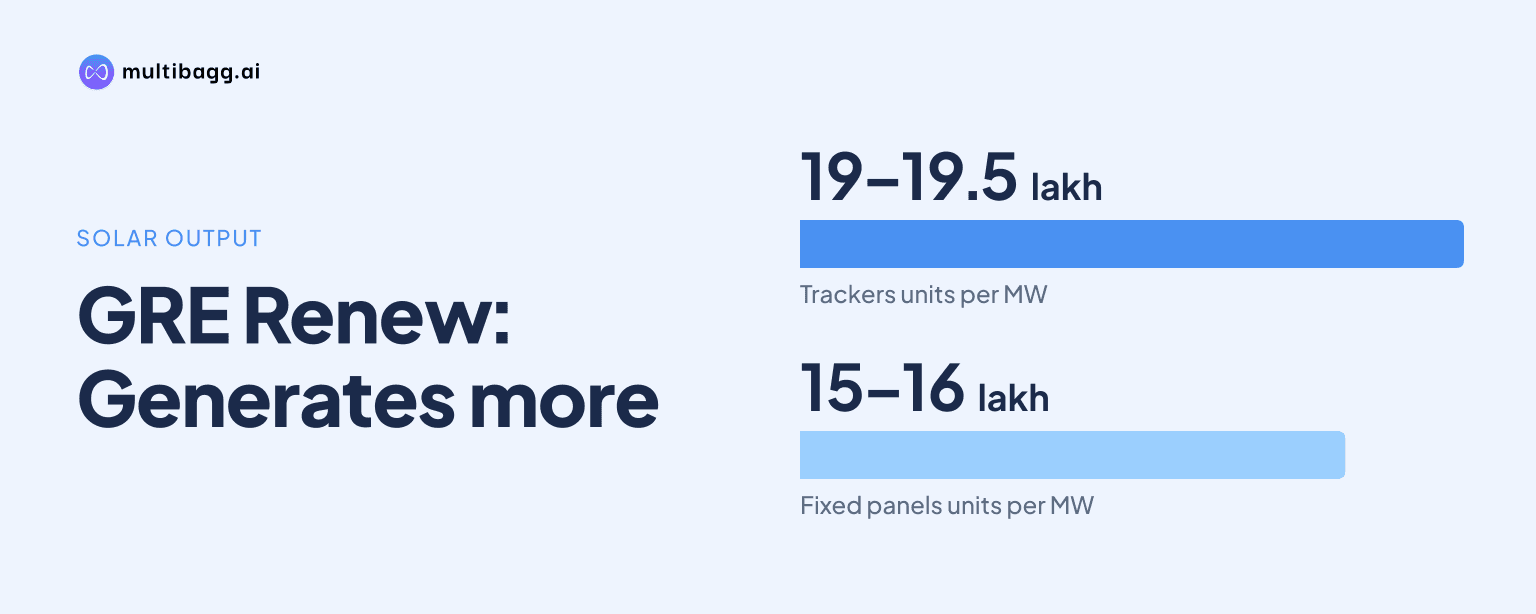
GRE Renew Enertech Limited said on November 13, 2026, that its tracker-equipped solar parks generate 19 lakh to 19.5 lakh units per megawatt (MW), compared with 15 lakh to 16 lakh units from fixed-panel ground mounts. Management said the claimed output difference supports its turnkey model for land, grid connectivity and operations.
Know GRE Renew Enertech inside out
Results, valuation, peers and who's buying, in one view.
How do GRE Renew tracker parks increase solar generation?
GRE Renew says its specialised tracker, introduced in 2022, starts with modules facing east in the morning and moves them from east to west with the sun. Management said this captures radiation beyond the period in which conventional fixed, south-facing ground-mounted panels produce their best output, which it described as roughly 11 AM to 3 PM depending on the season.
Management put tracker-based output at 19 lakh to 19.5 lakh units per MW, against 15 lakh to 16 lakh units per MW for a fixed-panel system. That implies a claimed difference of 3 lakh to 4.5 lakh units per MW. GRE Renew said the tracker raises capital expenditure by a small percentage, but did not provide the additional cost or independent generation data in the call.
GRE Renew also told callers that a customer seeking the output associated with a 1 MW conventional installation may need 750 kilowatts (kW) to 800 kW under its tracker arrangement. Management presented this as an illustration of lower capacity requirements and did not disclose project-specific calculations behind the comparison.
What is included in GRE Renew’s solar-park model?
GRE Renew’s park model packages land procurement or leasing, substation identification, licensing, land development and the connection route into a single offering for captive industrial customers. Management said a 10 MW project can require 30 acres to 35 acres, often involving leases of 27 years or 29 years with multiple farmers rather than one landowner.
GRE Renew said it develops shared amenities including site levelling, street lighting and borewell facilities before allocating capacity to individual customers. Its cited park clusters are generally 5 MW or 10 MW. For a customer taking 1 MW within a 10 MW cluster, management said its engineering team uses the previous year’s electricity-bill data to determine capacity allocation.
Grid access is another part of the package. Management said GRE Renew identifies the relevant substation, engages with distribution and generation departments, and lays the line after securing rights of way from landholders. It said government policy permits a connection distance of up to 5 kilometres, while cited projects may be 0.5 kilometre to 3 kilometres from the substation.
Got a follow-up? Ask IRIS
How does GRE Renew earn revenue after a project is built?
GRE Renew said engineering, procurement and commissioning revenue is the first income stream in customer-financed projects, while operation and maintenance creates a second stream for ground-mounted parks. Management said it operates and maintains these projects for 25 years after commissioning, with annual revenue escalation, although it did not disclose the escalation rate or current operation-and-maintenance revenue.
A third stream comes from managing power-purchase arrangements in the third-party model, where GRE Renew invests in a plant and sells power to an industrial user. Management said it began charging new customers Rs 0.20 to Rs 0.25 per unit for this service during FY27, with charges potentially falling to Rs 0.15 per unit for larger orders. It said it did not levy this charge for the preceding two to three years.
GRE Renew illustrated the third-party proposition using an industrial tariff of Rs 8 per unit and a discount of Rs 1 to Rs 1.5 per unit, before wheeling, banking, cross-subsidy and other charges. Management said a 500 kW ground-mounted pilot supplies Reliance Jio and a separate 300 kW project supplies Futaba, which it identified as a Maruti Industries subsidiary.
What do the tracker strategy and park model mean for GRE Renew’s results?
GRE Renew reported consolidated revenue from operations of Rs 139 crore in H1 FY27, compared with Rs 44 crore in H1 FY26, a year-on-year increase of about 217%. Earnings before interest, tax, depreciation and amortisation (EBITDA) rose to Rs 13 crore from Rs 6 crore, while the EBITDA margin declined to 9.52% from 13.01%.
Management attributed the margin movement to a large back-to-back engineering, procurement and commissioning contract for 50 MW alternating current (AC) and 65 MW direct current (DC). The project accounted for about 48% of H1 FY27 revenue and was executed at a lower margin to establish utility-scale solar execution credentials, according to management.
Profit after tax rose to Rs 9 crore in H1 FY27 from Rs 4 crore in H1 FY26, but the profit-after-tax margin declined to 6.56% from 9.13%. As of September 30, 2026, GRE Renew reported an order book of Rs 229 crore and a completed-and-ongoing portfolio of about 197 MW.
Conclusion
GRE Renew’s tracker claim is central to its solar-park proposition: management says higher generation per MW can be combined with land aggregation, substation connectivity and long-term operations support for industrial users. H1 FY27 revenue increased to Rs 139 crore from Rs 44 crore, while the 50 MW AC and 65 MW DC lower-margin contract contributed to declines in EBITDA and profit-after-tax margins.
The next disclosed milestones are commissioning of the 1 MW rooftop project at Rashtrapati Bhawan and completion of an ongoing approximately 10.5 MW independent power producer project in the coming months. Management said its independent power producer portfolio would then be roughly 25 MW to 26 MW, making commissioning progress, recurring power revenue and the realised economics of tracker-based parks the next disclosed items to watch.