










GRE Renew Enertech Limited expands IPP base to 15-16 MW
Key highlights
- GRE reported 15-16 MW of operating IPP projects in FY27 and 10-11 MW in capital work in progress.
- GRE’s 3 MW SECI rooftop portfolio has a disclosed tariff of Rs 5 per unit fixed for 25 years.
- GRE is executing a 1 MW rooftop solar project at Rashtrapati Bhawan, with commissioning expected in coming months.
- RESCO power-sales revenue was Rs 3.33 crore in H1 FY27, compared with Rs 129 crore from solar EPC.
powered by IRIS
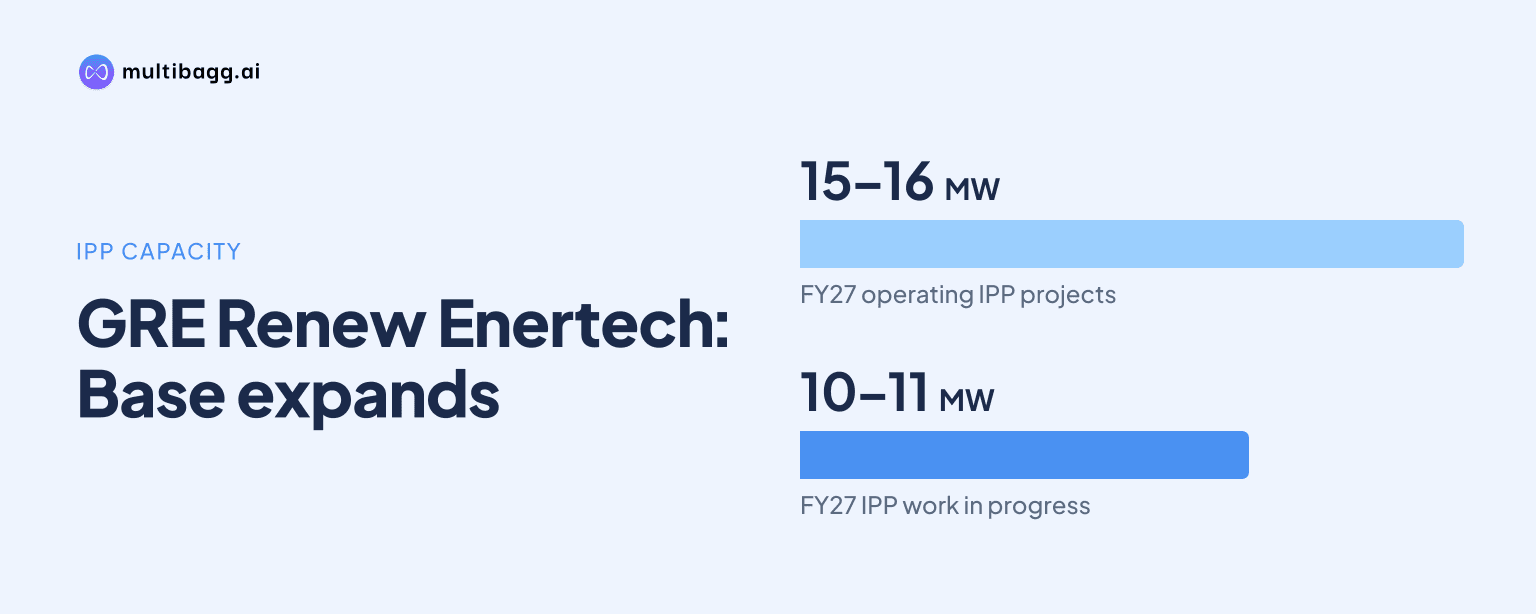
GRE Renew Enertech Limited said it has 15-16 megawatts (MW) of operating independent power producer (IPP) projects in FY27 and 10-11 MW in capital work in progress, supported by power-sale arrangements with SECI, Reliance Jio and Futaba and a 1 MW Rashtrapati Bhawan rooftop project under execution.
Know GRE Renew Enertech inside out
Results, valuation, peers and who's buying, in one view.
What does GRE’s IPP portfolio include?
GRE’s disclosed IPP portfolio includes a 3 MW rooftop portfolio awarded through the Solar Energy Corporation of India (SECI), a 500 kilowatt (kW) ground-mounted project supplying Reliance Jio, a 300 kW ground-mounted project supplying Futaba, and the 1 MW Rashtrapati Bhawan rooftop project. Management said the Rashtrapati Bhawan installation remained under progress and was expected to be commissioned in the coming months.
The 3 MW SECI portfolio is spread across government buildings in Jaipur, Ajmer, Jodhpur, Ahmedabad, Vastral and Gandhinagar Chiloda. GRE said the assets include installations of 500 kW and 400 kW at facilities associated with the Ministry of Home Affairs, Border Security Force, Central Industrial Security Force and Central Reserve Police Force. The company funded these rooftop installations and said their power purchase agreement (PPA) carries a Rs 5 per-unit tariff fixed for 25 years.
GRE described the Jio and Futaba projects as pilot third-party IPP arrangements, under which it continues to supply electricity rather than merely building a plant for the customer. The company said the Rashtrapati Bhawan asset is also intended to generate revenue for 25 years after commissioning. This differs from its engineering, procurement and commissioning (EPC) business, where the customer generally finances and owns the solar asset.
How does GRE earn revenue from IPP projects?
GRE earns IPP revenue by selling generated electricity from assets it funds, and power sales under its renewable energy service company (RESCO) model generated Rs 3.33 crore in H1 FY27. Solar EPC generated Rs 129 crore, or about 93% of consolidated revenue of Rs 139 crore, showing that EPC remained the larger business during the first half while owned assets added a separate recurring revenue stream.
Management described two ground-mounted routes for power sales: supplying electricity to the government system or to third-party industrial users. In an illustration, it said an industrial customer paying Rs 8 per unit could receive a Rs 1 to Rs 1.5 per-unit discount without funding a solar plant. Management also estimated wheeling, banking, cross-subsidy and other charges at about Rs 2.5 per unit in that example, rather than disclosing this as actual project economics.
GRE said it now charges new customers a PPA-management fee of 20 paise to 25 paise per unit, while a large order or group may be charged 15 paise per unit. It said this fee was not charged for two to three years before the current year. For captive solar-park clients, GRE also said it provides operations and maintenance for 25 years after commissioning, with annual escalation in that maintenance revenue.
Got a follow-up? Ask IRIS
How large is GRE’s operating and pipeline IPP base?
GRE said it has 15-16 MW of IPP projects operating in FY27 and capital work in progress of about 10-11 MW, which management described as its current working pipeline. The disclosure followed an investor’s reference to a 15.5 MW RESCO portfolio projected for FY27, compared with 3.8 MW in FY26. Management did not provide capacity targets for FY28 or FY29.
The company separately identified an ongoing IPP project of about 10.5 MW that it expects to commission in the coming months. Management had earlier described its IPP base as roughly 25-26 MW after ongoing projects are completed. It also referred to a two-project third-party installation funded with initial public offering proceeds, but cited its capacity uncertainly as “9.6 or 7 MW,” making that statement unsuitable for a precise portfolio calculation.
GRE’s approximately 197 MW completed and ongoing portfolio is broader than its IPP assets because it includes EPC work. Its solar-park model for captive users uses tracker technology, which management said produces about 19 lakh to 19.5 lakh units from a 1 MW installation, compared with about 15 lakh to 16 lakh units for a fixed-panel system. That comparison reflects management’s stated generation experience rather than a forecast for all projects.
How is GRE funding its IPP expansion?
GRE had used Rs 29.85 crore of Rs 39.56 crore in initial public offering proceeds by September 30, 2026, for the Himmat Nagar solar project supporting RESCO expansion. During H1 FY27, it also raised Rs 8.50 crore through unsecured loans, increased its cash-credit limit by Rs 5 crore, and secured a Rs 2.58 crore term loan specifically for the Rashtrapati Bhawan project.
The funding programme accompanied a rise in H1 FY27 consolidated revenue to Rs 139 crore from Rs 44 crore in H1 FY26, while profit after tax increased to Rs 9 crore from Rs 4 crore. However, management said a 50 MW alternating-current (AC) and 65 MW direct-current (DC) back-to-back EPC project represented about 48% of first-half revenue and reduced reported margins because GRE accepted the project at a lower margin to establish utility-scale credentials.
Management said the margin effect from the 50 MW AC and 65 MW DC project could continue until execution is completed in H2 FY27 and H1 FY28. GRE reported an order book of Rs 229 crore as of September 30, 2026, and management said it expected 70% to 80% of the EPC order book to convert in H2 FY27. Its stated priorities are working-capital management, execution efficiency, project-margin monitoring and careful capital deployment while expanding RESCO assets.
Conclusion
GRE’s disclosures show an effort to add contracted power-sales income alongside its larger EPC operation. The 3 MW SECI portfolio has a disclosed 25-year tariff of Rs 5 per unit, while the Jio and Futaba arrangements demonstrate third-party supply. Yet power sales of Rs 3.33 crore remained far below solar EPC revenue of Rs 129 crore in H1 FY27.
The next disclosures to watch are commissioning of the 1 MW Rashtrapati Bhawan project and the approximately 10.5 MW ongoing IPP project, both of which management expects in the coming months. Progress in moving the 10-11 MW of capital work in progress into operation, and the duration of margin pressure from the 50 MW AC and 65 MW DC EPC project through H1 FY28, will also indicate how the portfolio expansion is progressing.