










Manorama FY26 margin reached 27.1% after five-year rise
Key highlights
- Manorama's standalone EBITDA margin increased to 27.1% in FY26 from 14.0% in FY22.
- Manorama's standalone revenue rose to Rs 1,357.7 crore in FY26 from Rs 279.1 crore in FY22.
- Manorama reported standalone ROE of 40.3% and ROCE of 33.6% in FY26.
- Manorama's standalone net debt-to-equity ratio declined to 0.38 in FY26 from 0.83 in FY25.
powered by IRIS
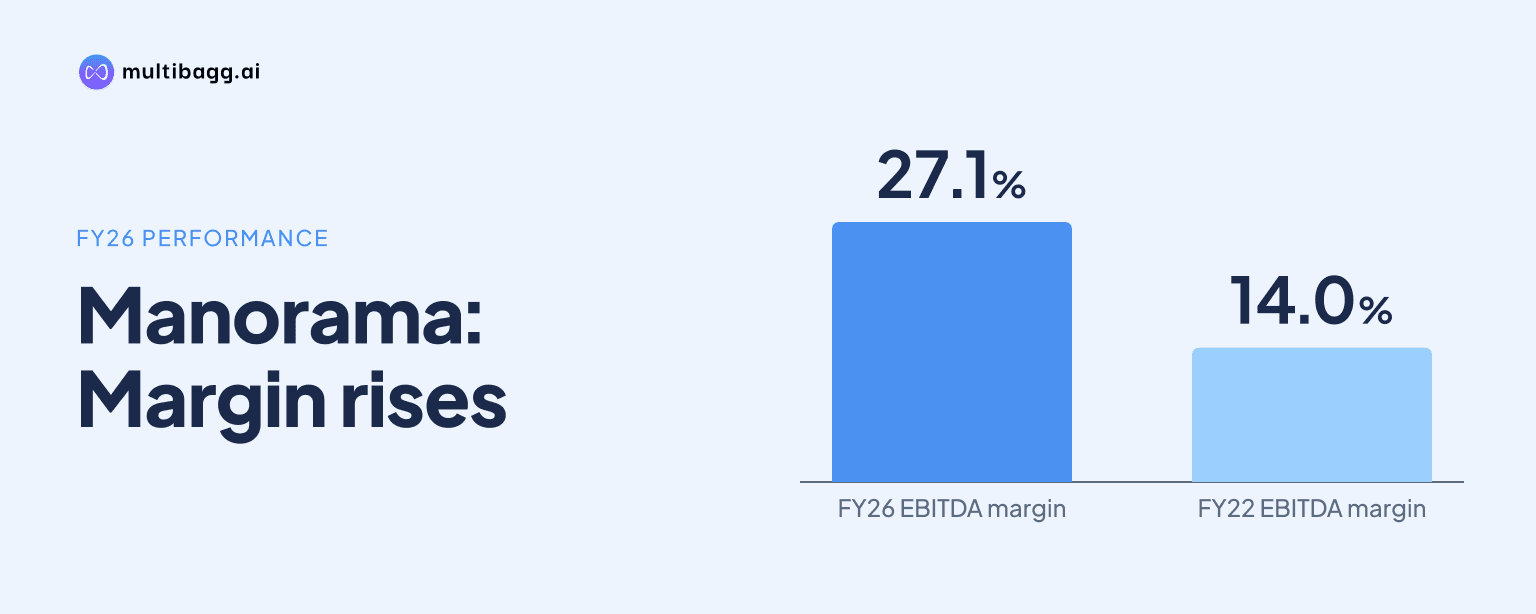
Manorama lifted its standalone earnings before interest, tax, depreciation and amortisation (EBITDA) margin to 27.1% in FY26 from 14.0% in FY22, as revenue rose to Rs 1,357.7 crore from Rs 279.1 crore. The FY26 outcome also included a 17.2% profit after tax margin, return on equity of 40.3% and net debt-to-equity of 0.38.
Know Manorama Industries inside out
Results, valuation, peers and who's buying, in one view.
How did Manorama's revenue and EBITDA change from FY22 to FY26?
Manorama's standalone revenue increased to Rs 1,357.7 crore in FY26 from Rs 279.1 crore in FY22, while EBITDA rose to Rs 367.7 crore from Rs 38.9 crore. The reported EBITDA margin consequently increased by 13.1 percentage points, from 14.0% to 27.1%, over the five fiscal-year series.
The increase was concentrated in the latter part of the period. Revenue rose from Rs 279.1 crore in FY22 to Rs 350.8 crore in FY23 and Rs 457.1 crore in FY24, before reaching Rs 770.8 crore in FY25 and Rs 1,357.7 crore in FY26. EBITDA similarly moved from Rs 38.9 crore to Rs 56.5 crore, Rs 73.5 crore, Rs 191.1 crore and Rs 367.7 crore across those years.
The margin progression was gradual through FY24 and accelerated thereafter. EBITDA margin was 16.1% in both FY23 and FY24, then rose by 8.7 percentage points to 24.8% in FY25 and a further 2.3 percentage points to 27.1% in FY26. The standalone annual data does not provide a product, customer or geography breakdown that assigns a specific cause to the FY22-to-FY26 change.
Did Manorama retain its higher margin in H1FY27?
Manorama reported a standalone EBITDA margin of 26.7% in H1FY27, 0.4 percentage points below its FY26 margin of 27.1% and 12.7 percentage points above FY22. H1FY27 standalone revenue was Rs 860 crore and EBITDA was Rs 229.4 crore, compared with Rs 1,357.7 crore and Rs 367.7 crore, respectively, for the full FY26 period.
Quarterly standalone data shows margins close to the FY26 annual level over the latest five reported quarters. Margin was 27.1% in Q2FY26 and Q3FY26, 26.9% in Q4FY26, 27.3% in Q1FY27 and 26.4% in Q2FY27. Revenue increased from Rs 323.3 crore in Q2FY26 to Rs 456.1 crore in Q2FY27, while EBITDA rose from Rs 87.7 crore to Rs 120.2 crore.
The latest sequential comparison showed a lower margin despite higher revenue. Q2FY27 standalone revenue of Rs 456.1 crore was above Rs 404 crore in Q1FY27, but EBITDA margin declined by 0.9 percentage points from 27.3% to 26.4%. Separately, Manorama said consolidated Q2FY27 revenue growth was supported by a stronger value-added product mix and increased utilisation of upgraded fractionation capacity.
How did Manorama's profit after tax change through FY26?
Manorama's standalone profit after tax (PAT) rose to Rs 233.2 crore in FY26 from Rs 24.2 crore in FY22, and PAT margin increased to 17.2% from 8.7%. That represented an 8.5-percentage-point increase in the reported share of revenue converted into PAT, alongside the 13.1-percentage-point EBITDA-margin increase.
PAT margin remained below 9% in the first three years shown, at 8.7% in FY22, 8.5% in FY23 and 8.8% in FY24. It then reached 14.5% in FY25 and 17.2% in FY26. Absolute PAT followed that sequence, increasing from Rs 29.8 crore in FY23 and Rs 40.1 crore in FY24 to Rs 112.1 crore in FY25.
Earnings per share rose to Rs 39 in FY26 from Rs 4 in FY22, with Rs 5 reported for FY23, Rs 7 for FY24 and Rs 19 for FY25. Manorama states that FY22 to FY24 earnings per share were adjusted to a face value of Rs 2 per share, making that adjustment relevant to comparisons with FY25 and FY26.
Got a follow-up? Ask IRIS
What happened to Manorama's returns and working capital?
Manorama's standalone return on equity (ROE) rose to 40.3% in FY26 from 10.5% in FY22, while return on capital employed (ROCE) increased to 33.6% from 10.4%. Manorama calculates ROE using average shareholders' equity, rather than only the equity balance at the end of each fiscal year.
The return measures accelerated after FY24. ROE moved from 11.7% in FY23 and 12.6% in FY24 to 28.1% in FY25 and 40.3% in FY26. ROCE was 12.5% in FY23, fell to 10.6% in FY24, and then rose to 19.8% in FY25 and 33.6% in FY26.
Working-capital days decreased to 125 in FY26 from 242 in FY22, a reduction of 117 days. The decline occurred alongside the increase in revenue, EBITDA margin, ROE and ROCE, although the presentation does not quantify the individual contribution of working capital to either return metric.
How did Manorama's debt position change by FY26?
Manorama's standalone net debt-to-equity ratio declined to 0.38 in FY26 from 0.83 in FY25. The FY26 ratio was also below 0.77 in FY24, but remained above the 0.21 reported in FY22, showing that the latest annual reduction did not return the ratio to the FY22 level.
The ratio rose from 0.17 in FY23 to 0.77 in FY24 and 0.83 in FY25 before its FY26 decline. This means the 0.45 reduction between FY25 and FY26 followed two years in which the ratio had increased sharply from the FY23 reading.
Manorama reported consolidated net debt-to-equity of 0.04 in H1FY27, compared with 0.38 in FY26 and 0.83 in FY25 in the consolidated key-metrics series. This is not a direct continuation of the standalone series. At 30 September 2026, consolidated cash, cash equivalents and other bank balances were Rs 469 crore, while consolidated borrowings were Rs 516.9 crore.
Conclusion
Manorama's standalone record from FY22 to FY26 shows revenue increasing from Rs 279.1 crore to Rs 1,357.7 crore as EBITDA margin rose from 14.0% to 27.1%. The same period included a PAT-margin increase from 8.7% to 17.2%, ROE of 40.3% and ROCE of 33.6% in FY26, while working-capital days declined to 125.
The next reported measures to watch are whether Manorama sustains margins near the 26.7% recorded in H1FY27 as it increases utilisation of upgraded fractionation capacity, and whether working capital moderates. Consolidated working-capital days were 233 in H1FY27 versus 123 in FY26, while consolidated inventories rose to Rs 1,001.2 crore at 30 September 2026 from Rs 727.8 crore at 31 March 2026.