










Manorama Gets 71.4% of FY26 Revenue From Stearin and CBE
Key highlights
- Stearin and CBE contributed 71.4% of Manorama’s FY26 revenue.
- Manorama reported consolidated FY26 revenue of Rs 1,366.7 crore and an EBITDA margin of 26.4%.
- Manorama reported an export-to-domestic mix of 61:39 in H1FY27.
- Manorama reported FY26 asset turnover of 7.4 times.
powered by IRIS
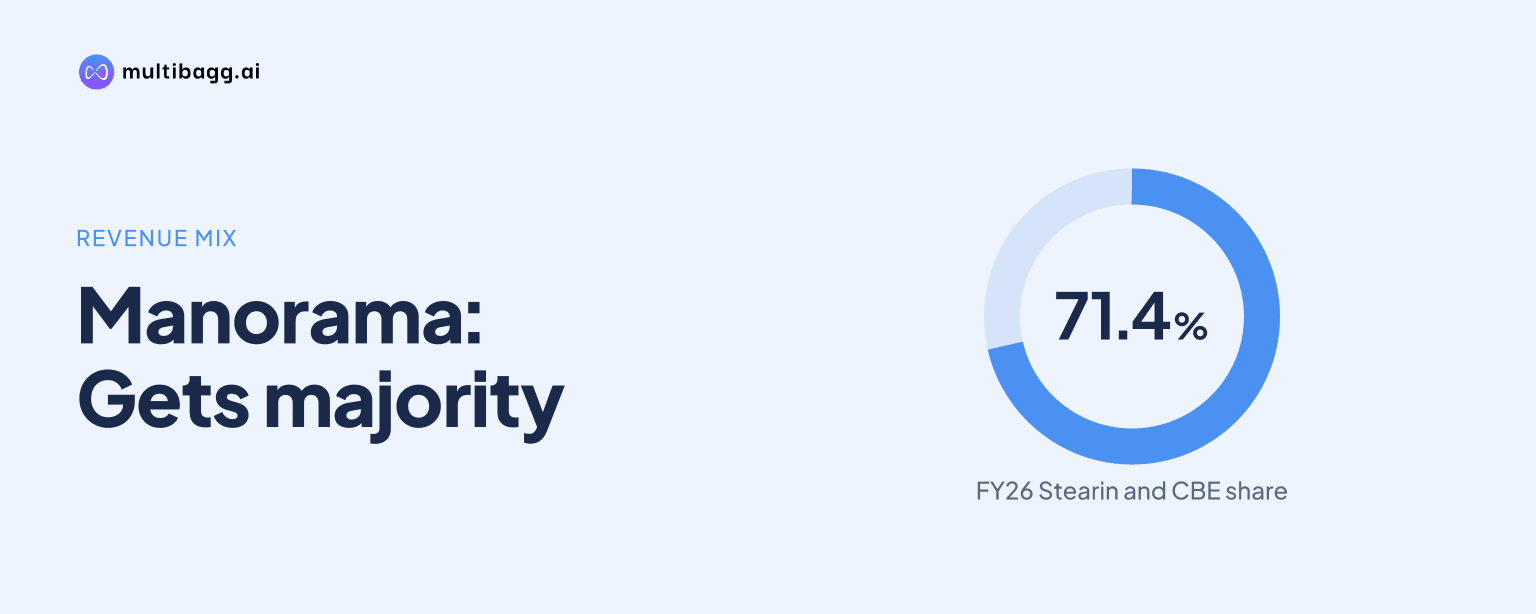
Manorama generated 71.4% of FY26 revenue from stearin and cocoa butter equivalents (CBE), linking its specialty-fats model to Indian collection of Sal and Mango seeds and procurement of Shea inputs from West Africa. Its integrated fractionation system produces ingredients for chocolate, confectionery and personal-care applications.
Know Manorama Industries inside out
Results, valuation, peers and who's buying, in one view.
What does Manorama source for its specialty-fats platform?
Manorama sources Sal, Mango and other exotic seeds across India, while procuring Shea nuts and Shea butter from West African countries. Its Indian collection network is described as tribal-community based, with village-level aggregation, linking tree-borne oilseeds to the processing chain. The presentation identifies this sourcing ecosystem as one of four engines behind a specialty-fats business built over nearly two decades.
The procurement model extends beyond Indian forest sourcing. Manorama states that its seed and butter supply chain draws from India, Africa and other countries, and specifically says it efficiently sources Shea nuts from West Africa. These inputs support its food and personal-care portfolio, including specialty fats, butters, stearin, olein and CBE rather than a single-oil product range.
The supplied presentation does not disclose that Manorama sells processing by-products as cattle feed. Its stated portfolio comprises stearin and olein fractions, MILCOAR CBE, and other specialty fats and butters. The disclosed core applications are chocolate, confectionery and personal care, so the presentation provides no cattle-feed revenue, volume or margin figure.
How does Manorama turn seeds and butter into CBE?
Manorama describes a fully integrated manufacturing ecosystem with fractionation capacity. Fractionation is the disclosed processing mechanism behind its stearin and olein fractions, while MILCOAR is identified as its CBE product line. The company groups these products with other specialty fats and butters used in chocolate, confectionery and personal-care formulations.
Manorama describes CBE as a trans-fat-free vegetable fat that is fully compatible with cocoa butter and has similar physical and chemical properties. The company says CBE can improve heat and melt stability in chocolate products, as well as shelf life and storage performance. It identifies India, Southeast Asia and the Middle East as tropical markets where those characteristics are relevant.
The company attributes FY26 asset turnover of 7.4 times to continuous capacity expansion and resulting operating leverage. This is not a disclosed capacity figure: Manorama does not provide fractionation capacity in tonnes, plant utilisation or plant locations in the supplied pages. The presentation nevertheless establishes that manufacturing is integrated with procurement rather than described as an outsourced step.
How important are stearin and CBE to Manorama revenue?
Stearin and CBE accounted for 71.4% of Manorama’s FY26 revenue, the largest product grouping explicitly quantified in the presentation. The balance, calculated at 28.6%, is not broken down by product, geography or end market. The disclosure therefore establishes the central role of stearin and CBE, but not separate sales for Shea butter, olein or personal-care fats.
Manorama reported consolidated FY26 revenue of Rs 1,366.7 crore and an export-to-domestic mix of 61:39 in H1FY27. These measures cover different reporting periods, so they cannot be used to calculate FY26 export revenue. They show that the company reported a sizeable FY26 revenue base and international sales exposure in the following half-year period.
Manorama also reports geographical presence in more than 39 countries. This figure indicates presence rather than the number of customers, factories or sourcing markets. The presentation connects that reach to specialty ingredients for food, confectionery and personal-care markets, without disclosing customer-level sales or country-wise revenue.
Got a follow-up? Ask IRIS
Why does Manorama cite certifications and customer relationships?
Manorama says certifications including FSSC 22000, ISO, RSPO and Fairtrade provide access to premium global food, confectionery and personal-care markets. The presentation does not specify the revenue covered by each certification or state that every product holds every certification. The disclosed point is the role of these standards in market access for its specialty-fats portfolio.
The company also cites long-standing relationships with Fortune 500 companies, supported by customised product development and stringent quality standards. It does not name the customers, disclose contract periods or report customer concentration. The source therefore supports the existence of this customer category and the stated relationship mechanisms, not a measure of sales dependence on individual clients.
Manorama identifies regulations in the European Union, India through FSSAI, and several other markets as an industry demand driver for CBE. It says manufacturers can use up to 5% CBE in a finished chocolate product while retaining the chocolate label. That permitted level does not indicate that every chocolate maker uses 5% CBE or guarantee demand for Manorama products.
What financial measures does Manorama report for its model?
For FY26, Manorama reported a consolidated earnings before interest, tax, depreciation and amortisation (EBITDA) margin of 26.4%, a profit after tax (PAT) margin of 16.5%, return on equity (ROE) of 39.4% and return on capital employed (ROCE) of 46.2%. It presents these measures alongside 7.4 times asset turnover, linking the latter to capacity expansion and operating leverage.
The presentation separately reports standalone compound annual growth rates (CAGR) for FY22 to FY26 of 48.5% for revenue, 75.3% for EBITDA and 76.2% for PAT. EBITDA and PAT grew faster than revenue over that period under the company’s standalone calculation. These figures should not be directly combined with consolidated FY26 revenue and margins because the reporting bases differ.
Manorama also says CARE Ratings upgraded its bank facilities from A to A+. The presentation does not give the date, facility amount or rating rationale. Separately, its standalone balance sheet shows total borrowings of Rs 516.6 crore at 30 September 2026, up from Rs 354.3 crore at 31 March 2026, while inventories increased to Rs 796.5 crore from Rs 710.4 crore.
Conclusion
Manorama’s disclosed model combines Indian aggregation of tree-borne seeds, Shea procurement from West Africa and integrated fractionation into specialty ingredients. Stearin and CBE supplying 71.4% of FY26 revenue connects the sourcing network and processing system directly to its reported product mix, while the disclosed portfolio serves chocolate, confectionery and personal-care applications.
The next point to watch is whether Manorama’s continuous capacity expansion continues to support the FY26 asset-turnover level of 7.4 times. The H1FY27 export-to-domestic mix of 61:39 is another disclosed measure to monitor, while product-level volumes, fractionation capacity, customer concentration and any cattle-feed sales channel remain undisclosed in the supplied presentation.