








Markolines targets Rs 1,000 crore revenue within three years

Find your next multibaggerBe a Pro Investor
Research stocks and track your picks on the go. Download the app.
Key highlights
- Markolines targets Rs 1,000 crore of revenue within three years, compared with FY26 revenue of Rs 348 crore.
- Markolines cited a close-to-Rs 800 crore unexecuted order book on November 19, 2026, versus Rs 624 crore reported on September 30.
- Markolines' active bidding pipeline was Rs 2,000 crore, and management said 20%-25% conversion could add Rs 400 crore to Rs 500 crore of orders.
- Q2 FY27 revenue rose 10.75% to Rs 86.02 crore and EBITDA increased 24.62% to Rs 11.34 crore.
powered by IRIS
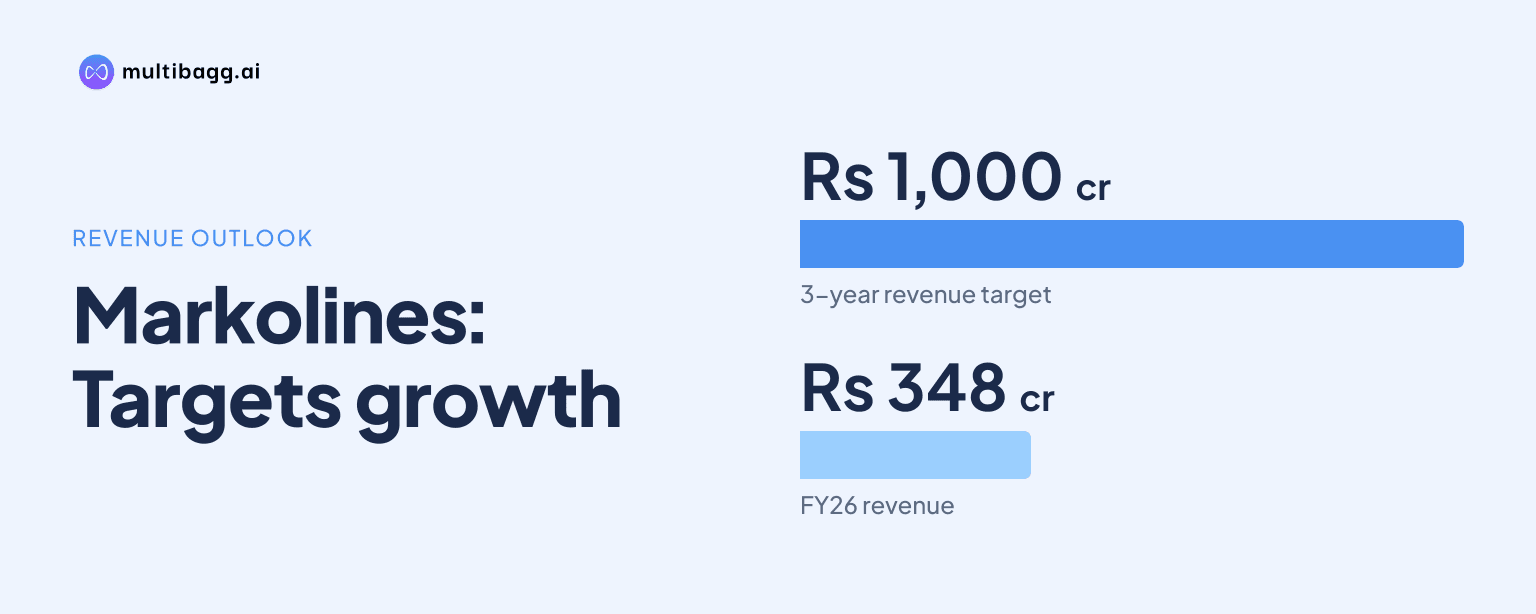
Markolines Pavement Technologies Limited is targeting Rs 1,000 crore of revenue within three years, management said on November 19, 2026, citing a nearly Rs 800 crore unexecuted order book, an active Rs 2,000 crore bidding pipeline and expansion into specialised construction and marine infrastructure. The target follows FY26 revenue of Rs 348 crore.
Know Markolines Pavement Technologies inside out
Results, valuation, peers and who's buying, in one view.
Can Markolines reach Rs 1,000 crore revenue in three years?
Markolines said its Rs 1,000 crore revenue ambition could be achieved in three years through its current growth path, bidding pipeline, proposed amalgamation and additional infrastructure opportunities. Management also said it expects annual growth of 25% to 30% over the next three years, while stressing that order selection from the pipeline depends on payment cycles, profitability and other project factors.
The base for that ambition was FY26 consolidated revenue from operations of Rs 348 crore, compared with Rs 307 crore in the preceding fiscal year. In the first half of FY27, revenue reached Rs 161 crore, up 7.64% year on year from Rs 150 crore, while profit after tax rose faster, by 18.15%, to Rs 9.31 crore from Rs 7.88 crore.
Management did not provide a year-by-year revenue bridge to Rs 1,000 crore or quantify the contribution expected from each new business. Its stated plan instead combines highway maintenance, higher specialised-construction activity, conversion of selected tenders, merger-related bidding capacity and work in adjacent infrastructure sectors such as marine and sports facilities.
What order book supports Markolines' revenue target?
Markolines said it had close to Rs 800 crore of unexecuted orders at the time of the November 19 call, after adding orders to the Rs 624 crore reported as of September 30, 2026. Management separately referred to Rs 625 crore as of September 20 and said subsequent additions had taken the book close to Rs 800 crore, without disclosing the value or dates of those additions.
The company described its Rs 2,000 crore bidding pipeline as a pool from which it will bid selectively rather than a committed order book. Management said a conservative 20% to 25% conversion of that pipeline would add about Rs 400 crore to Rs 500 crore of orders. That range is a management scenario, not order-inflow guidance, and the company did not disclose its historic bidding success ratio.
Execution timing differs by contract type. Major maintenance and repairs, or MMR, orders generally run for six to 12 months, according to management, while construction orders normally take 18 to 24 months. Management also said certain specialised construction contracts can be spread over three to four years, which means the order book is not expected to convert into revenue in a single reporting year.
Got a follow-up? Ask IRIS
Which businesses are expected to drive Markolines' growth?
Markolines expects specialised construction to account for a larger share of revenue over time, supported by a current order-book mix of 60% specialised construction and 40% major maintenance. For revenue through September, however, the mix was the reverse: specialised construction accounted for 35%, while maintenance generated 65%, indicating that the longer-duration specialised orders had not yet become the larger revenue contributor.
The specialised offering includes micro-surfacing, cold-in-place recycling, or CIPR, and full-depth reclamation, or FDR. Management linked the higher specialised-construction mix to Q2 profitability, saying it was one factor behind the increase in earnings before interest, tax, depreciation and amortisation, or EBITDA, margin to 13.18% from 12.10% in Q1 FY27.
Marine infrastructure is another part of the stated expansion plan. Markolines has received two projects in the Andaman and Nicobar Islands involving a bridge and road connection between two islands, management said. The company is also evaluating port construction and jetty development, but it did not disclose the value, execution schedule or expected revenue contribution of these marine opportunities.
The company also cited rehabilitation work at a facility in Andhra Pradesh as experience that could support future bids outside roads. Management said that work across new segments is intended to build eligibility for further tenders, rather than providing a quantified near-term sales forecast. In its core market, it said roads require overlay and maintenance every five to seven years under Indian Roads Congress and Ministry of Road Transport and Highways codes.
How is current performance tracking against Markolines' growth plan?
Markolines reported Q2 FY27 revenue of Rs 86.02 crore, up 10.75% from Rs 77.67 crore in Q2 FY26 and up 13.39% sequentially. Q2 EBITDA rose 24.62% to Rs 11.34 crore from Rs 9.10 crore, while profit after tax increased 21.21% to Rs 4.95 crore from Rs 4.08 crore.
The comparison shows profitability growing faster than revenue in both periods: H1 revenue increased 7.64%, EBITDA rose 16.87% and profit after tax increased 18.15%. Management attributed Q2 margin improvement to operational efficiency, project funding and payment-cycle characteristics, as well as a higher proportion of specialised construction work than MMR activity.
Markolines' proposed amalgamation with Markolines Infra is a further component of the plan. Management said it had obtained Securities and Exchange Board of India clearance and was responding to queries for submission to the National Company Law Tribunal. It expects completion before the end of FY27 or, at the latest, early in the next financial year, while noting that the process is subject to adjudication.
Conclusion
Markolines' three-year Rs 1,000 crore target rests on a larger available work pool than its FY26 revenue base of Rs 348 crore: close to Rs 800 crore of unexecuted orders, a Rs 2,000 crore pipeline and a planned shift toward specialised construction. Q2 FY27 results showed revenue growth of 10.75%, while EBITDA rose 24.62%, reflecting the segment mix and execution factors management identified.
The next items to watch are whether selected pipeline bids convert into the management's illustrative Rs 400 crore to Rs 500 crore range, how quickly the close-to-Rs 800 crore order book is executed, and the completion of the Markolines Infra merger. Management expects the merger by the end of FY27 or early in the following financial year and says it would improve eligibility for larger tenders.

