








Markolines Q2 EBITDA rises 24% as margin reaches 13.18%

Find your next multibaggerBe a Pro Investor
Research stocks and track your picks on the go. Download the app.
Key highlights
- Markolines reported Q2 FY27 EBITDA of Rs 11.34 crore, up 24% year on year.
- Markolines' Q2 FY27 EBITDA margin increased to 13.18% from 12.10% in Q1 FY27.
- Markolines' H1 FY27 PAT rose 18.15% to Rs 9.31 crore while revenue increased 7.64% to Rs 161 crore.
- Markolines said its unexecuted order book had risen close to Rs 800 crore by November 19, 2026.
powered by IRIS
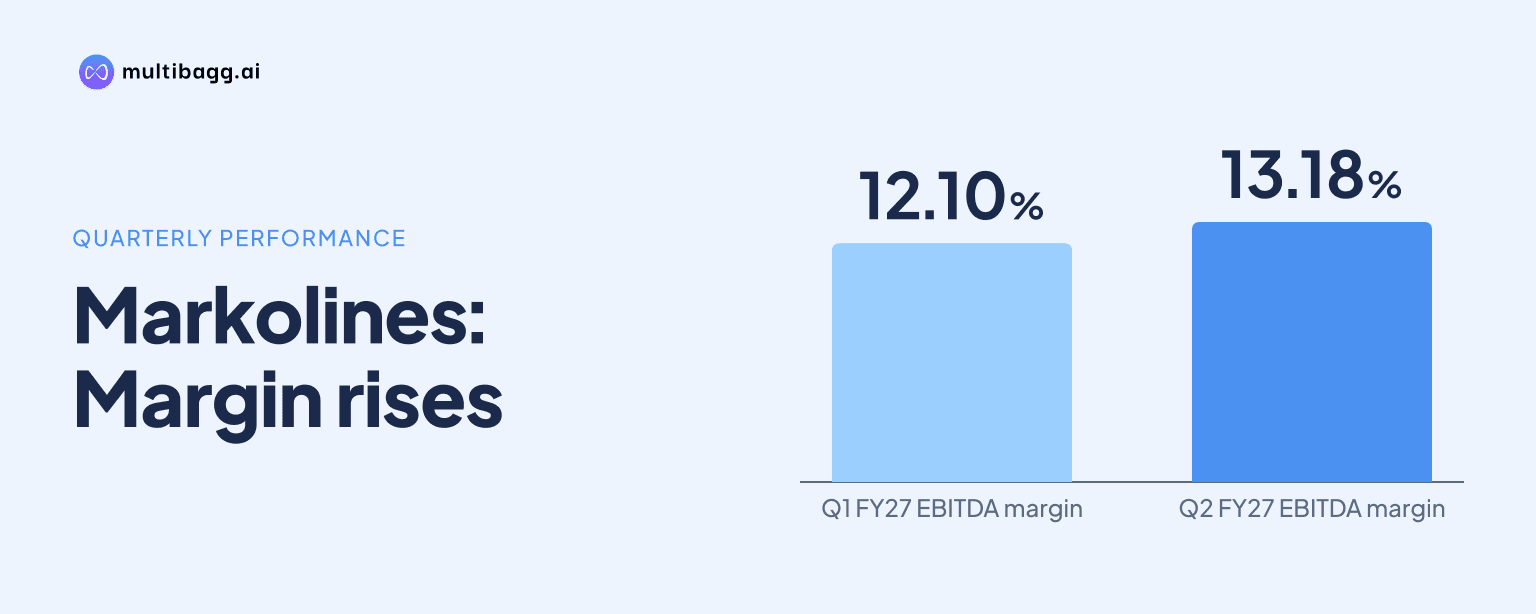
Markolines Pavement Technologies Limited reported a 24% year-on-year rise in Q2 FY27 EBITDA to Rs 11.34 crore, while EBITDA margin reached 13.18%, from 12.10% in Q1 FY27. Management attributed the margin expansion partly to a higher share of specialised construction activities relative to major maintenance and repair work.
Know Markolines Pavement Technologies inside out
Results, valuation, peers and who's buying, in one view.
How did Markolines perform in Q2 FY27?
Markolines increased revenue from operations by 10.75% year on year to Rs 86.02 crore in Q2 FY27, from Rs 77.67 crore in Q2 FY26, while EBITDA, or earnings before interest, tax, depreciation and amortisation, rose faster at 24% to Rs 11.34 crore from Rs 9.10 crore. The difference between revenue and EBITDA growth was the central feature of the quarter.
Profit after tax, or PAT, increased 21.21% to Rs 4.95 crore from Rs 4.08 crore a year earlier, and basic earnings per share rose to Rs 2.23 from Rs 1.70. Sequentially, revenue increased 13.39%, EBITDA rose 25.53%, and PAT grew 13.53%, according to management on the November 19, 2026 earnings call.
The EBITDA margin was 13.18% in Q2 FY27, compared with 11.72% in Q2 FY26 and 12.10% in Q1 FY27. That represents a 1.46-percentage-point increase from the year-earlier quarter and a 1.08-percentage-point sequential increase, showing that operating profit improved more quickly than the 10.75% revenue increase.
Why did Markolines' EBITDA margin expand?
Management said Q2 FY27's additional EBITDA came particularly from a higher percentage of specialised construction work over major maintenance and repair, or MMR, activities. It also cited project-level operational efficiency, machinery deployment, capital employed and payment cycles as factors that can affect EBITDA across contracts.
The mix was already changing by September 2026: specialised construction represented 35% of revenue and maintenance represented 65%. In the unexecuted order book, however, specialised construction accounted for 60% and major maintenance for 40%, indicating that the backlog had a greater specialised-construction share than revenue recognised through September.
Management did not provide a formal margin target or say that 13.18% would be maintained in subsequent quarters. It said tender pricing seeks to secure a fixed bottom line, but also noted that EBITDA can vary by project because work requires different levels of machinery, funding deployment and payment-cycle management.
Got a follow-up? Ask IRIS
What does the first-half performance show?
Markolines reported H1 FY27 revenue of Rs 161 crore, up 7.64% from Rs 150 crore in H1 FY26, while EBITDA rose 16.87% to Rs 20.51 crore from Rs 17.55 crore. Thus, EBITDA growth exceeded revenue growth by 9.23 percentage points in the first half, extending the Q2 pattern.
H1 FY27 PAT reached Rs 9.31 crore, compared with Rs 7.88 crore in H1 FY26, a 18.15% increase, while earnings per share increased to Rs 4.19 from Rs 3.42. The first-half profit increase was more than twice the 7.64% revenue growth rate, although management did not separate the contribution of each business vertical to H1 profit.
For context, Markolines reported consolidated revenue from operations of Rs 348 crore in FY26, compared with Rs 307 crore in FY25. Management linked its longer-term opportunity to a road-maintenance market in which it said India spends about 15% on maintenance, versus an international benchmark of about 40%, but it did not quantify the addressable market or forecast industry spending.
What backlog and execution mix could influence future margins?
Markolines said its unexecuted order book was Rs 624 crore as of September 30, 2026, and had risen to close to Rs 800 crore by the November 19 call after additional orders. It also described an active bidding pipeline of about Rs 2,000 crore, from which management said a conservative 20% to 25% conversion could add roughly Rs 400 crore to Rs 500 crore of orders.
The execution periods differ by activity: MMR orders generally run for six to 12 months, while construction orders are generally completed in 18 to 24 months. This distinction matters because the order book's 60% specialised-construction share may be executed over a longer period than short-duration maintenance work, rather than translating immediately into revenue.
Management said it was targeting 25% to 30% year-on-year growth over the next three years and aimed to build a Rs 1,000 crore business within three years. Its stated priorities include enlarging the order book selectively based on payment cycles and profitability, expanding specialised construction, and building adjacent capabilities in marine and sports infrastructure.
Conclusion
Markolines' Q2 FY27 result showed operating profit outpacing revenue: EBITDA rose 24% to Rs 11.34 crore on revenue growth of 10.75%, while the margin reached 13.18%. Management connected the improvement to specialised construction work and execution factors, and the 60% specialised-construction share in the order book suggests that business mix remains central to the earnings profile.
The next items to watch are conversion of the Rs 2,000 crore bidding pipeline, execution of an order book management put close to Rs 800 crore in November 2026, and the proposed merger of Markolines Infra with Markolines. Management said Securities and Exchange Board of India clearance had been received and expected completion before the end of the current financial year or early in the following financial year, subject to the National Company Law Tribunal process.

