










Marushika H1 revenue rises 72% as PAT increases 126%
Key highlights
- Marushika reported H1 FY27 revenue of Rs 83.46 crore, up 71.59% year on year.
- Marushika’s H1 FY27 PAT rose 126.29% to Rs 7.04 crore from Rs 3.11 crore.
- The Rs 31.19 crore Delhi Metro Phase 4 communications project was 85% complete on November 4, 2026.
- Marushika’s Rs 30 crore NASEC KUM smart-parking mandate is scheduled to run through July 2027.
powered by IRIS
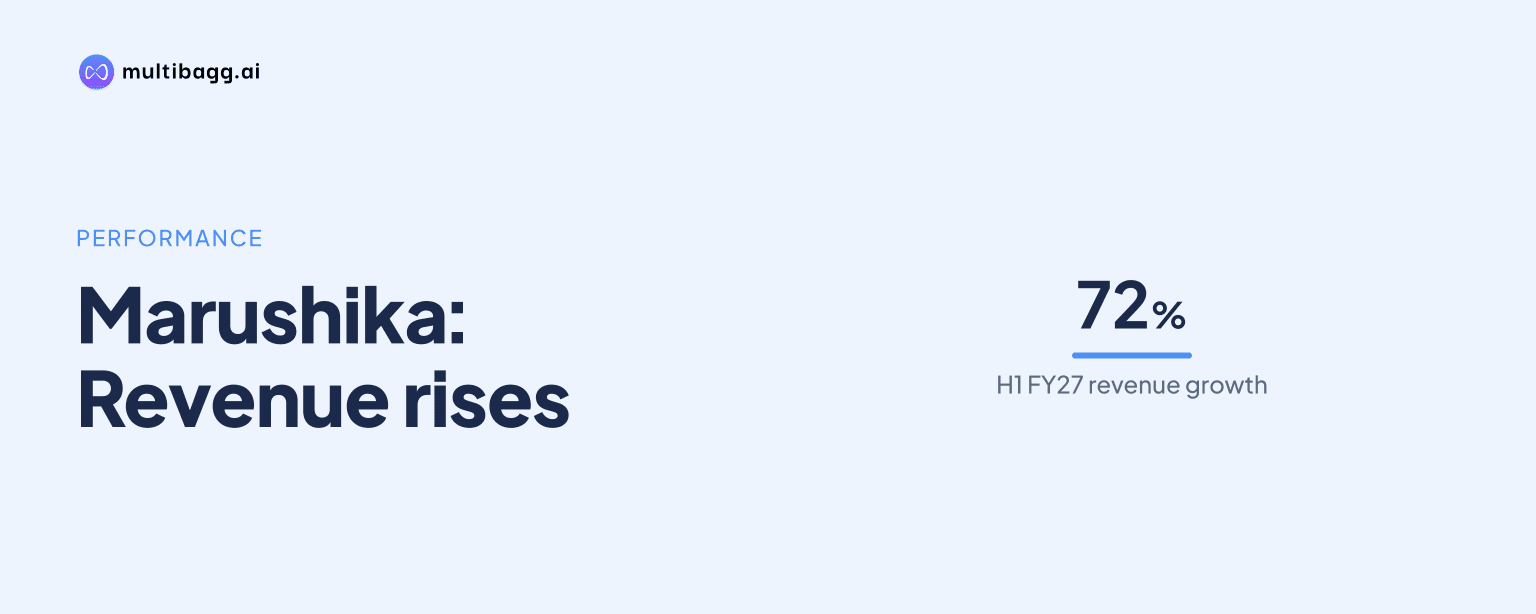
Marushika Technology Limited reported H1 FY27 revenue from operations of Rs 83.46 crore, up 71.59% from H1 FY26, while profit after tax rose 126.29% to Rs 7.04 crore for the half year ended September 30, 2026. Management linked the faster profit growth to larger project execution and direct bidding for government projects.
Know Marushika Technology inside out
Results, valuation, peers and who's buying, in one view.
How did Marushika perform in H1 FY27?
Marushika reported faster growth in profit than revenue during H1 FY27. Revenue from operations increased by Rs 34.82 crore to Rs 83.46 crore from Rs 48.64 crore in H1 FY26, while profit after tax, or PAT, rose by Rs 3.93 crore to Rs 7.04 crore from Rs 3.11 crore.
Earnings before interest, tax, depreciation and amortisation, or EBITDA, reached Rs 10.25 crore in H1 FY27, according to management, representing growth of 80.02%. Management said EBITDA margin expanded by 12.29% and PAT margin expanded by 8.44%, while attributing the improvement to execution of larger-volume projects.
The principal financial change was that PAT grew 54.70 percentage points faster than revenue, based on the reported 126.29% and 71.59% growth rates. Management said it was targeting bigger projects and bidding directly with government entities, but it did not disclose the revenue share, contract count or margin contribution from direct government work.
Which projects are supporting Marushika’s execution?
Marushika said its Rs 31.19 crore Delhi Metro Phase 4 communications project was 85% complete on the November 4, 2026 earnings call. The company described the contract as moving rapidly toward completion, although it did not provide a planned completion date or state how much H1 FY27 revenue it had recognised from the project.
The company also said it had completed and delivered the Rs 24.83 crore RailCloud data-centre hardware contract. The contrast with the Delhi Metro project is clear: RailCloud was stated to be 100% delivered, while the larger Delhi Metro communications contract remained under execution at 85%.
Marushika additionally disclosed a Rs 30 crore smart-parking mandate from NASEC KUM with consortium partners, scheduled to run through July 2027. It also cited a Rs 2.50 crore National Highways Authority of India, or NHAI, order for a centralised control and monitoring system for streetlights, with management saying it expected repeat NHAI orders.
Why is Marushika pursuing direct government projects?
Marushika said it is pursuing bigger contracts and direct bids with government bodies, which management cited in explaining the H1 FY27 increase in profitability. The company linked this approach to the reported 8.44% PAT-margin expansion, but did not offer a comparison between the economics of direct contracts, consortium work and other customer engagements.
The company described itself as operating across more than 17 Indian states, with more than 150 projects delivered over more than 15 years. Its IT and telecom infrastructure business, covering data centres, cybersecurity networks, server systems and IPBX solutions, represented 99.27% of consolidated vertical revenue mix in the call presentation.
Marushika named the Parliament of India, Ministry of Home Affairs, Indian Army, Navy, Air Force, Tata and LSTOM among its customer relationships. It also identified Rittal, Matrix, Delta, LG and Barco as original equipment manufacturer, or OEM, partners, saying these relationships support the integration of technology layers for government, public-sector and large system-integrator customers.
Got a follow-up? Ask IRIS
What growth plans has Marushika disclosed?
Marushika’s stated plan includes using third-party service providers for specialist capabilities while limiting internal fixed overheads, expanding OEM relationships and extending its network footprint across India. Management also identified cloud-first technology, including multi-cloud and serverless computing, as part of its approach to infrastructure delivery.
The company said it had signed a strategic partnership with Senar for an artificial intelligence-led robotic rehabilitation and healthcare product, which it planned to bring to market during the year. Management also said artificial intelligence and cybersecurity adoption could complement Marushika’s infrastructure business because both require underlying IT systems.
Marushika has launched four cloud-native software-as-a-service, or SaaS, learning-management platforms for regulated institutions. Medilect is intended for medical education; LuminAID is intended for applications including police training and census tracking; and Finilect and Unilect are intended for banking, non-banking financial companies and universities.
Management characterised the SaaS platforms as a potential high-margin addition and said it hoped they would become part of the business soon. However, the call provided no revenue contribution, customer numbers, contracted deployment dates or financial targets for Medilect, LuminAID, Finilect or Unilect.
How has Marushika’s capital base changed?
Marushika reported total equity of Rs 54.33 crore in H1 FY27, compared with Rs 47.29 crore at the end of the prior year. That was an increase of Rs 7.04 crore, equal in numerical value to the H1 FY27 PAT figure, although management did not state that the reported profit was the cause of the equity increase.
Management said Marushika listed on the NSE SME platform in 2026 and described the listing as providing public-market scale and corporate transparency for its next stage of growth. It also cited consolidated return on investment and return on equity of 52.77%, and return on capital employed of 26.88%, without giving prior-period comparisons.
The balance-sheet update accompanied a business mix led by IT and telecom infrastructure at 99.27% of consolidated vertical revenue. Smart-city activity, including the Rs 2.50 crore NHAI streetlight order, and newer auto-tech and defence activity were discussed, but Marushika did not provide separate H1 FY27 revenue or profit figures for those areas.
Conclusion
Marushika’s H1 FY27 performance combined 71.59% revenue growth with a 126.29% rise in PAT, showing profit increasing faster than sales during the September 2026 half year. Management associated that outcome with execution of larger infrastructure projects and a shift toward directly bidding for government work, while IT and telecom infrastructure remained 99.27% of vertical revenue.
The next disclosed milestones are completion of the Rs 31.19 crore Delhi Metro Phase 4 communications project, which was 85% complete, and execution of the Rs 30 crore NASEC KUM smart-parking mandate through July 2027. Management’s plans for the Senar partnership and four SaaS platforms remain unresolved financially because the call gave no revenue targets, customer metrics or deployment timetable for those initiatives.