










Parth Electricals targets 10-11% PAT margin through mix
Key highlights
- H1 FY27 revenue from operations rose 42% to Rs 114.19 crore, while PAT increased 49.2% to Rs 9.10 crore.
- Management targets a 10% to 11% PAT margin over the next two to three years, with roughly 100 basis points of annual improvement.
- Subcontracting expense increased to Rs 11.94 crore in H1 FY27 from Rs 2.61 crore as EPC and service revenue expanded.
- Parth Electricals has a Rs 47.60 crore Reliance Jio data-centre order and expects at least 10% PAT from it.
powered by IRIS
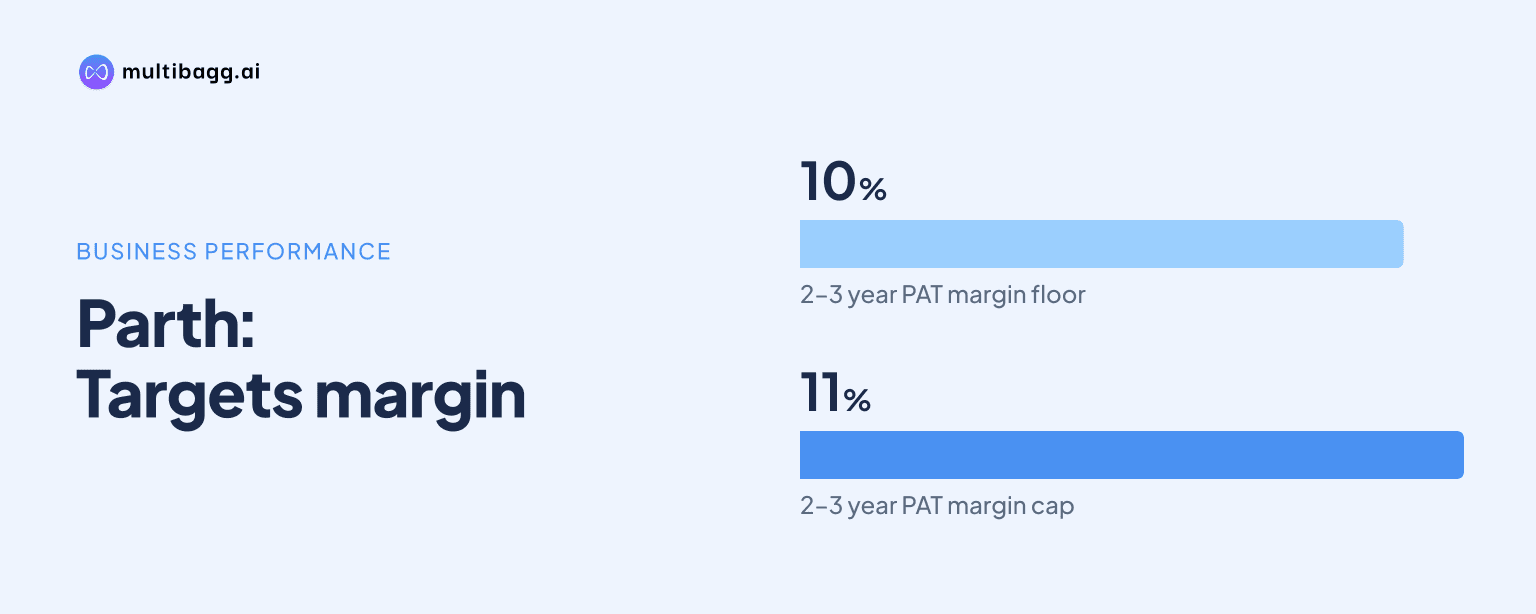
Parth Electricals & Engineering Limited is targeting a 10% to 11% profit-after-tax margin over the next two to three years through more proprietary products, exports, consultancy and direct business, after H1 FY27 revenue rose 42% to Rs 114.19 crore and profit after tax rose 49.2% to Rs 9.10 crore.
Know Parth Electricals & Engineering inside out
Results, valuation, peers and who's buying, in one view.
How will Parth Electricals change its revenue mix?
Parth Electricals plans to make manufacturing and technology-driven products the main part of its mix, while restricting engineering, procurement and construction, or EPC, work to projects that help sell its own equipment. Management said it accepted some EPC orders because they included ring main units, or RMUs, and compact substations, which could otherwise face tight pricing from EPC contractors. Those projects increased subcontracting costs, but management expects product revenue to take a larger share after current orders are executed.
Management said the transition should be visible after the existing EPC orders, which are expected to be executed over the next 12 months. Parth Electricals will still consider value-added EPC projects, particularly gas insulated switchgear, or GIS, substations, where its equipment can be included. The company has started a 66 kilovolt, or kV, to 11 kV GIS substation project for Kandla Port, and management said technology-led EPC projects should target more than 10% PAT.
Management’s medium-term objective is 30% to 40% compound annual revenue growth, with PAT margin improving by about 100 basis points each year until it reaches 10% to 11%. It said the mix could potentially support a 12% PAT margin if advanced products and specialised services gain share, but described 10% as its conservative minimum focus. This is management’s target rather than a reported financial result.
What does H1 FY27 show about margins and costs?
H1 FY27 showed higher revenue and profit, but earnings before interest, tax, depreciation and amortisation, or EBITDA, margin was unchanged at 12.78%. Revenue from operations increased 42% to Rs 114.19 crore, while total income increased 43.5% to Rs 116.40 crore. EBITDA rose 42.4% to Rs 14.88 crore and PAT increased 49.2% to Rs 9.10 crore, meaning profit grew faster than revenue during the half year.
Gross margin improved by 444 basis points to 33.25%, which management attributed to a better business mix and lower material cost as a share of income. Employee cost was broadly flat at Rs 6.97 crore, while other expenses rose to Rs 16.84 crore from Rs 5.79 crore. The main driver was subcontracting expense, which increased to Rs 11.94 crore from Rs 2.61 crore as service and EPC revenue rose, offsetting much of the gross-margin benefit.
Operating cash flow was negative Rs 6.45 crore in H1 FY27 after Rs 16.67 crore went into working capital. Management said it built inventory in September for a large data-centre project intended for faster execution in October and November. Its stated priority for the remaining half is to execute the order book, protect margins and convert working capital into cash.
Got a follow-up? Ask IRIS
Which products and markets are expected to lift Parth Electricals margins?
Parth Electricals expects its own 33 kV GIS and 33 kV RMU products to increase value addition in projects that currently require externally sourced medium-voltage, or MV, equipment. Development work for the products was complete and final type testing was under way during the call. Management said the Karachiya, Vadodara facility was due to be inaugurated by the end of November 2026, after which it planned to bid more actively for utility and industrial tenders.
The first trial export order for the new 33 kV RMU was for a green-hydrogen facility in South Korea, with delivery expected in November. In the United States, management said its earlier project closed at a 6% to 7% PAT margin. It expects future US projects to deliver 12% to 15% PAT as it gains pricing knowledge and sells more advanced products, including intelligent motor control centres and MV switchgear.
Data centres are another intended outlet for proprietary MV and low-voltage equipment. Parth Electricals has a Rs 47.60 crore Reliance Jio data-centre order after a Rs 1.60 crore amendment, and management expects at least 10% PAT from that project. For an 80-megawatt data centre, it estimated the MV block at about Rs 50 crore and the broader addressable electrical supply opportunity at Rs 150 crore, including low-voltage switchgear and potential GIS products.
How should direct customers and consultancy affect working capital?
Parth Electricals intends to prioritise business-to-business, or B2B, and direct industrial customers because management said these customers commonly provide advances and pay within 30 days. By contrast, utility and public-sector projects can require upfront investment, high-security bank guarantees and a longer cycle through installation and handover. Management said utilities may release 70% to 80% of supply value within 30 to 45 days, but the overall project cycle still extends cash conversion.
The proposed acquisition of 100% of Takalkar Power Engineers & Consultants Private Limited is intended to add engineering design and advisory capability for transmission and distribution networks from 11 kV to 765 kV. Management expects the consultancy business to strengthen design capability, support international expansion and add a specialised service component to the product mix. The transaction remained in process, with no completion date, purchase price or financial contribution disclosed during the call.
Funding plans currently rely on internal accruals and bank facilities rather than an immediate capital raise. Parth Electricals said Rs 19.77 crore of capital expenditure in H1 FY27 took cumulative spending on GIS Karachiya and Khordha, Odisha to Rs 28.43 crore. Management also said ICICI Bank had sanctioned Rs 50 crore of additional facilities, while further Canara Bank limits were expected to be renewed without extra collateral.
Conclusion
Parth Electricals’ margin plan depends on reducing the share of subcontract-heavy EPC activity and increasing the share of self-manufactured GIS, RMUs, air insulated switchgear and low-voltage equipment. Exports, direct industrial customers and the proposed consultancy acquisition are intended to support that shift. H1 FY27 showed 42% revenue growth to Rs 114.19 crore and a 444-basis-point gross-margin improvement, but also Rs 11.94 crore of subcontracting expense and negative operating cash flow of Rs 6.45 crore.
The next milestones are the Karachiya inauguration by the end of November 2026, completion of type testing for 33 kV GIS and RMUs, execution of the Rs 47.60 crore data-centre order, and the Odisha facility joining operations toward the close of FY27. The unresolved matters are whether the Takalkar acquisition closes and whether working capital converts into positive cash flow by the financial year-end, as management expects.