










Parth Electricals’ H1 FY27 gross margin rose 444 bps, EBITDA flat
Key highlights
- Parth Electricals’ H1 FY27 gross margin increased 444 basis points to 33.25%.
- Materials declined to 66.8% of total income in H1 FY27 from 71.2% in H1 FY26.
- Subcontracting costs rose to ₹11.94 crore from ₹2.61 crore, while EBITDA margin was 12.78%.
- Parth Electricals’ PAT increased 49.2% to ₹9.10 crore in H1 FY27.
powered by IRIS
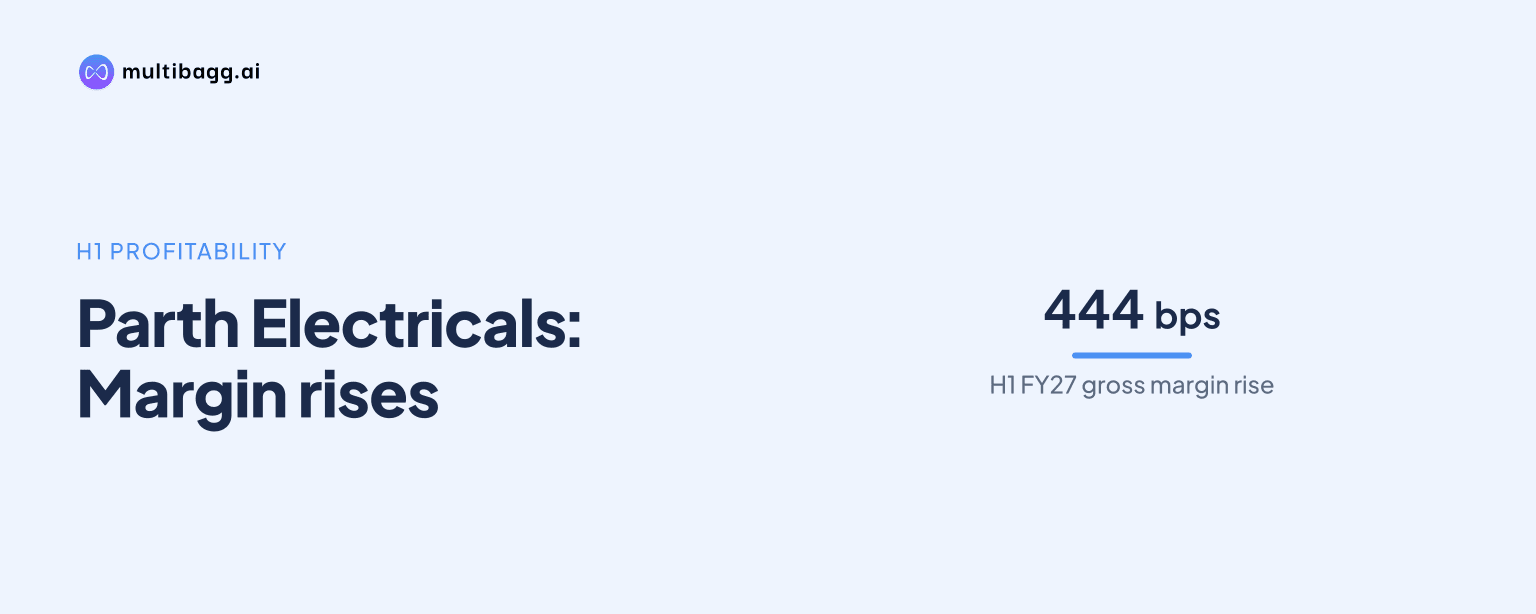
Parth Electricals & Engineering Ltd. increased gross profit margin by 444 basis points to 33.25% in the first half of fiscal year 2027 (H1 FY27), as materials declined to 66.8% of total income from 71.2%; however, ₹11.94 crore of subcontracting costs left EBITDA margin at 12.78%, 10 basis points below H1 FY26.
Know Parth Electricals & Engineering inside out
Results, valuation, peers and who's buying, in one view.
Why did Parth Electricals’ gross margin rise in H1 FY27?
Parth Electricals’ gross margin rose because cost of materials grew more slowly than income as the mix shifted towards services and engineering, procurement and construction (EPC) work. Revenue from operations increased 42.0% year on year to ₹114.19 crore in H1 FY27, while total income rose 43.5% to ₹116.40 crore from ₹81.11 crore. Material cost, including inventory changes, increased 34.6% to ₹77.70 crore from ₹57.74 crore.
Gross profit consequently increased 65.6% to ₹38.70 crore from ₹23.37 crore, and the margin reached 33.25% from 28.81%. The presentation attributes the lower material intensity to the services-and-EPC mix, with materials representing 66.8% of total income in H1 FY27 compared with 71.2% in H1 FY26. That change reduced the material-cost ratio by 440 basis points, while gross margin rose 444 basis points.
The income and cost movements explain the wider gross-profit spread. Total income increased by ₹35.29 crore, while materials increased by ₹19.96 crore, resulting in a ₹15.33 crore increase in gross profit. The presentation does not disclose separate services or EPC revenue, but specifically identifies their mix shift as the reason for the reduced materials share.
How did subcontracting keep Parth Electricals’ EBITDA margin flat?
Subcontracting absorbed much of Parth Electricals’ gross-margin expansion, rising to ₹11.94 crore in H1 FY27 from ₹2.61 crore in H1 FY26. Other expenses increased 191% to ₹16.84 crore from ₹5.79 crore and represented 14.5% of total income, compared with 7.1% a year earlier. Subcontracting alone rose to 10.3% of total income from 3.2%.
Earnings before interest, tax, depreciation and amortisation (EBITDA), including other income, still increased 42.4% to ₹14.88 crore from ₹10.45 crore. Its margin, however, declined 10 basis points to 12.78% from 12.88%, rather than following the 444-basis-point gain in gross margin. The presentation says higher subcontracting expenses kept EBITDA margin near-flat.
Employee-benefit expense moved in the opposite direction, declining 2.2% to ₹6.97 crore from ₹7.13 crore despite the ₹35.29 crore increase in total income. Employee cost therefore fell to 6.0% of total income from 8.8%, which the presentation describes as operating leverage on people cost. The ₹11.94 crore subcontracting cost was nevertheless higher than the employee-benefit expense.
Other income also supported reported EBITDA. It rose to ₹2.21 crore from ₹0.71 crore, including ₹1.20 crore of export incentives and ₹0.92 crore of interest income. The export incentives included Duty Drawback and Remission of Duties and Taxes on Exported Products (RoDTEP), and the ₹1.50 crore year-on-year increase in other income is included in Parth Electricals’ EBITDA measure.
Got a follow-up? Ask IRIS
What did the margin outcome mean for Parth Electricals’ profit after tax?
Parth Electricals increased profit after tax (PAT) by 49.2% to ₹9.10 crore in H1 FY27 from ₹6.10 crore a year earlier. Profit before tax rose 46.4% to ₹12.05 crore from ₹8.23 crore, while PAT margin increased 30 basis points to 7.82% from 7.52%. Net-profit margin therefore improved despite the 10-basis-point decline in EBITDA margin.
Finance cost increased 32.6% to ₹1.51 crore from ₹1.14 crore, while depreciation and amortisation rose 22.2% to ₹1.32 crore from ₹1.08 crore. Tax, comprising current and deferred tax, increased 38.5% to ₹2.95 crore from ₹2.13 crore. These items reduced ₹14.88 crore of EBITDA to ₹9.10 crore of PAT.
The profit bridge shows where the gross-profit gain was absorbed. Gross profit increased by ₹15.33 crore, EBITDA increased by ₹4.43 crore, profit before tax increased by ₹3.82 crore and PAT increased by ₹3.00 crore. The ₹11.05 crore increase in other expenses was the main difference between gross-profit growth and EBITDA growth.
What is Parth Electricals’ H2 FY27 margin and capacity focus?
Parth Electricals’ stated focus for the second half of FY27 is to collect receivables into cash, strengthen operating cash flow and commission ₹21.55 crore of capital work in progress (CWIP) into revenue. Management also identified high-margin segments, exports and premium technology-driven products such as gas-insulated switchgear (GIS) as margin-expansion areas. The presentation does not provide a numerical gross-margin or EBITDA-margin target.
Capacity additions are part of that plan. The GIS manufacturing facility at Karachiya, Vadodara, was completed and was scheduled for inauguration in November 2026. Cumulative capital expenditure at Vadodara Unit-2 was ₹21.79 crore, while Khordha, Odisha Unit-3 had received ₹6.64 crore, taking total deployed capital expenditure to ₹28.43 crore at H1 FY27.
The Odisha build-out has a later timetable. The 60,000 square-foot shopfloor was under construction, with completion targeted for March 2027 and full operations targeted for June 2027. The first rental unit in Odisha was already operational, with initial orders under execution and trial assembly and testing of ring main units for Tata Power in progress.
Management cited a ₹470 crore order book and a bid pipeline exceeding ₹300 crore as revenue-growth drivers alongside the Vadodara GIS unit and Odisha facilities. Those figures are disclosed order and bidding indicators, rather than H1 FY27 revenue of ₹114.19 crore. Management also said it was evaluating strategic acquisitions to add engineering and design capabilities and enter new geographies and international markets.
Conclusion
Parth Electricals’ H1 FY27 performance combined lower material intensity with sharply higher subcontracting. Materials fell from 71.2% to 66.8% of total income, lifting gross margin to 33.25%, while subcontracting rose by ₹9.33 crore and other expenses reached 14.5% of income. Gross profit and PAT increased 65.6% and 49.2%, respectively, but EBITDA margin remained at 12.78%.
The next disclosed developments are the November 2026 inauguration of the Vadodara GIS facility, conversion of ₹21.55 crore of CWIP into revenue, and the Odisha shopfloor’s targeted March 2027 completion and June 2027 full operation. Management’s stated H2 FY27 priority is receivable collection and improved operating cash flow.