










Raj Rayon Industries Limited says supplier credit funds its cycle
Key highlights
- RRIL says supplier credit covers its production-to-collection cycle before supplier payments fall due.
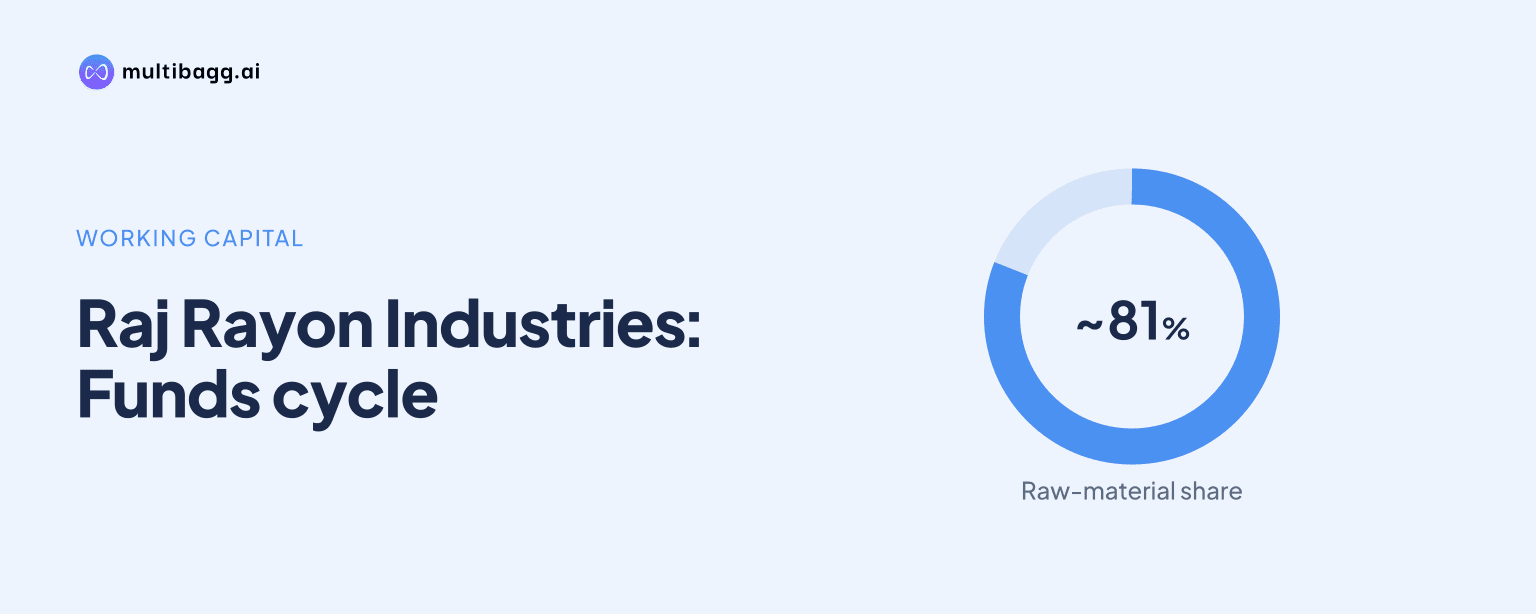
- PTA and MEG account for about 81% of RRIL's raw-material requirements.
- RRIL claims a 1–2% pricing premium over many industry peers.
- RRIL reports 3,500+ customers across India and 15+ export markets.
powered by IRIS
Raj Rayon Industries Limited says supplier credit allows it to complete production and collect from customers before supplier payments fall due, creating structurally negative working capital across 3,500+ customers in India and 15+ export markets. RRIL says non-fund-based facilities support this model and claims a 1–2% quality-related price premium over many peers.
Know Raj Rayon Industries inside out
Results, valuation, peers and who's buying, in one view.
How does RRIL fund its production-to-collection cycle?
RRIL says it funds the production-to-collection cycle through credit extended by raw-material suppliers. The company states that it completes the entire cycle, from procuring inputs to collecting customer payments, within the supplier-credit period. It says non-fund-based facilities back the arrangement and describes the resulting position as self-funded, without funded working-capital use.
The disclosure does not give the number of supplier-credit days, inventory days, customer receivable days or the value of non-fund-based facilities. Those omitted measures limit external assessment of the negative working-capital claim, but the mechanism is clear: supplier payment falls due after the company says it has converted inputs into polyester yarn and received cash from customers.
The model is particularly relevant because purified terephthalic acid, or PTA, and mono ethylene glycol, or MEG, together account for about 81% of RRIL's raw-material requirements. RRIL prices its products at a conversion margin above prevailing PTA and MEG prices and says raw-material price movements are passed through to customers. The stated objective is to preserve the conversion margin when those input prices change.
Which products and sales channels support RRIL's cash cycle?
RRIL identifies partially oriented yarn, or POY, as its largest revenue stream, drawn textured yarn, or DTY, as a growing stream, and chips as its smallest product line with marginal quantity. This mix places polyester yarn at the centre of the model, with PTA and MEG price pass-through serving as the pricing mechanism for the main input-intensive products.
Agents and traders are RRIL's currently dominant sales channel because, according to the company, they provide short payment cycles and insurance coverage. That channel structure is directly linked to the supplier-credit model because quicker collection helps the company complete its cycle before supplier payments are due. RRIL plans to shift progressively toward direct manufacturers as it scales, but gives no timing, sales-share target or collection-period assumption for that transition.
RRIL says its 3,500+ customer base and broad approval base mean additional capacity can be absorbed without extensive re-qualification. The company does not disclose the number of active buyers within that base, revenue by sales channel, or the shares of revenue generated by POY, DTY and chips. The approvals are therefore a stated readiness for capacity expansion rather than a reported measure of recurring sales or collections.
Got a follow-up? Ask IRIS
Why does RRIL claim a 1–2% pricing premium?
RRIL says it commands a 1–2% premium over many industry peers because of consistent quality, lot continuity and established brand trust. Its stated rationale is that lot continuity reduces wastage in customers' manufacturing processes, giving customers an operating reason to pay more than for comparable yarn from other suppliers.
The company says it built 3,500+ customer approvals in three operating years and that this qualification work is complete for expanded capacity. RRIL does not disclose average realised prices, product-level margins, a peer-price comparison or customer retention data. The presentation therefore reports the claimed premium and its stated drivers, but does not quantify its realised contribution to revenue or profitability.
The 1–2% premium and the PTA-MEG pass-through mechanism perform different functions in the revenue model. RRIL says pass-through addresses changes in the roughly 81% raw-material basket represented by PTA and MEG, while the premium reflects product quality and customer manufacturing benefits. Input-price pass-through is intended to protect conversion margin, whereas the premium depends on continuing customer acceptance of RRIL's stated quality and lot-continuity proposition.
What supply-chain factors does RRIL say support this model?
RRIL says its Silvassa plant is located near the western Indian cluster that produces about 70–73% of the country's PTA and MEG and accounts for about 70% of domestic polyester consumption. The company also identifies a dry port 30 kilometres away, which it says provides import access alongside its domestic sourcing arrangements.
India currently has a PTA supply deficit of about 2.5 million metric tonnes per annum, or MMTPA, according to RRIL, with imports from more than 10 international suppliers filling the shortfall. RRIL nevertheless says longstanding relationships with domestic PTA suppliers enable 100% local sourcing and support a single-source raw-material ecosystem. The company presents this as supporting supply-chain stability, manufacturing continuity and quality control.
RRIL says domestic PTA and MEG supply could increase by about 150% within two years, based on 3.2 million metric tonnes from Reliance Industries Limited, 1.2 million metric tonnes from Indian Oil Corporation Limited and Panipat Refinery, and 1.2 million metric tonnes from GAIL Mangalore. Management characterises the proposed supply increase as creating a favourable pricing environment for downstream manufacturers. It also says PTA and MEG prices rose amid the West Asia crisis and are expected to moderate over coming quarters.
The company also cites continuous melt integration, which it says converts polyethylene terephthalate, or PET, directly into fibre and eliminates the chip-cost layer. RRIL says India has 14 direct-melt manufacturers, compared with 26–30 chip buyers that it describes as having a structural cost disadvantage. It does not disclose its unit-cost saving from this process, the share of output produced through it, or supplier concentration.
Conclusion
RRIL's stated model combines supplier credit, non-fund-based facilities and agent- or trader-led sales with short payment cycles to finance production through collection. Its reported pricing structure seeks to pass through changes in PTA and MEG, which make up about 81% of raw-material requirements, while its claimed 1–2% premium and 3,500+ approvals are presented as commercial support for pricing and demand absorption.
The next point to watch is RRIL's planned progressive move toward direct manufacturers, because the presentation does not disclose how that change could affect collection timing or the supplier-credit cycle. Management also plans to revive exports from FY27 through specialty products including Dope Dyed, Micro and Full Dull yarns, drawing on its earlier presence in 15+ international markets; no export target or working-capital effect is disclosed.