










Raj Rayon Industries Limited regained IND BBB+ after revival
Key highlights
- RRIL moved from IND D in 2018 to IND BBB+/Stable in 2024, and the rating was affirmed in 2025.
- RRIL’s revenue rose from Rs 137 crore in FY23 to Rs 1,180 crore in FY26.
- SVG infused Rs 124.9 crore in 2021, while Rs 80 crore settled legacy creditors under the NCLT resolution.
- RRIL plans Rs 650 crore of capital expenditure over the next two years for capacity above 700 TPD.
powered by IRIS
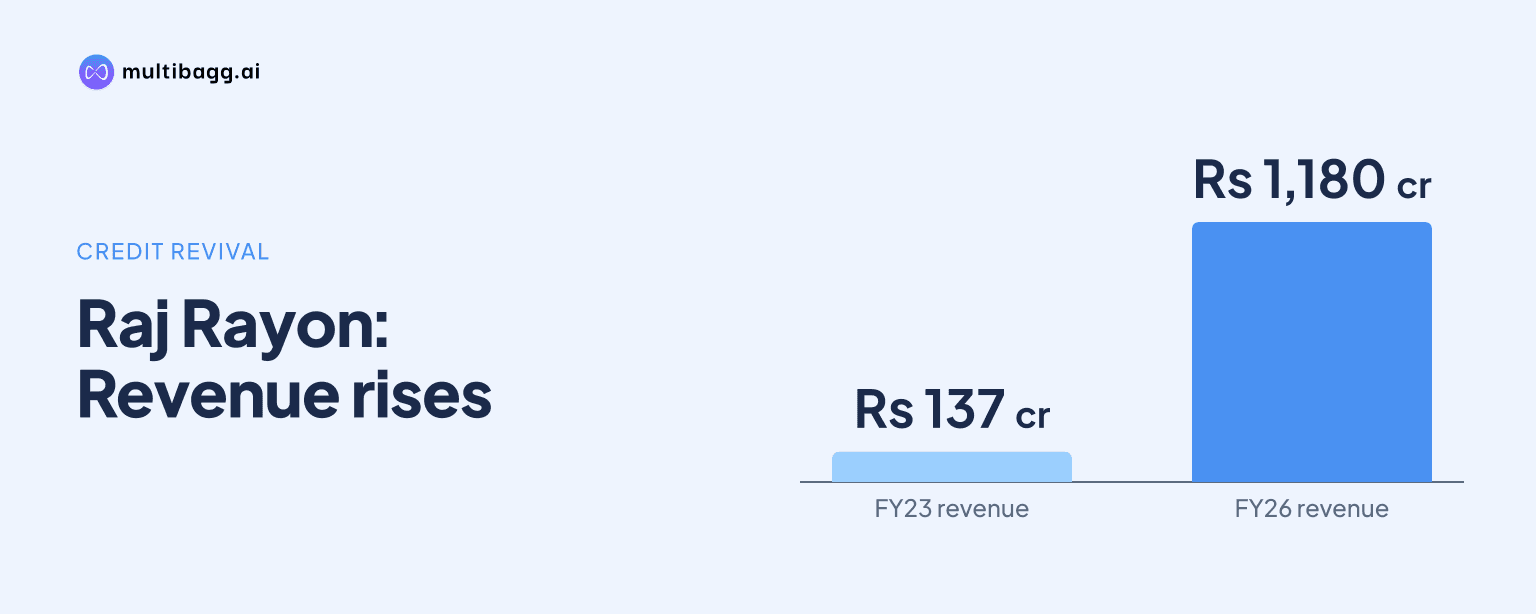
Raj Rayon Industries Limited reached IND BBB+/Stable in 2024 after commercial production resumed in January 2023 under SVG Group’s 2021 National Company Law Tribunal (NCLT) resolution, and the rating was affirmed in 2025. The presentation traces recovery from IND D in 2018 alongside revenue growth from Rs 137 crore in FY23 to Rs 1,180 crore in FY26.
Know Raj Rayon Industries inside out
Results, valuation, peers and who's buying, in one view.
How did RRIL move from IND D to IND BBB+?
RRIL moved from default-category ratings to IND BBB+/Stable through the 2021 insolvency resolution, a January 2023 plant restart and subsequent operating expansion. The presentation records an IND D rating in 2016 after lenders invoked Strategic Debt Restructuring when debt obligations were not serviced, followed by IND D, issuer not cooperating, in 2018 when production at the Silvassa plant stopped.
SVG Group acquired RRIL through the NCLT process in 2021 and commercial production resumed in January 2023. The listed rating sequence is IND BBB/Stable in 2023, IND BBB+/Stable in 2024 and an affirmation of IND BBB+/Stable in 2025. The presentation attributes the 2024 rating position to parent linkages, adequate liquidity, credit metrics expected to improve in the medium term and the operating turnaround.
What funding supported RRIL’s NCLT resolution and restart?
RRIL received Rs 124.9 crore of SVG capital in 2021, while the NCLT resolution settled legacy creditors for Rs 80 crore. The creditor settlement comprised Rs 55 crore in cash and Rs 25 crore in compulsorily convertible preference shares (CCPS), which the presentation says convert to equity at face value by 2029. It also states that no contingent liabilities remained after the Corporate Insolvency Resolution Process.
SVG’s Rs 124.9 crore infusion comprised Rs 54.9 crore of equity share capital, Rs 25 crore of CCPS and a Rs 45 crore unsecured loan. RRIL also reports Rs 450 crore of unabsorbed tax losses carried forward, which management describes as a tax shield as profitability scales.
RRIL says Rs 306 crore was invested in infrastructure and machinery following the 2021 revival, including modernisation and removal of obsolete equipment at its 25-acre Silvassa site. Bank of Baroda had sanctioned Rs 185 crore, with Rs 66.69 crore repaid and Rs 118.31 crore outstanding, while HDFC Bank had sanctioned Rs 83.5 crore, drawn Rs 64.73 crore and repaid Rs 3.5 crore. The presentation expects the remaining HDFC facility to be drawn in Q2-Q3 FY27.
Got a follow-up? Ask IRIS
How did RRIL’s revenue, debt and capacity change after restart?
RRIL’s revenue rose from Rs 137 crore in FY23 to Rs 745 crore in FY24, Rs 849 crore in FY25 and Rs 1,180 crore in FY26. FY24 was the first full year of operations, and the presentation calls its Rs 745 crore revenue the company’s highest in three decades. FY25 revenue was about six times the FY23 level, according to the presentation.
Term loans increased by Rs 102.7 crore between FY23 and FY26 as RRIL expanded production, while fund-based working-capital utilisation fell from Rs 25 crore in FY25 to Rs 2.6 crore in FY26. The Rs 270 crore working-capital limit is distinct from this utilisation figure because the presentation says working-capital use is predominantly non-fund-based. Management has set a FY27 deleveraging target of about Rs 60 crore through surplus cash and targeted prepayments.
Aggregate installed capacity increased from 371 tonnes per day (TPD) in FY24 to 391 TPD in FY25 and 477 TPD in FY26, representing the presentation’s stated 13% annual growth rate. This aggregate measure includes material processed at multiple production stages. Separately, RRIL reports FY26 capacities of 400 TPD in polymerisation, 350 TPD in partially oriented yarn (POY) and fully drawn yarn (FDY) spinning, and 150 TPD in drawn textured yarn (DTY).
What operating links and expansion plans underpin RRIL’s next phase?
RRIL’s presentation identifies SVG’s textile experience, customer relationships and diversified customer base as factors supporting the 2025 rating affirmation. RRIL manufactures chips, POY, DTY and speciality yarns at Silvassa, while SVG Fashions operates downstream fabric and garment activities. The presentation says this structure provided captive demand during ramp-up and helped RRIL build a customer base of more than 3,500 within two years of revival.
The product mix expanded in FY26 with dope-dyed yarns, cotton-look yarns and other speciality products. POY is described as RRIL’s largest revenue segment, while DTY is presented with a 10% to 12% earnings before interest, tax, depreciation and amortisation (EBITDA) margin, compared with 5% to 7% for POY. RRIL also plans to add FDY through its combined POY/FDY spinning infrastructure.
RRIL plans Rs 650 crore of capital expenditure over the next two years, targeting more than 700 TPD of total capacity. Its stated post-expansion targets are 700 TPD of polymerisation, 650 TPD of POY/FDY, 400 TPD of DTY and 50 TPD of circular knitted fabric. Against FY26 levels, those targets represent planned increases of 75% in polymerisation, 86% in POY/FDY and 167% in DTY.
Conclusion
RRIL’s presentation documents a recovery from a halted Silvassa plant and IND D status in 2018 to an IND BBB+/Stable rating in 2024, affirmed in 2025. The sequence included SVG’s 2021 NCLT acquisition, Rs 80 crore settlement of legacy creditors, commercial production from January 2023 and revenue growth of Rs 1,043 crore between FY23 and FY26.
The next disclosed measures are the Rs 650 crore capital-expenditure plan, post-expansion capacity targets above 700 TPD and management’s FY27 deleveraging target of about Rs 60 crore. Progress on the remaining HDFC Bank drawdown in Q2-Q3 FY27, commissioning of the proposed capacity and targeted debt prepayments are the stated developments to watch.