










Raj Rayon Q2 EBITDA more than doubled, reaching Rs 32.8 crore
Key highlights
- Raj Rayon’s Q2FY27 EBITDA rose 110.6% year on year to Rs 32.8 crore.
- Raj Rayon’s Q2FY27 revenue from operations increased 43.0% to Rs 456.5 crore.
- Raj Rayon’s blended realisations rose to about Rs 125 per kg from Rs 94 per kg in Q2FY26.
- Raj Rayon’s Q2FY27 production increased 12.5% to 47,093 MT and utilisation reached 106%.
powered by IRIS
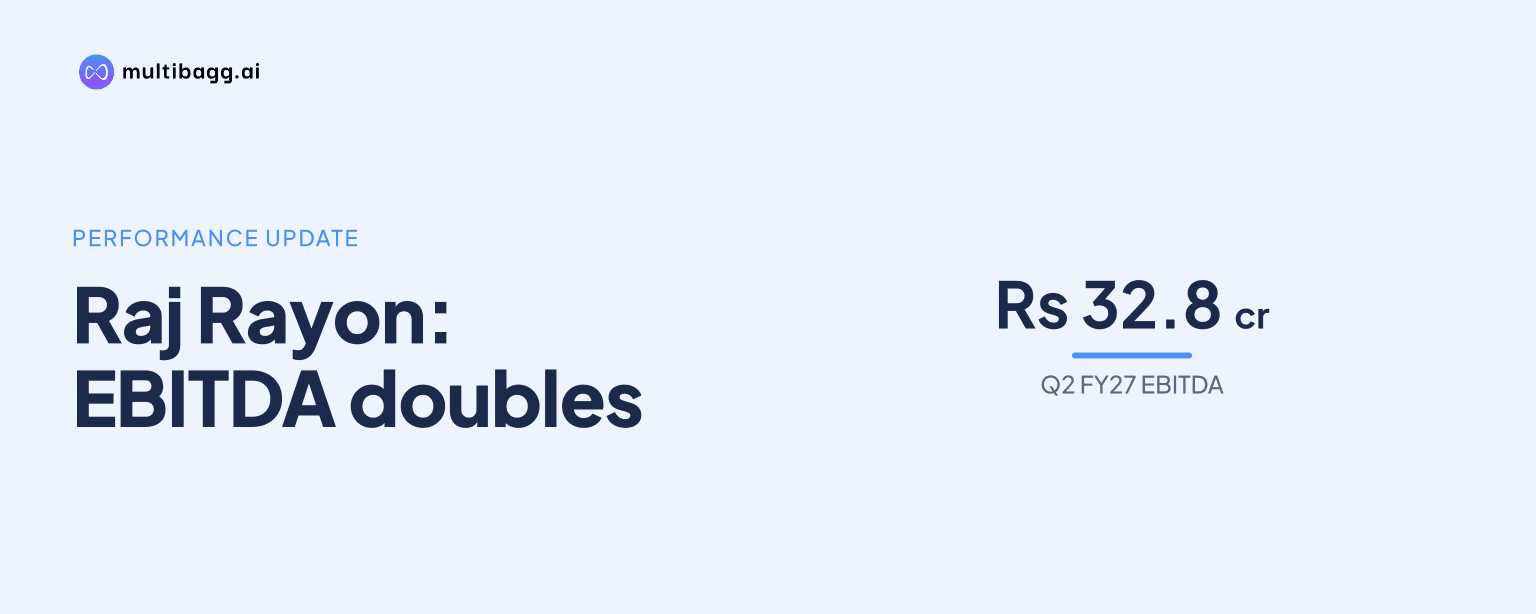
Raj Rayon reported earnings before interest, tax, depreciation and amortisation (EBITDA) of Rs 32.8 crore in Q2FY27, up 110.6% year on year, as revenue rose 43.0% to Rs 456.5 crore. Management attributed the faster profit growth to post-debottlenecking output, a higher-value yarn mix, blended realisations of about Rs 125 per kg and a wider gross spread.
Know Raj Rayon Industries inside out
Results, valuation, peers and who's buying, in one view.
Why did Raj Rayon’s Q2FY27 EBITDA rise faster than revenue?
Raj Rayon’s EBITDA rose 110.6% from Rs 15.6 crore in Q2FY26 to Rs 32.8 crore in Q2FY27, exceeding the 43.0% rise in revenue from operations from Rs 319.3 crore to Rs 456.5 crore. EBITDA margin increased to 7.2% from 4.9%, while profit after tax (PAT) rose 186.7% to Rs 23.0 crore from Rs 8.0 crore and PAT margin reached 5.0% from 2.5%.
Raj Rayon’s gross profit increased 45.8% to Rs 88.9 crore in Q2FY27 from Rs 61.0 crore a year earlier, while gross profit margin moved to 19.5% from 19.1%. Employee cost rose to Rs 4.6 crore from Rs 3.9 crore and other expenses increased to Rs 51.5 crore from Rs 41.5 crore, but EBITDA grew faster than both cost lines. Finance cost was Rs 5.0 crore against Rs 4.2 crore, and depreciation increased to Rs 5.1 crore from Rs 4.5 crore.
How did Raj Rayon’s product mix and realisations change in Q2FY27?
Raj Rayon said its sales mix shifted up its integrated chain from chips towards partially oriented yarn (POY) and draw textured yarn (DTY), while POY sales included more dope-dyed, micro-denier and cotton-look products. Management said this mix change and a firmer price environment raised blended realisations to about Rs 125 per kg in Q2FY27 from Rs 94 per kg in Q2FY26. It also said gross spread rose to about Rs 25 per kg from Rs 18 per kg.
Raj Rayon’s volume growth was smaller than its revenue growth, consistent with management’s explanation of changes in mix and realisations. Production increased 12.5% year on year to 47,093 metric tonnes (MT) in Q2FY27, while sales volume rose 6.5% to 35,979 MT. DTY volume grew 11.5%, according to management, and capacity utilisation reached 106%, compared with 95% in Q2FY26. The presentation says utilisation above 100% reflected enhanced production capability after debottlenecking while installed capacity remained unchanged.
What did Raj Rayon’s Q1FY27 shutdown change?
Raj Rayon completed a planned 46-day plant shutdown in Q1FY27 for debottlenecking, which management said increased production capacity from 350 tonnes per day to 400 tonnes per day in Q2FY27. Q2FY27 was the first full quarter following the work. Production was 47.09 thousand MT, compared with 41.87 thousand MT a year earlier, and capacity utilisation was reported at 106%.
The first-half comparison shows the shutdown’s effect before the Q2FY27 recovery. H1FY27 production declined 15% to 67.71 thousand MT from 79.35 thousand MT in H1FY26, while sales fell 14% to 53.41 thousand MT from 62.12 thousand MT. H1FY27 capacity utilisation was 76%, below 93% a year earlier. Despite lower volumes, H1FY27 revenue increased 14% to Rs 660.9 crore and EBITDA rose 62.0% to Rs 50.1 crore, with EBITDA margin increasing to 7.6% from 5.3%.
Got a follow-up? Ask IRIS
What does Raj Rayon’s first-half balance sheet show?
Raj Rayon reported total equity of Rs 186.3 crore at September 2026, up from Rs 156.5 crore at March 2026, while non-current borrowings declined to Rs 137.5 crore from Rs 150.8 crore. Management said net debt fell by about Rs 77 crore during the first half and that Raj Rayon held around Rs 100 crore in liquid investments for growth capital expenditure and raw-material purchases when prices are favourable.
Raj Rayon’s balance sheet also recorded changes in working-capital accounts and liquid assets. Investments rose to Rs 100.2 crore at September 2026 from Rs 25.3 crore at March 2026, while cash and cash equivalents fell to Rs 1.6 crore from Rs 12.4 crore. Trade receivables increased to Rs 48.4 crore from Rs 30.2 crore, and trade payables rose to Rs 273.6 crore from Rs 208.9 crore. Net cash from operating activities was Rs 92.2 crore in the six months to September 2026, versus Rs 82.6 crore in the comparable prior period, while net investing cash outflow was Rs 82.0 crore.
What is Raj Rayon planning after the Q2FY27 debottlenecking?
Raj Rayon expects H2FY27 volumes to increase compared with H1FY27 because of the larger production capacity, although management said profitability will depend on market conditions. Raj Rayon plans to commence a 10-tonnes-per-day fabric line in Q3FY27 and ramp it up in Q4FY27. Management described the line as a step towards forward integration into higher-value products beyond the polyester-yarn chain.
Management plans to increase Raj Rayon’s fabric capacity to 25 tonnes per day next year and to 100 tonnes per day over the following two to three years. It also said Raj Rayon is adding value-added machinery and cost-saving utilities. Management expects new domestic purified terephthalic acid (PTA) capacity to make India self-sufficient in that feedstock and bring domestic feedstock prices into line, which it believes could widen converter margins. These are management expectations rather than reported Q2FY27 results.
Conclusion
Raj Rayon’s Q2FY27 result combined 43.0% revenue growth with a 110.6% increase in EBITDA, reflecting the reported gains in realisations, specialty POY and DTY mix, and production capability after debottlenecking. The contrast with H1FY27 is material: production fell 15% during the first half because of the 46-day shutdown, while EBITDA still rose 62.0% to Rs 50.1 crore as EBITDA margin increased to 7.6%.
The next disclosed milestones are commencement of the 10-tonnes-per-day fabric line in Q3FY27, its planned ramp-up in Q4FY27, and management’s expectation that H2FY27 volumes will exceed H1FY27 volumes. Raj Rayon’s planned scale-up to 25 tonnes per day next year and 100 tonnes per day over the following two to three years, along with market conditions and PTA feedstock developments, remain the stated factors to watch.