










Raj Rayon Industries Limited targets 700-plus TPD by FY29
Key highlights
- RRIL plans Rs 650 crore of brownfield expansion at its Silvassa facility.
- RRIL targets total capacity of more than 700 TPD, with full commissioning planned in CY2028.
- RRIL plans to increase DTY capacity from 150 TPD to 400 TPD, a 167% rise.
- Management targets about 80% of peak revenue from value-added, specialty and sustainable products.
powered by IRIS
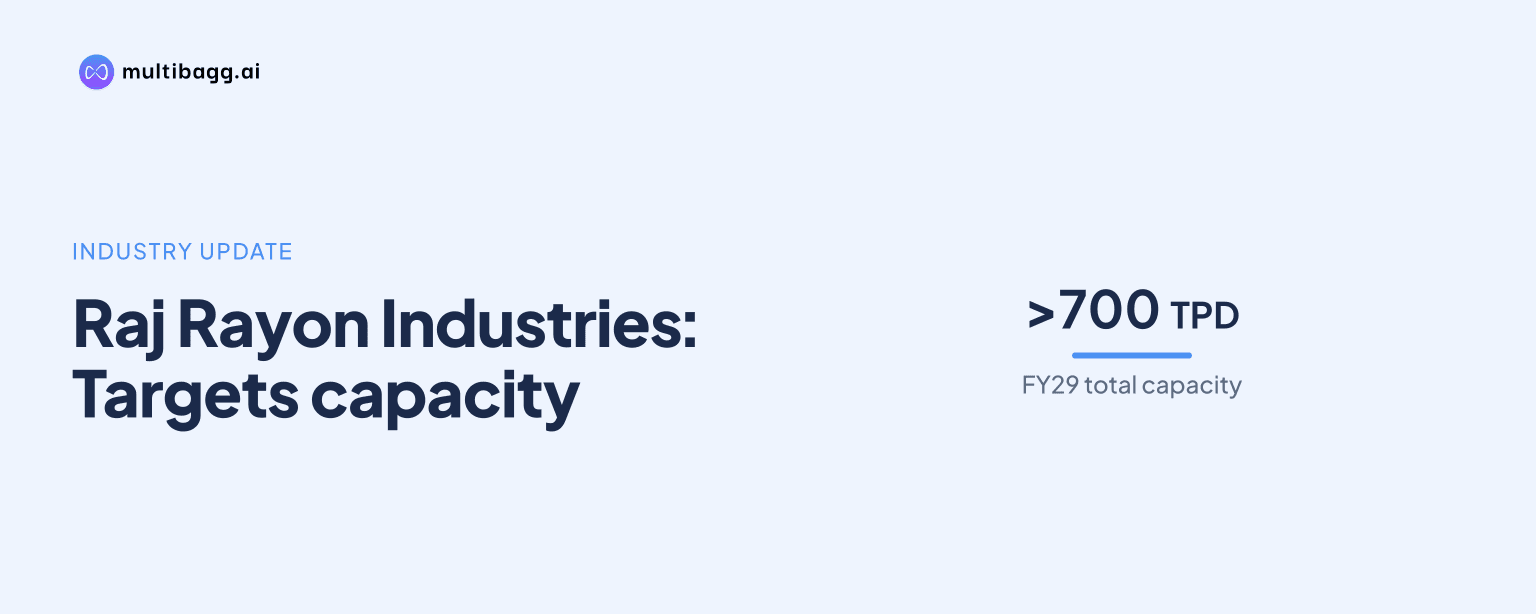
Raj Rayon Industries Limited plans a Rs 650 crore brownfield expansion at Silvassa that targets total capacity of more than 700 tonnes per day by CY2028, with FY29 as the first full year of commercialisation. RRIL also targets value-added, specialty and sustainable products to contribute about 80% of revenue at peak utilisation.
Know Raj Rayon Industries inside out
Results, valuation, peers and who's buying, in one view.
What will RRIL's Rs 650 crore expansion add?
RRIL plans to add 300 tonnes per day (TPD) of polyester yarn, 50 TPD of recycled polyester yarn and about 10 TPD of fabrics at its existing integrated Silvassa facility. The company describes Phase II as a brownfield project, using its existing site, and puts the planned capital expenditure at Rs 650 crore.
The programme follows a planned debottlenecking of polymerisation capacity from 350 TPD to 400 TPD in May 2026. RRIL states that its post-expansion total capacity will exceed 700 TPD across polyester yarn, recycled polyester yarn and fabrics. The source does not provide a separate capacity reconciliation between the 400-TPD polymerisation figure and all final product lines.
RRIL estimates annual revenue potential of about Rs 2,700 crore to Rs 3,000 crore at peak utilisation. This is a management estimate for the fully utilised expanded operation, rather than guidance for FY29 revenue. The company’s revenue model currently identifies partially oriented yarn, or POY, as its largest stream, with drawn textured yarn, or DTY, growing and chips at marginal volumes.
When will RRIL commission the planned capacity?
RRIL schedules full capacity commissioning in CY2028 and identifies FY29 as the first full year of full commercialisation. The sequence begins with the May 2026 polymerisation debottlenecking and includes fabrics commencement in Q3FY27, before the broader Phase II capacity reaches full commissioning.
The company also plans to double its value-added dope-dyed yarn capacity in Q3FY27. That date is earlier than the CY2028 full-commissioning target, showing that selected products are intended to enter production before the full 700-plus-TPD platform is available. The presentation does not disclose annual commissioning volumes or utilisation targets for each intervening year.
RRIL plans to revive exports from FY27 through specialty products including dope-dyed, micro and full-dull yarns. It says it has more than 3,500 customer approvals across India and an earlier presence in more than 15 export markets. Management presents that approval base as reducing the need for extensive re-qualification of expanded output, not as a disclosed order book.
How will RRIL shift its revenue mix?
RRIL targets about 80% of revenue at peak utilisation from value-added, specialty and sustainable products. The mix shift is intended to be delivered through higher DTY capacity, fabrics and recycled yarn, compared with the present model in which POY is the largest revenue stream.
DTY capacity is planned to increase from 150 TPD to 400 TPD, a 167% rise. Management indicates steady-state earnings before interest, tax, depreciation and amortisation, or EBITDA, margins of 10% to 12% for DTY, compared with 5% to 7% for POY. These are management’s product-margin indications, not reported margins or forecasts for a specified financial year.
The 50-TPD recycled-yarn line is linked to polyethylene terephthalate, or PET, bottle collection, recycled-chip production and recycled-yarn production. Management says recycled yarn carries a 30% to 40% premium to virgin yarn, while also stating that SVG will be one part of total consumption as recycled-yarn output is internationalised.
Fabrics are planned to commence in Q3FY27 and add a downstream product category to the Silvassa operation. RRIL lists performance apparel, automotive fabrics, seat belts, geogrids, agritech, industrial packaging, suede and specialty fabrics as potential applications. The presentation does not disclose product-specific fabric revenue, customer contracts or utilisation levels.
Got a follow-up? Ask IRIS
What margin and cost mechanisms does RRIL identify?
RRIL identifies operating leverage, product mix, packaging, logistics, energy efficiency and biomass conversion as the mechanisms expected to affect costs and margins. The volume mechanism is fixed-cost absorption as polymerisation scales from 400 TPD to more than 700 TPD, which management describes as about 75% more production volume.
The company says logistics costs can be eliminated for in-house DTY and fabrics, while higher production may strengthen negotiations with freight providers and distributors. It also plans to use 100% recycled packing materials, reuse paper tubes and jumbo bags, and eliminate cartons and other packaging materials. No combined rupee estimate is disclosed for those packaging and logistics measures.
RRIL plans a Rs 25 crore biomass-fuelled heating project for commissioning in December 2026. Management says the project would reduce furnace-oil consumption by 23,000 kilograms a day and produce manufacturing-cost savings of about 1% to 2%. The company also targets solar power for about 50% of power requirements, with an additional estimated production-cost saving of about 2%.
Further energy measures include vapour-absorption chillers intended to eliminate conventional air-conditioning electrical load and air pre-heaters intended to reduce heat-transfer-medium fuel use. These initiatives accompany the planned scale-up, but the presentation does not state their capital cost except for the Rs 25 crore biomass project.
Why does RRIL emphasise its Silvassa location?
RRIL says Silvassa is in a western region that produces about 70% to 73% of India’s purified terephthalic acid, or PTA, and mono ethylene glycol, or MEG, while accounting for about 70% of domestic polyester consumption. PTA and MEG together account for about 81% of RRIL’s raw-material requirement, making access to those inputs relevant to the expanded operation.
The company says its plant is 30 kilometres from a dry port and that it sources 100% of its PTA locally through domestic supplier relationships. This is set against India’s stated PTA supply deficit of about 2.5 million metric tonnes a year, which the presentation says is supplied through imports from more than 10 international suppliers.
RRIL also cites 900,000 square feet of already built manufacturing space at its facility. Management estimates that using this infrastructure makes expansion 30% to 40% cheaper than a greenfield project because civil costs are already sunk. That is a management comparison, and the presentation does not provide a standalone civil-cost breakdown within the Rs 650 crore plan.
Conclusion
RRIL’s Phase II plan combines higher output with a defined product-mix change: total capacity of more than 700 TPD, DTY capacity of 400 TPD and recycled-yarn capacity of 50 TPD. Management’s Rs 2,700 crore to Rs 3,000 crore peak-revenue estimate and 80% value-added, specialty and sustainable revenue target depend on the planned ramp-up of DTY, fabrics and recycled yarn rather than only greater POY volumes.
The next disclosed milestones are the May 2026 debottlenecking to 400 TPD of polymerisation capacity, the December 2026 biomass-project commissioning and fabrics and dope-dyed yarn actions in Q3FY27. Full capacity commissioning is planned for CY2028, after which FY29 is intended to be the first full year of commercialisation.