










Parth plans ₹6 crore Takalkar deal for GIS capability
Key highlights
- Parth proposes to acquire 100% of Takalkar for ₹6 crore in cash.
- The consideration includes ₹4.98 crore upfront and ₹1.02 crore conditional on receivable collections by 31 March 2027.
- Takalkar reported FY26 turnover of ₹6.04 crore, up 46% from ₹4.13 crore in FY25.
- Parth says the acquisition supports GIS solutions up to 220 kV and adds HV and EHV design capability.
powered by IRIS
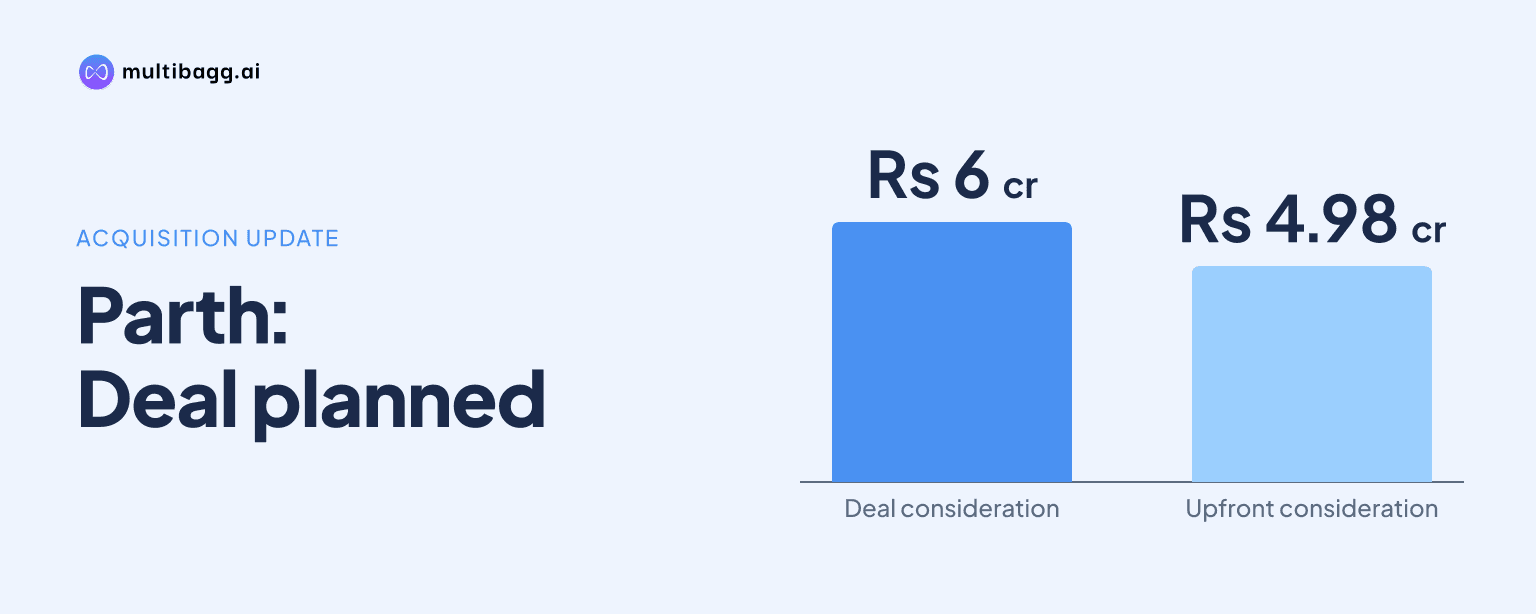
Parth Electricals & Engineering Ltd. plans to acquire 100% of Takalkar for ₹6 crore in cash, a proposed transaction intended to add high-voltage and extra-high-voltage engineering capability and support gas-insulated switchgear solutions up to 220 kilovolts (kV). The board approved the deal on 29 October 2026, subject to stock-exchange approval.
Know Parth Electricals & Engineering inside out
Results, valuation, peers and who's buying, in one view.
What are the terms of Parth’s Takalkar acquisition?
Parth has proposed a ₹6 crore all-cash acquisition of 100% of Takalkar, which would become its wholly owned subsidiary after transaction closure. The board approved the proposal on 29 October 2026, and Parth expects completion within about one month, subject to stock-exchange approval. The company says the transaction is not a related-party transaction and that the price is based on a valuation report.
The consideration comprises ₹4.98 crore, or 83%, payable upfront on share transfer and ₹1.02 crore, or 17%, deferred. The deferred payment is conditional on the realisation by 31 March 2027 of identified Takalkar receivables outstanding on 30 September 2026. This makes part of the consideration dependent on collection rather than payable at closing.
Takalkar reported turnover of ₹6.04 crore in FY26, up 46% from ₹4.13 crore in FY25, according to the presentation. Its net worth was ₹2.47 crore as of 31 March 2026. The presentation does not disclose a target for Takalkar’s revenue, profit or cost contribution after the transaction closes.
What capabilities would Takalkar add to Parth?
Takalkar would add electrical engineering services and civil, mechanical, structural and electrical design and consultancy capabilities to Parth. Its work covers power generation, transmission and distribution, and its customers include power utilities, industries and government departments. Parth says the acquisition would strengthen its high-voltage (HV) and extra-high-voltage (EHV) engineering depth.
The stated product-development objective is to enable gas-insulated switchgear (GIS) solutions up to 220 kV. This aligns with Parth’s Vadodara GIS unit, scheduled for inauguration in November 2026, which is set to roll out 33 kV GIS and ring main unit (RMU) products. The presentation does not specify a commercial launch date for a 220 kV GIS product.
Parth also cites a broader product portfolio, competitiveness, customer reach and cross-selling as strategic outcomes of the transaction. Takalkar, based in Vadodara and operating across India, would provide an in-house engineering and design team rather than a stated manufacturing-capacity addition. The presentation does not disclose the number of staff or contracts that would transfer with the business.
How does the Takalkar deal fit Parth’s FY27 strategy?
The proposed deal fits Parth’s stated inorganic-expansion plan, which focuses on targets that enrich engineering and design capabilities and can support entry into new geographies and international markets. In its H1 FY27 presentation, Parth identified revenue growth, margin expansion and inorganic expansion as its three growth engines. Takalkar is positioned as an engineering and design acquisition within that third engine.
Parth reported a ₹470 crore order book and a bid pipeline of more than ₹300 crore as part of its revenue-growth plan. Its stated capacity milestones include the Vadodara GIS unit from November 2026 and Odisha facilities intended to serve the eastern market. Management also identified high-margin segments, a growing export footprint and technology-driven products such as GIS as elements of its margin-expansion focus.
The milestone schedule places completion of the 100% Takalkar acquisition in December 2026, alongside full delivery of a data-centre order for Vertiv in Jamnagar. It also lists delivery of UL-certified medium-voltage switchgear to the United States in February 2027, completion of a 60,000 square foot Odisha facility in March 2027, and full Odisha operations in June 2027. The schedule indicates that Parth plans to integrate the transaction while commissioning new facilities.
Got a follow-up? Ask IRIS
What was Parth’s financial position before the proposed deal?
Parth reported cash and bank balances of ₹37.45 crore at H1 FY27, down from ₹71.53 crore at H1 FY26, while the upfront acquisition payment is ₹4.98 crore. The presentation does not identify a separate funding source, although it labels the purchase an all-cash transaction. Parth also reported no long-term debt and short-term borrowings of ₹18.74 crore at H1 FY27.
Net worth rose 21% to ₹131.74 crore at H1 FY27 from ₹108.69 crore at H1 FY26. Over the same period, net fixed assets increased to ₹30.33 crore from ₹21.03 crore, while capital work in progress (CWIP) rose to ₹21.55 crore from ₹7.69 crore. Parth said fixed assets and CWIP together reached ₹51.88 crore as its GIS plant neared completion.
Operating cash flow moved to an outflow of ₹6.45 crore in H1 FY27 from an inflow of ₹8.95 crore in H1 FY26. Working-capital changes shifted to an outflow of ₹16.67 crore from an inflow of ₹1.94 crore, while the cash conversion cycle rose to 92 days from 58 days. Receivable days increased to 94 from 47 during the same comparison.
Management described the working-capital movement as timing-driven, citing raw-material purchases in September for a Reliance Data Centre project running from October to December. It said September billing of ₹25.63 crore, its highest monthly billing, was collectible by 15 November and that it expected the cycle to decline in H2 FY27. Separately, Parth raised ₹11.18 crore in H1 FY27 through a preferential issue of 3,00,000 equity shares and 1,00,000 warrants at ₹344 each, with 25% paid upfront on the warrants.
What must happen before the Takalkar acquisition closes?
The acquisition requires stock-exchange approval and completion of share transfer before Takalkar becomes Parth’s wholly owned subsidiary. Following the 29 October 2026 board approval, Parth expected closure within about one month and listed completion in December 2026 as a milestone. The ₹1.02 crore deferred amount remains contingent on specified receivable collections by 31 March 2027.
Parth will also need to integrate Takalkar’s engineering and consultancy team with its GIS-development plan, including the stated aim of solutions up to 220 kV. The presentation does not provide a financial-synergy target, integration-cost estimate, earnings-accretion estimate or timetable for a 220 kV GIS launch. Those disclosures leave the financial outcome of the capability addition unspecified.
The planned integration comes as Parth’s H2 FY27 priorities include collecting receivables into cash and commissioning ₹21.55 crore of CWIP into revenue-generating assets. Its cash conversion cycle was 92 days at H1 FY27, compared with 73 days in FY26. The presentation does not disclose a combined budget for acquisition integration and facility commissioning.
Conclusion
Parth’s proposed ₹6 crore acquisition of Takalkar is a capability-led transaction that would bring engineering, design and consultancy work in-house while supporting its aim to develop GIS solutions up to 220 kV. Takalkar’s FY26 turnover of ₹6.04 crore, up 46% from FY25, gives a recent measure of the target’s scale, but Parth has not quantified expected post-acquisition revenue or profit benefits.
The next disclosed points to watch are the expected closing around December 2026, subject to stock-exchange approval, and the 31 March 2027 deadline for the receivable-linked ₹1.02 crore payment. Parth’s execution plan also calls for commissioning ₹21.55 crore of CWIP, opening the Vadodara GIS plant in November 2026 and reducing the 92-day cash conversion cycle in H2 FY27.