










BigBloc blocks supplied 90% of H1 FY27 revenue despite expansion
Key highlights
- BigBloc generated 90% of its Rs 162 crore H1-FY27 revenue from AAC blocks.
- AAC panels contributed 4% of H1-FY27 revenue and construction materials contributed 6%.
- BigBloc has 2,50,000 cubic metres per annum of AAC wall-panel capacity at Ramosadi.
- BigBloc’s H1-FY27 sales volume rose 22% year on year to 4,46,769 cubic metres.
powered by IRIS
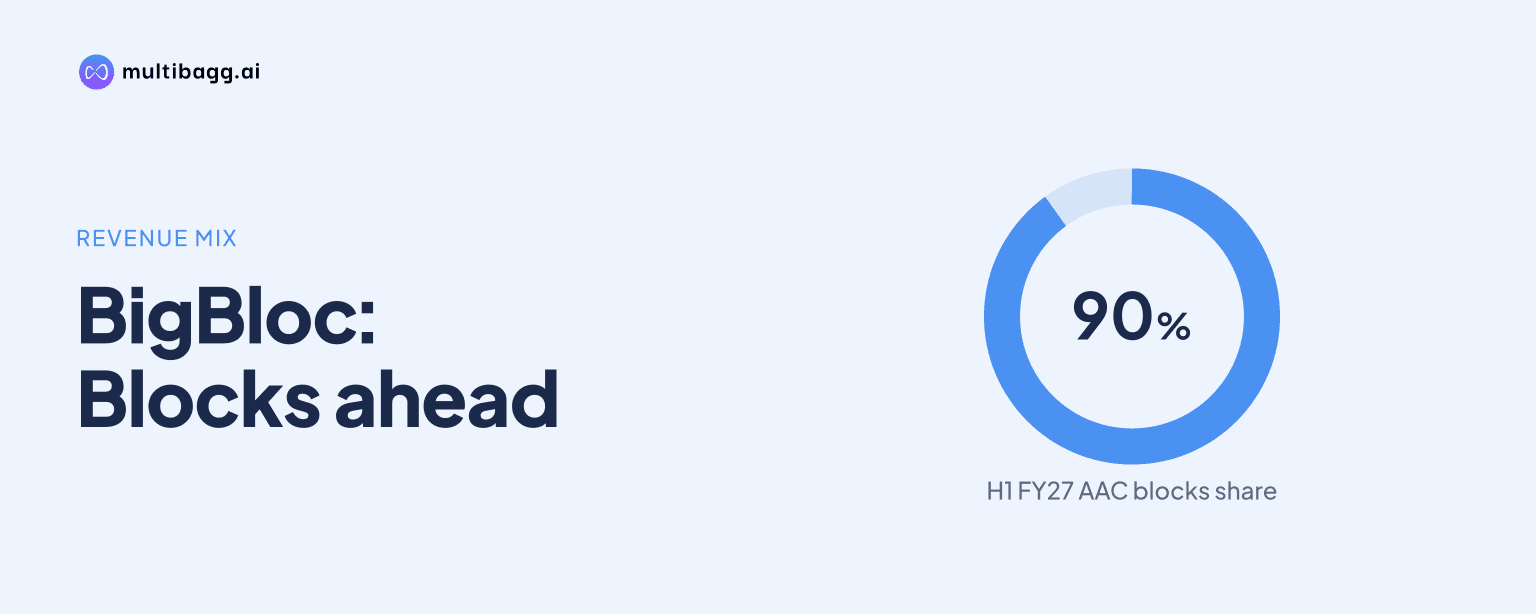
BigBloc Construction Limited derived 90% of Rs 162 crore revenue from autoclaved aerated concrete, or AAC, blocks in H1-FY27, while AAC panels supplied 4% and construction materials 6%, showing the newer building-solutions lines remained smaller than its core block business in the six months ended September 30, 2026.
Know BIGBLOC Construction inside out
Results, valuation, peers and who's buying, in one view.
How dependent is BigBloc on AAC blocks?
BigBloc remains dependent on AAC blocks, which formed 90% of H1-FY27 revenue, compared with 4% from AAC panels, 6% from construction materials and 0.01% from others. The product mix shows that blocks remained the main revenue source despite the company’s stated portfolio-expansion strategy.
BigBloc markets its AAC blocks under the NXTBLOC brand, while ZMARTBUILD Wall by NXT BLOC is its co-branded wall-panel product under a joint venture with Siam Cement Group International. The construction-materials range includes NXTFIX semi-premix mortar and NXTPLAST ready-mix cement plaster, while NXTGRIP tile adhesive is listed as an upcoming product.
The presentation does not disclose revenue, volume or profit separately for NXTFIX, NXTPLAST, NXTGRIP or AAC panels. As a result, the 10% combined contribution from panels and construction materials establishes their current revenue scale, but does not show product-level demand or profitability.
What building products does BigBloc offer beyond blocks?
BigBloc offers AAC wall panels and construction chemicals alongside AAC blocks, linking the newer products to wall construction, block installation and plastering. Its block platform includes AAC fly-ash blocks and AAC sand-based blocks for residential, commercial, industrial and infrastructure applications.
BigBloc describes ZMARTBUILD Wall by NXT BLOC panels as composite products made with cement, lime and silica sand and reinforced with two-way welded steel mesh. The Ramosadi product range includes panels from 8 feet to 20 feet long for external and internal non-load-bearing walls, roofs and floors in residential, commercial and industrial buildings.
BigBloc positions NXTFIX for AAC block jointing and bonding and NXTPLAST for internal and external wall plastering. NXTFIX contains cement, graded sand and specialised polymers, while NXTPLAST uses polymer additives; both products require water before application, according to the presentation.
BigBloc says NXTBLOC is three times lighter than conventional bricks and can reduce steel consumption by 20% while enabling construction up to four times faster. These are the company’s product-proposition claims rather than reported H1-FY27 operating outcomes, and the presentation gives no adoption metric for those stated benefits.
How does BigBloc’s capacity support the broader portfolio?
BigBloc reports total manufacturing capacity of 13,00,000 cubic metres per annum, comprising 10,50,000 cubic metres per annum for the AAC-block platform and 2,50,000 cubic metres per annum for AAC wall panels. The block operations are located at Umargaon, Kapadvanj and Wada, while Ramosadi is the joint-venture facility producing AAC blocks and AAC wall panels.
BigBloc’s facility utilisation ranged from 38.25% at Ramosadi to 110.52% at Kapadvanj as of H1-FY27. Ramosadi’s rate indicates available capacity at the joint-venture site, but it cannot be read as wall-panel-only utilisation because the presentation lists both AAC blocks and panels among the products manufactured there.
At group level, BigBloc reported capacity utilisation of 68.74% in H1-FY27, compared with 69.34% in Q2-FY27. H1-FY27 sales volume rose 22% year on year to 4,46,769 cubic metres from 3,66,383 cubic metres in H1-FY26, although the presentation does not divide the volume growth between blocks and panels.
Got a follow-up? Ask IRIS
Has BigBloc’s financial profile changed as it expands products?
BigBloc’s financial disclosures do not provide segment profit for AAC panels or construction materials, so their effect on margins cannot be measured from the presentation. Revenue recovered to Rs 283.4 crore in FY26 from Rs 224.6 crore in FY25, after declining from Rs 243.2 crore in FY24.
BigBloc reported Rs 162 crore of revenue from operations, Rs 9.6 crore of earnings before interest, tax, depreciation and amortisation, or EBITDA, and a Rs 3.5 crore loss after tax in H1-FY27. The half-year result is not directly comparable with the three full financial years in the table, but the displayed EBITDA margin was 5.93%, compared with 6.21% in FY26.
BigBloc said it followed gradual price revisions in response to higher lime, coal and other input costs. It also reported greater automation in boiler and material-handling operations, a shift from rented forklifts to owned electric forklifts, and installation of 3.5 megawatts of rooftop solar capacity across all plants during Q2-FY27; no cost savings were quantified.
What is BigBloc planning for the portfolio next?
BigBloc plans geographic expansion, further automation and additions to its product range. It acquired 57,500 square metres of land in Madhya Pradesh to strengthen and scale its AAC-block business in central India, but did not disclose a plant capacity, capital cost, construction schedule or commissioning date.
BigBloc identifies AAC wall panels and NXTGRIP tile adhesive as its stated product-expansion initiatives. Management also plans automation at new and existing plants, an in-house logistics network intended to support faster dispatch, and targeted hiring and training, without giving H2-FY27 revenue, margin or market-share targets.
BigBloc reported a supply chain across 9 cities in 4 states, more than 100 real-estate clients and a 13,00,000-cubic-metre annual manufacturing capacity. Those existing operating measures provide the platform for the planned additions, but the presentation does not say when construction chemicals or panels could make a larger share of revenue.
Conclusion
BigBloc’s H1-FY27 mix shows that its building-solutions portfolio extends beyond AAC blocks, but the financial base remains concentrated: blocks supplied 90% of Rs 162 crore revenue, while panels and construction materials together supplied 10%. Higher H1 sales volume and a 13,00,000-cubic-metre annual capacity support the wider platform, though product-level margins and volumes remain undisclosed.
The next disclosed developments to watch are the use of the 57,500-square-metre Madhya Pradesh land, the planned NXTGRIP tile-adhesive addition and changes in Ramosadi’s 38.25% H1-FY27 utilisation. Management’s automation, in-house logistics and hiring plans are also relevant, but the presentation provides no timing or financial targets for their execution.