










McLeod Russel’s NARCL deal sets Rs 1,050 crore repayment
Key highlights
- McLeod Russel classified Rs 1,050 crore of Rs 2,483.30 crore NARCL-assigned debt as sustainable.
- McLeod Russel retained an estimated Rs 119 crore for NARCL’s proposed 10% fully diluted equity allotment.
- McLeod Russel proposed selling six tea-estate assets for Rs 149.21 crore against a Rs 118.59 crore carrying value.
- McLeod Russel set Rs 150 crore of JCAF debt for repayment over 15 months after a Rs 62 lakh adjustment.
powered by IRIS
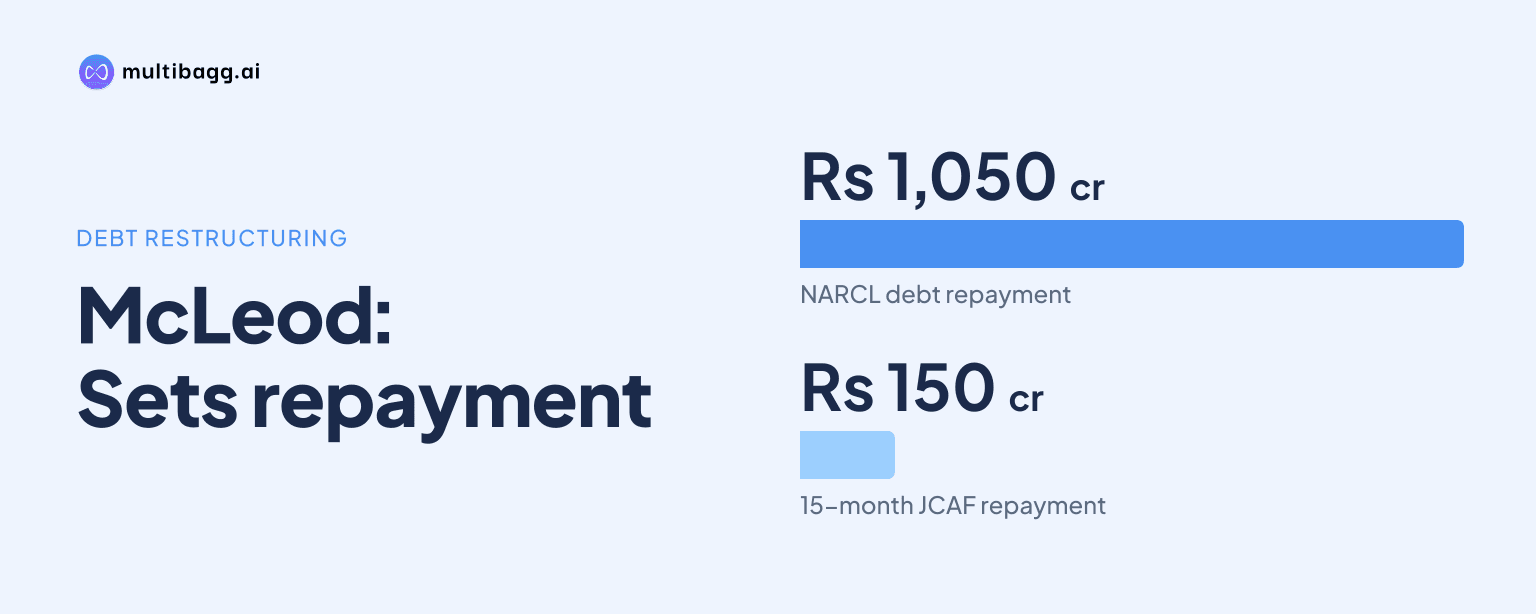
McLeod Russel India Limited has set Rs 1,050 crore of debt assigned to National Asset Restructuring Company Limited for repayment over three years, from Rs 2,483.30 crore assigned at the December 31, 2025 cut-off. The arrangement remains conditional on asset monetisation, promoter contributions, approvals and an estimated Rs 119 crore equity conversion for NARCL.
Know Mcleod Russel India inside out
Results, valuation, peers and who's buying, in one view.
How has McLeod Russel restructured its NARCL debt?
McLeod Russel has restructured Rs 2,483.30 crore of borrowings assigned to National Asset Restructuring Company Limited, or NARCL, into Rs 1,050 crore of sustainable debt. The assigned borrowing included Rs 1,322.23 crore of accrued interest, meaning accrued interest represented more than half of the balance transferred to NARCL at the December 31, 2025 cut-off date.
NARCL’s sanction letter was issued on April 2, 2026, and McLeod Russel executed the Master Restructuring Agreement, or MRA, on September 29, 2026. India Debt Restructuring Company Limited, appointed by NARCL as its exclusive service agent, handled the restructuring process. McLeod Russel must pay the sustainable debt through promoter contributions, asset monetisation, operational accruals and other sources over three years.
McLeod Russel had adjusted Rs 27.42 crore of repayments made by March 31, 2026 against the NARCL sustainable debt. The company recognised the restructured NARCL borrowing at fair value under Indian Accounting Standards, or Ind AS. It said Rs 846.48 crore of remaining unsustainable debt, mainly unpaid interest, was no longer required and was recorded under exceptional items in the year ended March 31, 2026.
What equity conversion does McLeod Russel owe NARCL?
McLeod Russel is required to allot equity equivalent to 10% of its fully diluted equity capital to NARCL under the MRA. The company has retained an estimated Rs 119 crore from unsustainable debt for this purpose and reported that amount under non-current liabilities as of September 30, 2026.
The estimated Rs 119 crore conversion is not yet a completed equity allotment. McLeod Russel said the final accounting adjustments will follow determination of the amount, shareholder approval of the required resolution and implementation by the company. The potential conversion therefore remains a condition of the NARCL restructuring rather than issued share capital at the reporting date.
A separate MRA-linked disclosure covers Rs 170 crore of short-term borrowings and inter-corporate deposits that McLeod Russel says are to be converted into equity share capital. Interest of Rs 181.34 crore was outstanding on those facilities as of September 30, 2026, while Rs 61.11 crore of unprovided interest is expected to be extinguished upon conversion of the principal, subject to confirmation and shareholder approval.
What conditions must McLeod Russel meet to retain the debt deals?
McLeod Russel must satisfy conditions precedent under both the NARCL MRA and the one-time settlement, or OTS, with J C Flower Asset Restructuring, or JCAF. Management said steps had been initiated and that it expected the conditions to be met within the stipulated periods, although the filing does not state all deadlines.
The company said it had executed memoranda of understanding to sell certain tea estates, received additional promoter contributions and submitted a settlement plan for provident fund dues. Promoters and related parties also executed an unattested agreement to pledge shares on October 9, 2026 as additional security. McLeod Russel repaid Rs 47.05 crore of sustainable debt from operational accruals, including Rs 19.01 crore during the six months ended September 30, 2026.
JCAF’s Rs 749.66 crore assigned balance was settled through an OTS sanctioned on May 13, 2026. McLeod Russel identified Rs 150 crore as sustainable debt after adjusting a Rs 62 lakh repayment made by March 31, 2026. This repayment schedule is shorter than NARCL’s, requiring payment through asset monetisation and other means within 15 months.
A further Rs 120.31 crore remains payable to one lender bank, where recovery proceedings are pending. McLeod Russel said its settlement proposal had been agreed in principle, but the amount, repayment period and payment modalities remain to be finalised. It has continued to provide simple interest while excluding penal or compound interest pending confirmation and reconciliation.
Got a follow-up? Ask IRIS
Which tea-estate sale is McLeod Russel relying on?
McLeod Russel has approved a proposed sale of specified assets at six tea estates with a carrying value of Rs 118.59 crore as of September 30, 2026. The company entered a memorandum of understanding and term sheet with a proposed buyer for aggregate consideration of Rs 149.21 crore, subject to due diligence and statutory, lender and other approvals.
The proposed sale has not been completed because a binding agreement remains to be executed. McLeod Russel has therefore not recognised its estimated Rs 53.34 crore profit on the transaction. Operations from the estates also remained within the financial results through September 30, 2026, generating Rs 16.81 crore of profit from the effective sale date, including Rs 16.76 crore in the reported period.
The disposal is part of the funding mechanism required by the NARCL plan, alongside promoter money and operational cash generation. McLeod Russel said tea realisations remained affected during the period, although production volumes had improved to some extent. It also cautioned that its tea cultivation, manufacturing and sales are seasonal, so the six months ended September 30, 2026 are not indicative of the year ending March 31, 2027.
What financial risks remain for McLeod Russel?
McLeod Russel said the restructuring will be revoked if it defaults on payments or fails to meet conditions, regulatory requirements or approvals. In that event, the debt would be restored and become payable under its original terms. The company’s borrowing resolution process began in 2019, after earlier proposed resolution plans and settlement offers did not result in implementation.
The company also reported Rs 2,761.09 crore of inter-corporate deposits to promoter-group and other entities as of September 30, 2026. It had provided Rs 2,346.75 crore against those deposits, leaving Rs 414.21 crore carried forward. McLeod Russel said the amount ultimately recoverable is not currently determinable and that it has initiated legal action against certain promoter-group entities.
McLeod Russel reported statutory liabilities of Rs 265.30 crore as of September 30, 2026, including a Rs 191.11 crore provident fund demand. The Assam Tea Employees Provident Fund Organisation approved repayment of dues through January 31, 2026 over three years on March 12, 2026. Management also said impairment valuation work was pending for operating assets and a Rs 159.67 crore investment in Borelli Tea Holdings Limited.
Conclusion
McLeod Russel has lowered the scheduled burden on its two largest asset reconstruction company exposures, with Rs 1,050 crore of NARCL debt and Rs 150 crore of JCAF debt designated sustainable against combined assigned borrowings of Rs 3,232.96 crore. The accounting adjustments and revised repayment schedules do not remove the conditions attached to those agreements.
The next disclosed milestones are completion of the six-estate transaction for Rs 149.21 crore, shareholder approval and final determination of the estimated Rs 119 crore NARCL equity conversion, and finalisation of the Rs 120.31 crore lender-bank settlement. McLeod Russel must also meet the MRA and OTS conditions precedent, because a default or unmet condition can restore the original debt terms.