










Meghmani Crop Nutrition Ltd has 5-crore nano urea capacity
Key highlights
- MCNL says its Sanand plant has installed capacity for 5 crore 500 ml nano urea bottles annually.
- MCNL says nano urea can curtail conventional urea requirement by at least 50%.
- MCNL reports testing nano urea in more than 11,000 farmers’ fields across 94 crops.
- MCNL reports an average 8% yield increase and plans Nano DAP, Nano NPK and Nano Zinc additions.
powered by IRIS
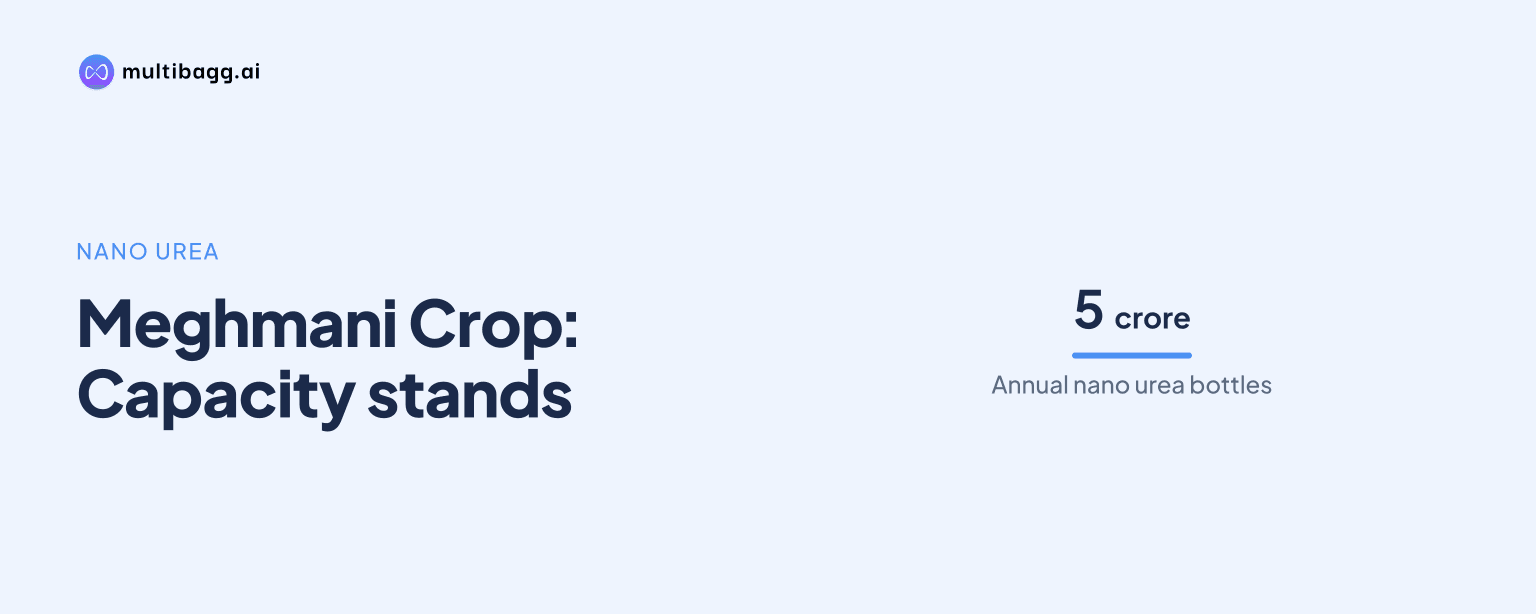
Meghmani Crop Nutrition Ltd says its Sanand plant has installed capacity to produce 5 crore 500 ml nano urea bottles a year, positioning the liquid product as an alternative to conventional urea. MCNL says its field testing covered more than 11,000 farmers’ fields across 94 crops and recorded an average 8% yield increase.
Know Meghmani Organics inside out
Results, valuation, peers and who's buying, in one view.
What does MCNL claim nano urea can replace?
MCNL says its liquid nano urea is intended to supply nitrogen to plants as an alternative to conventional urea and can curtail conventional urea requirement by at least 50%. The company says a 500 ml bottle contains 40,000 milligrams per litre of nitrogen and has nitrogen-nutrient impact equivalent to one bag of conventional urea.
The replacement claim is based on MCNL’s stated nutrient-delivery effectiveness. MCNL says conventional urea is 30% to 40% effective in delivering nitrogen to plants, compared with more than 80% for liquid nano urea. The presentation presents these as product claims and does not disclose nano urea sales volumes, pricing or revenue.
MCNL also links the liquid format to storage and transport. It says nano urea is cheaper than conventional urea, can be stored and transported easily, and may reduce farmers’ input, logistics and storage costs. The company describes the product as suitable for food crops, cash crops and horticulture crops, without providing crop-specific application rates.
How large is MCNL’s nano urea manufacturing capacity?
MCNL’s Sanand plant has installed annual capacity of 5 crore bottles, each holding 500 ml of nano urea. The disclosed capacity is the central manufacturing measure for MCNL’s foray into liquid nano urea fertilizer, but the presentation gives no production, utilisation or inventory figure for the plant.
The lack of operating data differs from the disclosures for MCNL’s wider group operations in Q2 FY27. Crop Protection production was 10,019 metric tonnes and capacity utilisation was 72%, while Pigments production was 4,252 metric tonnes and utilisation was 51%. No corresponding quarterly crop-nutrition production or utilisation metric is supplied.
MCNL places the opportunity against India’s conventional urea consumption and imports in 2021-22. The company says India consumed 34.2 million tonnes of urea, imported 9 million tonnes and spent about USD 6 billion on those imports. It also says urea accounted for about 70% of India’s total fertilizer subsidy, although these market figures do not indicate MCNL’s potential sales share.
What field results does MCNL report for nano urea?
MCNL says nano urea’s effectiveness was tested in more than 11,000 farmers’ fields across 94 crops, including rice and wheat. The company reports that an average 8% increase in yield was witnessed and repeats the approximately 8% figure in its sustainable-agriculture presentation.
The disclosed trial results provide scale and an average outcome, but not crop-by-crop evidence. MCNL does not state the trial period, locations, plot count per crop, baseline yields, application dose, control-group method or individual crop results. The presentation therefore supports the reported 11,000-plus-field and 94-crop testing scope, rather than a comparison of results among crops.
MCNL identifies training and awareness programmes, endorsements by opinion leaders, and farmers’ field trials as its on-field activities. A later presentation page refers to farmers’ meets, field days and demonstrations, with before-and-after imagery. Other than the average 8% yield statement, that page provides no numerical demonstration results.
Got a follow-up? Ask IRIS
How does MCNL describe nano urea’s environmental role?
MCNL says nano urea can lower the overall carbon emissions associated with fertilizer use because its targeted nutrient delivery reduces the amount of fertilizer needed per application. It also says nano urea production typically requires fewer resources and less energy than conventional urea production, without quantifying energy use or emissions.
The company says targeted nutrient delivery can minimise nutrient runoff and thereby support soil health, aquatic life and groundwater quality. MCNL further says nano urea typically has lower ammonia content than conventional urea, which it associates with reduced risks of air pollution and greenhouse-gas emissions. The presentation does not provide measured runoff, ammonia or carbon-reduction data.
MCNL connects this environmental positioning with its stated average yield outcome of about 8%. It says improved nutrient uptake can enable farmers to produce more food with less land, while its 500 ml bottle is presented as having the nitrogen-nutrient impact of one conventional urea bag. The document does not say whether the field trials measured soil, water or air outcomes alongside yield.
What crop-nutrition products does MCNL plan to add?
MCNL says it plans to strengthen its product portfolio with Nano DAP, Nano NPK and Nano Zinc. DAP refers to diammonium phosphate, while NPK refers to nitrogen, phosphorus and potassium. The company does not disclose launch dates, capacity, pricing, regulatory status or expected revenue for the planned products.
The current nano-fertilizer range listed by MCNL includes Meghmani Nano Urea and Meghmani Nano Urea Plus. Meghmani Nano Urea Plus is described as a liquid product containing 20% nitrogen by weight per volume. This lineup places the announced additions alongside a nitrogen-focused liquid-nutrition offering.
MCNL’s broader portfolio also includes Megamycor in a 3 kg pack and Megamycor Plus in a 250 g pack, both listed as mycorrhiza biofertilizers. It lists Omniplus in a 50 g pack as an organic fertilizer derived from Rhodophytes, Megazinc and Megasilo in 1 litre packs as micronutrients, and Orphos and Energy Plus in 1 litre packs as biostimulants.
Conclusion
MCNL’s crop-nutrition strategy combines a 5-crore-bottle annual nano urea plant at Sanand with a stated proposition that one 500 ml bottle has nitrogen-nutrient impact equivalent to one conventional urea bag. Its disclosed support includes tests in more than 11,000 farmers’ fields across 94 crops and an average reported yield increase of 8%, set against India’s 34.2 million tonnes of urea consumption in 2021-22.
The next item to watch is MCNL’s disclosed plan to add Nano DAP, Nano NPK and Nano Zinc. The presentation provides no rollout schedule, crop-nutrition sales figure or Sanand capacity-utilisation figure, so future disclosures on launches, production and distribution would show how the stated 5-crore-bottle capacity is being used.