










Meghmani Organics: Brazil unit supports export strategy
Key highlights
- MOL generated Rs 1,631 crore in FY26 crop-protection revenue, with exports contributing 87%.
- MOL established a wholly owned Brazil subsidiary in 2026; the US and Brazil together account for 45% of demand.
- The Dahej multipurpose plant has 5,000 MTPA capacity for high-value new-age insecticides.
- MOL's total registrations rose to 893 in FY26, including 450 export registrations.
powered by IRIS
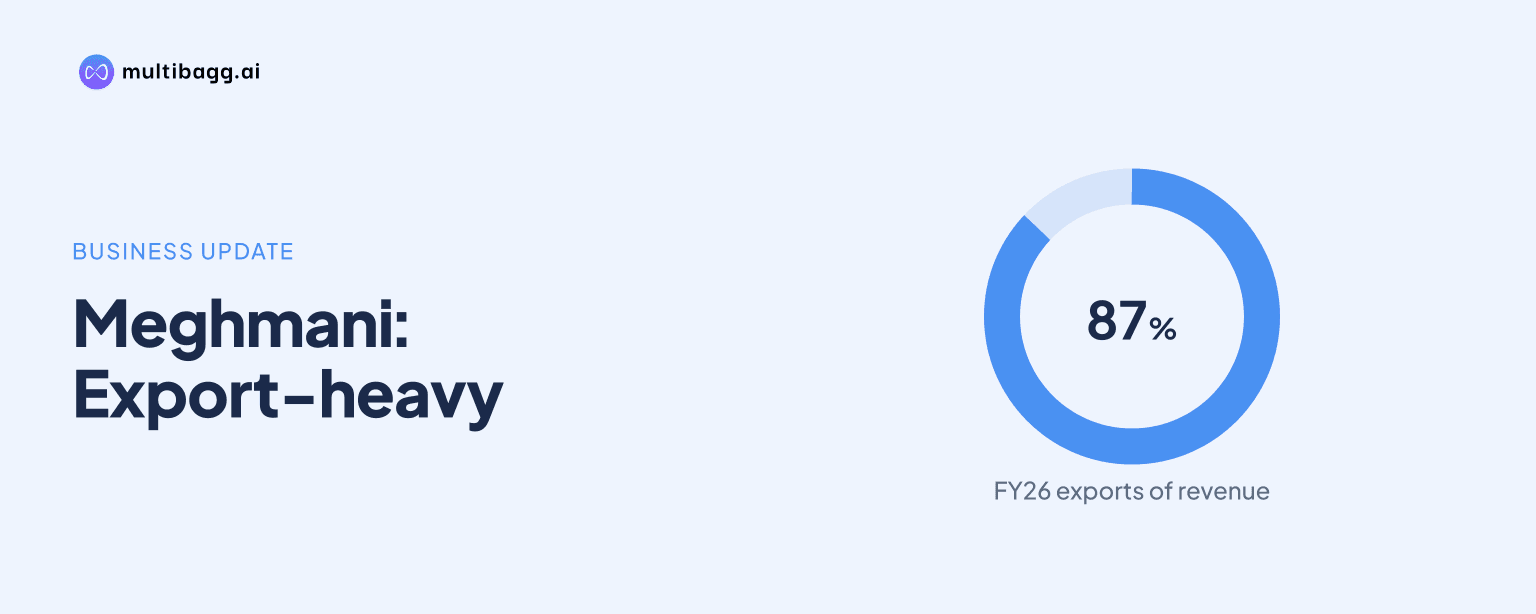
MOL generated Rs 1,631 crore in FY26 crop-protection revenue, of which exports were 87%, while its 2026 wholly owned Brazil subsidiary and 5,000 metric tonnes per annum (MTPA) Dahej multipurpose plant commissioned in 2023 support an export plan for high-value insecticides in more than 75 countries.
Know Meghmani Organics inside out
Results, valuation, peers and who's buying, in one view.
How export-dependent is MOL's crop-protection business?
MOL's crop-protection business is predominantly export-led: exports represented 87% of Rs 1,631 crore in FY26 revenue from operations, and the segment accounted for 78% of total revenue mix. The segment operates 55,980 MTPA of capacity across Ankleshwar, Dahej, Panoli and the Dahej multipurpose plant. Export contribution was also 87% in FY25, following 84% in FY24 and 89% in FY23.
FY26 crop-protection revenue rose by Rs 180 crore from Rs 1,451 crore in FY25, but remained Rs 309 crore below FY23 revenue of Rs 1,940 crore. Capacity increased by 1,020 MTPA from 54,960 MTPA in FY25 to 55,980 MTPA in FY26, while utilisation fell to 72% from 76%. The revenue recovery therefore coincided with lower utilisation of the expanded production base.
MOL also has a domestic route to market across 16 states, with more than 3,500 distributors and dealers, four manufacturing units and 19 warehouses in India. The company says its products and services reach approximately 10 million Indian farmers. However, the FY26 revenue mix shows that overseas markets remained the principal sales channel for crop protection.
Why is Brazil important to MOL's export plan?
Brazil is important because MOL says the US and Brazil together account for 45% of crop-protection demand, and it established a wholly owned subsidiary in Brazil in 2026 to cater to that market. The company also identifies Brazil and Latin America, along with Asia, Europe and Africa, as agricultural economies with different crop cycles that have supported crop-protection business through the year.
The Brazil subsidiary is part of an export network spanning more than 75 countries and more than 400 marquee customers. MOL is also setting up a representative office in China. These steps relate to a segment in which exports accounted for 87% of FY26 revenue and in which the US and Brazil already represent a significant part of demand.
MOL's registration base expanded to 893 in FY26 from 788 in FY25 and 685 in FY22. Export registrations increased by 70 to 450 in FY26, while registrations in India increased by 35 to 443. The latest-year addition to export registrations was therefore twice the increase in Indian registrations.
Got a follow-up? Ask IRIS
What does the Dahej multipurpose plant add to MOL's strategy?
The Dahej multipurpose plant adds 5,000 MTPA of installed capacity for high-value, new-age insecticides and was commissioned in 2023. MOL lists recently introduced products as Flubendamide, Cyfluthrin, Beta Cyfluthrin, Spiromesifen, Pymetrozine, Lambdacyhalothrin and Ethiprole. The facility adds products beyond established crop-protection offerings such as 2,4-D.
Management says the capital expenditure places MOL in the competitive landscape with multinational corporations and will provide a first-mover advantage. Management further says MOL is either the only manufacturer in India after a multinational corporation or the second manufacturer to produce these products. This is a management positioning statement rather than a disclosed market-share measure, but it identifies limited Indian manufacturing participation as the intended distinction.
MOL says it has built infrastructure for sustainable supply to global customers to benefit from the China Plus One strategy, or supply-chain diversification beyond China. The plant is therefore presented as a facility for supplying specified high-value insecticides to export customers, rather than solely as an addition to overall capacity. The presentation does not disclose a utilisation target for the 5,000 MTPA plant.
How do integration and registrations support MOL's product push?
MOL says it is an integrated crop-protection manufacturer covering pesticide intermediates, technical-grade pesticides and formulations sold in bulk packs and through branded business. Its facilities manufacture pyrethroid and herbicide pesticides, while key intermediates include cypermethric acid chloride, meta phenoxy benzaldehyde and meta phenoxy benzyl alcohol. The company says this intermediate production reduces reliance on imports.
The product basket includes 2,4-D, Profenophos, Cypermethrin, Lambda cyhalothrin, Bifenthrin, Dinotefuran, Flonicamid and Ethiprole. MOL also lists formulation brands including Megacyper, Megaban, Synergy, Courage, Megaclaim, Megastar Power, Megakill and Megastar. Several MPP products, including Cyfluthrin, Beta Cyfluthrin, Spiromesifen, Pymetrozine and Ethiprole, also appear in the wider listed portfolio.
MOL's in-house research and development facility and Good Laboratory Practice-accredited laboratory are intended to reduce the cost and cycle time for registration data, according to the presentation. Total registrations rose by 105 between FY25 and FY26, compared with an increase of eight between FY24 and FY25. Of the 893 registrations in FY26, 450 were for exports and 443 were in India.
Conclusion
MOL's crop-protection strategy combines an FY26 export base of Rs 1,631 crore, with 87% of revenue from overseas markets, with investments aimed at supplying those markets. The Brazil subsidiary addresses a country included with the US in 45% of demand, while the 5,000 MTPA Dahej multipurpose plant is intended to manufacture a specified group of high-value insecticides where management says Indian manufacturing competition is limited.
The next measures to watch are whether the Brazil subsidiary converts the existing demand base into sales growth, whether multipurpose-plant products contribute to utilisation above FY26's 72%, and whether export registrations continue to rise from 450. MOL has disclosed the Brazil subsidiary's market-serving objective and the plant's product plan, but it has not disclosed revenue or utilisation targets for these initiatives.