










MOL TiO₂ holds 18% Indian capacity as China duty returns
Key highlights
- MOL holds 18% of India’s disclosed domestic TiO₂ capacity through KCL.
- India imports about 79% of its TiO₂ requirement, while China represents 62% of the 4,85,000 MTPA market.
- The Ministry of Finance reimposed ADD on Chinese TiO₂ imports for five years on 24 October 2026.
- Paints and coatings account for 60% of TiO₂ applications, compared with 25% for plastics.
powered by IRIS
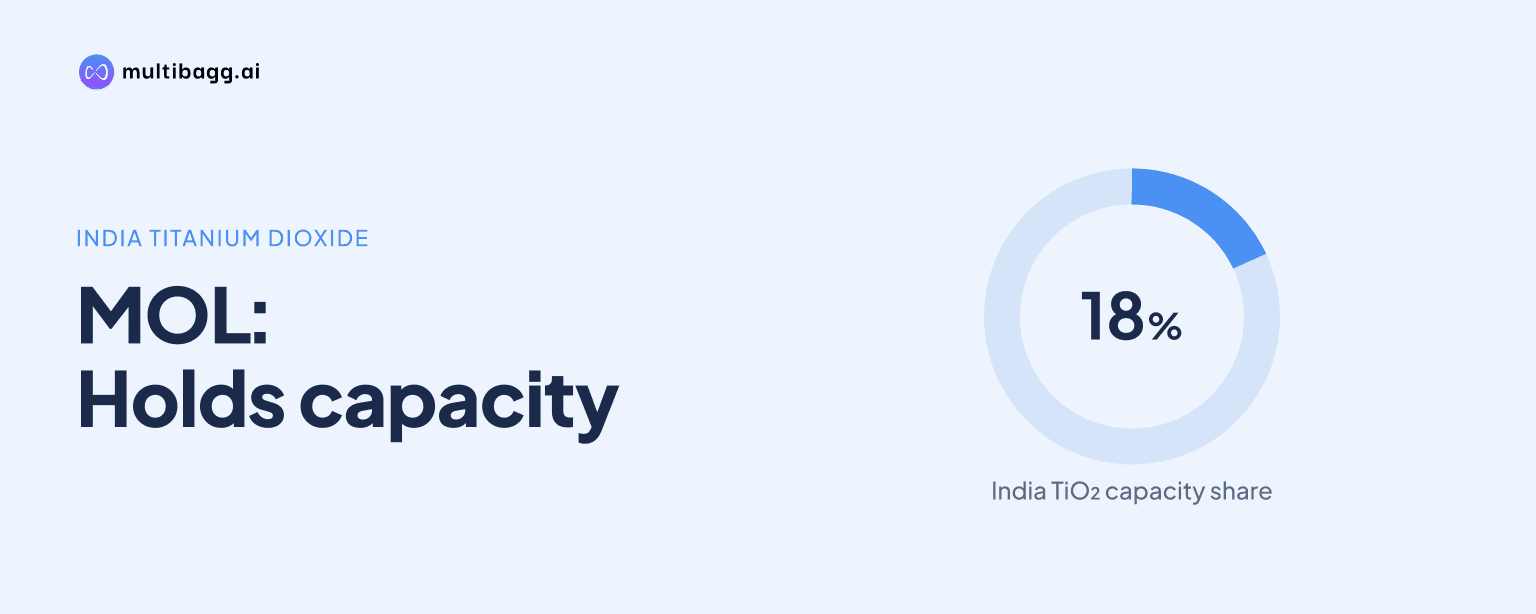
Meghmani Organics Limited (MOL) holds 18% of India’s domestic titanium dioxide capacity through Kilburn Chemicals Limited (KCL), while the Ministry of Finance reimposed anti-dumping duty on Chinese TiO₂ imports on 24 October 2026 for five years. India’s TiO₂ market totals 4,85,000 metric tonnes per annum (MTPA), with about 79% of requirements imported.
Know Meghmani Organics inside out
Results, valuation, peers and who's buying, in one view.
What is MOL’s position in India’s TiO₂ market?
MOL holds an 18% share of domestic TiO₂ capacity through KCL, according to the company’s industry overview. TiO₂, also called white pigment, is used to provide whiteness, opacity, brightness and ultraviolet resistance in end products. KCL gives MOL a position in a pigment category separate from its phthalocyanine pigment operations.
KCL ranks behind Kerala Minerals & Metals, which has 40% of disclosed domestic capacity, but ahead of Travancore Titanium Products at 17% and V.V. Titanium Pigments at 16%. MOL identifies itself as one of the few TiO₂ manufacturers in India, while locating KCL’s production site at Dahej, Gujarat.
India’s TiO₂ market totals 4,85,000 MTPA and is growing at a double-digit rate, according to MOL. Domestic supply represents 21% of the market, compared with China’s 62% and other sources’ 17%. This market split aligns with MOL’s estimate that imports account for about 79% of India’s TiO₂ requirement.
How dependent is India on imported TiO₂?
India imports about 79% of its TiO₂ requirement, with China supplying the largest share of imported material, MOL says. China accounts for 62% of the 4,85,000 MTPA market, compared with India’s 21% share. The gap between domestic supply and total demand is central to MOL’s stated import-substitution rationale for KCL.
The Ministry of Finance reimposed anti-dumping duty, or ADD, on TiO₂ imports from China on 24 October 2026 for five years. MOL says ADD had previously been withdrawn following a direction of the Kolkata High Court, after which the Directorate General of Trade Remedies (DGTR) took up the matter again for review. The disclosed duty concerns Chinese TiO₂ imports rather than every source of imported TiO₂.
The five-year ADD creates a defined policy period in a market where China represents 62% of supply and domestic sources account for 21%. MOL does not disclose the duty rate, projected import-volume changes or a financial forecast for KCL. Its presentation instead places the duty’s reinstatement alongside existing import dependence and its plan to support import substitution.
Got a follow-up? Ask IRIS
Which industries drive TiO₂ demand in India?
Paints and coatings are the largest disclosed TiO₂ end market at 60% of demand, followed by plastics at 25% and other applications at 15%. MOL also lists ceramic, rubber, textile and paper as TiO₂ applications. Across these products, the material provides opacity, brightness, whiteness and ultraviolet resistance.
MOL attributes TiO₂ demand growth to end-use industries including paints and coatings, plastics, rubber and ceramic, and says these industries are growing at a double-digit rate. The 60% share for paints and coatings makes it materially larger than plastics at 25%, while the remaining 15% includes other disclosed applications.
KCL produces anatase-grade TiO₂ at Dahej through the sulphate process, one of two production routes identified by MOL; the other is the chloride route. The Dahej facility includes a 12-megawatt captive power plant. MOL says sulphate-process know-how, together with handling bulk ilmenite and sulphuric acid, creates a high entry barrier for new producers.
Why did MOL acquire KCL for its pigment business?
MOL says it acquired KCL from NCIL to enter TiO₂ and broaden its pigment basket, describing the transaction as aligned with its long-term pigment-business expansion plan. Management also cites a higher-margin product opportunity, no stated threat from an alternative product or replacement, port proximity for key raw-material sourcing, and land for future growth at Dahej.
MOL’s existing pigment segment has capacity of 33,180 MTPA excluding TiO₂, across plants at Vatva, Panoli and Dahej. This capacity relates to phthalocyanine pigments rather than KCL’s TiO₂ operation, so it is not a measure of TiO₂ capacity. MOL says its pigment business operates in more than 75 countries and receives 90% of its business from repeat clients.
The pigment segment excluding TiO₂ reported revenue from operations of Rs 461 crore in FY26, down from Rs 553 crore in FY25. Utilisation declined to 40% from 46%, while export share fell by 2 percentage points to 78% from 80%. These figures describe the established pigment segment, not KCL, but provide context for MOL’s move into a further pigment category.
Conclusion
MOL’s KCL acquisition places the company in a domestically supplied portion of a 4,85,000 MTPA market dominated by imported material. The operating platform combines Dahej production through the sulphate process, anatase-grade TiO₂ and exposure to applications led by paints and coatings, which account for 60% of demand.
The next disclosed development to watch is the five-year ADD on Chinese TiO₂ imports that began on 24 October 2026. MOL also identifies land at Dahej for future growth, but the presentation provides no expansion timetable, capital-spending amount, production target or forecast financial contribution from KCL.