










MCX base-metal deliveries reach 6.21 lakh tonnes to date
Key highlights
- MCX reported around 6.21 lakh tonnes of metal deliveries since compulsory delivery contracts were phased in from March 2019.
- MCX base-metal deliveries rose to 34,707 tonnes in Q2 FY27 from 28,945 tonnes in Q1 FY27.
- Copper contributed 22,158 tonnes, or 63.8%, of MCX’s Q2 FY27 base-metal deliveries.
- MCX lists five designated metal warehouse locations: Thane, Raipur, Chennai, Kolkata and Palwal.
powered by IRIS
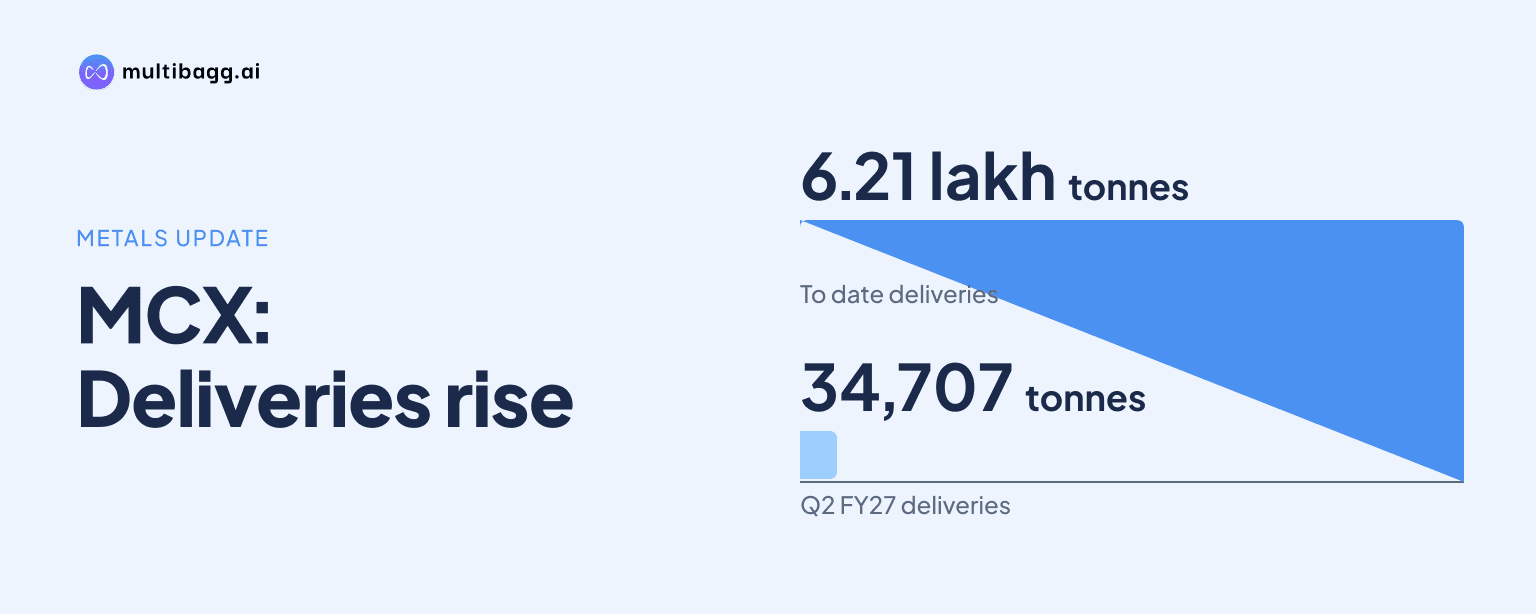
MCX reported around 6.21 lakh tonnes of base-metal deliveries since its contracts transitioned to compulsory delivery, with 34,707 tonnes delivered through call variants in Q2 FY27. Copper accounted for 22,158 tonnes, or 63.8% of the quarter’s total, while MCX says the transition to delivery-based settlement was phased in from March 2019.
Know Multi Commodity Exchange of India inside out
Results, valuation, peers and who's buying, in one view.
What base-metal delivery scale has MCX reached?
MCX has witnessed deliveries of around 6.21 lakh tonnes of metals since the transition to compulsory delivery contracts, according to its Q2 FY27 investor presentation. The exchange lists aluminium, copper, lead, nickel and zinc as deliverable base-metal contracts, with each showing a 2019 start year in its cumulative delivery data.
The commodity-level cumulative figures total 6,22,820 tonnes, equivalent to about 6.23 lakh tonnes. They comprise 1,93,586 tonnes of aluminium, 1,90,423 tonnes of copper, 1,46,227 tonnes of zinc, 80,963 tonnes of lead and 11,621 tonnes of nickel. This total is close to MCX’s rounded statement of around 6.21 lakh tonnes, although the presentation does not provide a reconciliation between the two figures.
MCX states that all base-metal contracts were converted into delivery-based settlement contracts from March 2019 onward in a phased manner. The delivery measure therefore records quantities settled through contracts, rather than the value of futures or options trading on the exchange.
The presentation also reports cumulative deliveries in other commodity categories. Gold contracts had a cumulative total of 181.52 tonnes, while silver contracts had a cumulative total of 6,460.49 tonnes; the metals-and-agri table additionally lists 47,469 tonnes of mentha oil and 2,598 tonnes of rubber.
How did MCX base-metal deliveries change in Q2 FY27?
MCX delivered 34,707 tonnes of base metals through call variants in Q2 FY27, compared with 28,945 tonnes in Q1 FY27 and 18,808 tonnes in Q2 FY26. The Q2 FY27 result was 5,762 tonnes higher quarter on quarter and 15,899 tonnes higher year on year.
The quarterly result also exceeded the quarterly average implied by the FY26 total. MCX reported 95,782 tonnes for FY26, equal to about 23,946 tonnes per quarter, whereas Q2 FY27 deliveries were 34,707 tonnes. FY26 deliveries were 26,399 tonnes above the FY25 total of 69,383 tonnes.
The increase from Q1 FY27 was not uniform across metals. Copper, lead, aluminium and nickel recorded higher deliveries, while zinc fell by 852 tonnes to 1,798 tonnes. Copper added 2,728 tonnes and lead added 3,272 tonnes, together accounting for 6,000 tonnes of the 5,762-tonne overall quarterly increase.
MCX’s delivery data should be read separately from turnover. Base metals generated average daily futures and options turnover of Rs 20,605 crore in Q2 FY27, up from Rs 16,313 crore in Q1 FY27 and Rs 2,638 crore in Q2 FY26, while the delivery table measures physical quantities rather than trading value.
Got a follow-up? Ask IRIS
Which metal drove MCX deliveries in Q2 FY27?
Copper drove MCX’s Q2 FY27 base-metal deliveries, contributing 22,158 tonnes out of the 34,707-tonne total. Its 63.8% share was greater than the combined 12,549 tonnes delivered in aluminium, lead, nickel and zinc contracts during the quarter.
Copper deliveries increased from 19,430 tonnes in Q1 FY27 and 3,203 tonnes in Q2 FY26. The 18,955-tonne year-on-year increase was the largest among the five reported base metals, and copper was also the leading single metal in Q2 FY27 futures turnover at 7.00% of MCX commodities futures turnover in H1 FY27.
Lead was the second-largest delivery category in Q2 FY27 at 6,952 tonnes, followed by aluminium at 3,670 tonnes. Lead rose from 3,680 tonnes in Q1 FY27, while aluminium increased from 3,123 tonnes; nickel rose from 62 tonnes to 129 tonnes but remained the smallest quarterly category.
The cumulative mix differs from the Q2 FY27 pattern. Aluminium is MCX’s largest base-metal delivery category since inception at 1,93,586 tonnes, narrowly ahead of copper at 1,90,423 tonnes. Zinc ranks third cumulatively at 1,46,227 tonnes despite its Q2 FY27 delivery volume declining from both Q1 FY27 and Q2 FY26.
Where can MCX base-metal contracts be delivered?
MCX has designated warehouses in Thane, Raipur, Chennai, Kolkata and Palwal in the National Capital Region for its deliverable metal contracts. The presentation identifies these five locations but does not disclose warehouse capacity, metal-specific storage allocation or delivery volumes by warehouse.
These locations support contracts for aluminium, copper, lead, nickel and zinc, all of which were converted to delivery-based settlement in phases from March 2019. Q2 FY27 delivery volumes across these contracts ranged from 129 tonnes for nickel to 22,158 tonnes for copper.
MCX’s broader operating data gives context on market activity but does not show how many traders participated in physical delivery. The exchange reported 4.0 lakh futures traded clients and 13.0 lakh options traded clients in Q2 FY27, while client trading represented 53.31% of futures activity and 41.59% of options activity.
MCX also reported 613 members, 28,913 authorised persons, presence across 652 cities and towns, and 5.37 crore unique client codes. None of these measures specifies the number of warehouse users, delivery participants or clients taking delivery in Q2 FY27.
Conclusion
MCX’s reported delivery data shows that its compulsory delivery framework has handled around 6.21 lakh tonnes of base metals since the phased transition began in March 2019. Q2 FY27 deliveries of 34,707 tonnes were higher than both Q1 FY27 and Q2 FY26, with copper’s 22,158 tonnes accounting for nearly two-thirds of the quarter’s delivered volume.
The next quarterly disclosure will show whether copper remains the largest delivery driver after its increase from 19,430 tonnes in Q1 FY27, and whether zinc recovers from 1,798 tonnes in Q2 FY27. MCX identifies five designated warehouse locations, but the presentation does not disclose warehouse capacity, an expansion plan or a delivery-volume target for the network.