










MCX Has About 250 FPIs, While Wider Access Awaits Rules
Key highlights
- MCX had onboarded about 250 FPIs by Q2 FY27.
- FPI volumes currently come from permitted cash-settled energy contracts.
- MCX average daily turnover reached Rs 12.6 lakh crore in Q2 FY27, up 20% from Rs 10 lakh crore in the preceding quarter.
- MCX reported 19.8 lakh traded clients in H1 FY27, compared with 20.9 lakh in the full prior year.
powered by IRIS
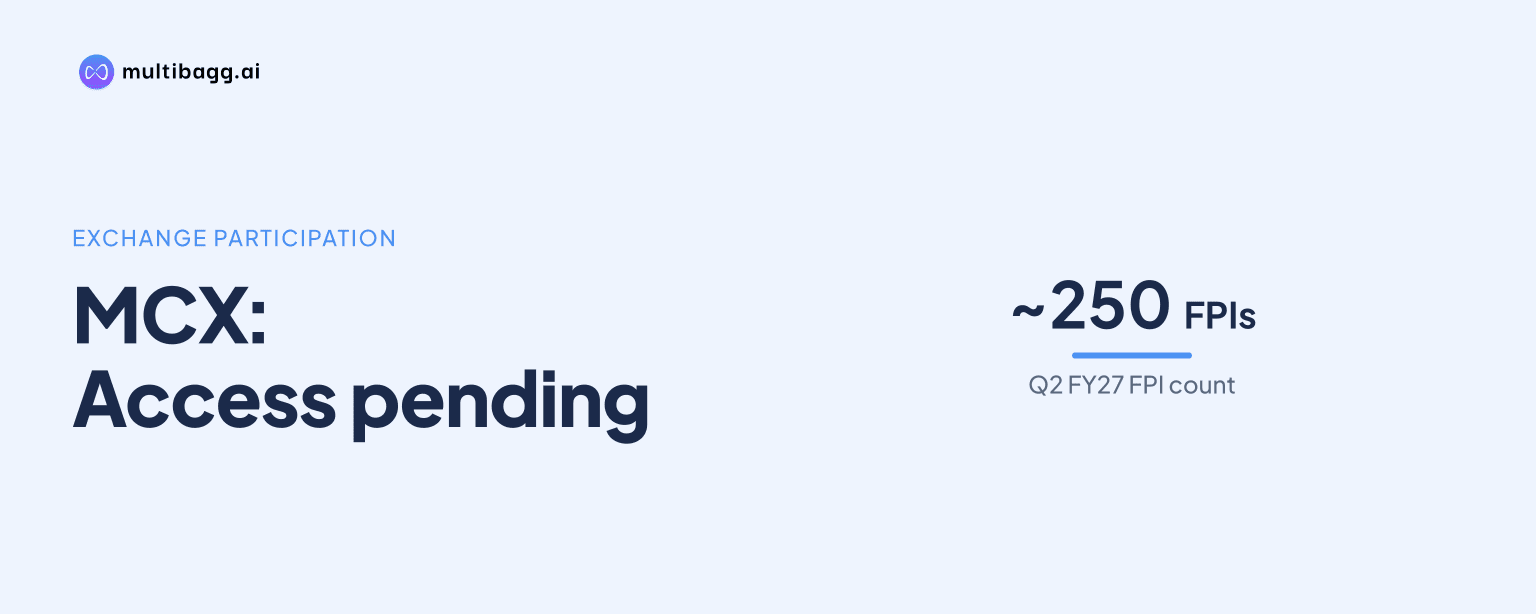
Multi Commodity Exchange of India Limited had onboarded about 250 foreign portfolio investors, or FPIs, by Q2 FY27, but their current activity is limited to permitted cash-settled energy contracts while final regulatory circulars are awaited. Management said FPI volumes are already coming into allowed contracts and expects foreign investors to take a larger role over time as the regulatory framework is finalised.
Know Multi Commodity Exchange of India inside out
Results, valuation, peers and who's buying, in one view.
What contracts can MCX FPIs trade today?
MCX said FPIs currently generate volumes in cash-settled energy contracts where they are permitted to trade. Management made this distinction while answering questions on the regulatory consultation paper, and it did not provide a date for access to additional commodity contracts.
The current scope is narrower than MCX's overall product range, which includes energy, bullion, base metals and agricultural commodities. Management did not identify an eligible list of additional contracts under the pending framework, nor did it disclose FPI turnover, open interest or the foreign-investor share of Q2 FY27 volumes.
The distinction is important because the exchange reported average daily turnover of Rs 12.6 lakh crore during the quarter, up 20% from Rs 10 lakh crore in the preceding quarter. MCX did not attribute that increase to FPIs, meaning the reported market-wide growth cannot be used to measure foreign participation.
How many FPIs has MCX onboarded?
MCX had onboarded about 250 FPIs as of its Q2 FY27 earnings call. Management said those investors were participating in the contracts where they are currently permitted, confirming that the existing energy-contract access is already operational rather than solely a future proposal.
Management described FPI participation as healthy and growing in late single-digit numbers, but did not specify whether that referred to trading volumes, client additions, market share or another measure. It also said it would not expect or want one participant category to become a very large contributor to the exchange.
The FPI count is distinct from MCX's much broader domestic and institutional client base. The exchange reported 19.8 lakh traded clients in the first half of FY27, nearing the 20.9 lakh traded clients reported for the full prior year. That comparison indicates wider participation growth across the platform, but it does not show how many of the 250 FPIs were active during the period.
Why is wider FPI access still pending?
Wider FPI participation remains dependent on final regulatory circulars, according to management. MCX said the consultation paper followed due diligence with relevant stakeholders, but it gave no timetable for the final rules or for any expansion in eligible contracts.
Management said it expects FPIs to play an increasing role in commodity derivatives over time as onboarding continues after the final circulars are issued. This is a management expectation, not a volume target: the call did not disclose a projected FPI client count, market-share objective or target date for broader participation.
An analyst noted that FPIs have been permitted in cash-settled commodities for some time without a significant scale-up in activity. The analyst asked whether co-location, product diversity or liquidity would be required for volumes to rise. MCX did not identify any of these mechanisms as a formal prerequisite for higher FPI activity.
Got a follow-up? Ask IRIS
Is FPI participation connected to MCX technology plans?
No, MCX said FPI participation and its data-centre planning are separate matters. Management said the exchange had nearly doubled its capacity in the preceding months, while a possible move involving the primary matching engine and data-centre operations remained under detailed review following stakeholder inputs.
An analyst asked whether FPI trading could begin alongside an infrastructure shift. Management rejected that linkage, saying capacity expansion was intended to support broader business growth and future scale rather than any specific investor segment. The review of the data-centre approach will be communicated once an optimum approach is reached.
MCX also said the higher technology costs associated with the expanded capacity are recurring operating expenses rather than one-time capital expenditure. This explanation separates the technology spending from the FPI regulatory issue, although both concern the exchange's ability to handle higher activity over time.
What products could support wider participation on MCX?
MCX said discussions with FPIs had shown heightened interest in India-specific contracts, especially those with domestic price discovery and delivery linkage. Management presented this as an indication of investor interest, while the presently stated FPI volumes remain in permitted cash-settled energy contracts.
The exchange has expanded contract features for domestic hedging. Futures in aluminium, copper and zinc now extend up to 12 months, while crude oil futures extend up to 18 months. Management said longer-dated contracts were sought by corporate and financial institutional participants seeking a longer planning horizon.
MCX also cited product activity across its markets. Its silver 100-gram futures contract, launched earlier in FY27, had average daily turnover of more than Rs 100 crore, while Gold 10-Gram Futures, introduced in the prior year, was described as popular. These products illustrate the wider portfolio, but management did not say they were currently accessible to FPIs.
Delivery arrangements are also changing in some metal contracts. Delivery locations for lead and zinc were consolidated to Chennai and Thane, respectively, while mini lead and zinc contracts use Palwal and Kolkata, respectively. These changes were scheduled to take effect in November 2026 and are intended to reduce the need for multiple Goods and Services Tax registrations for suppliers and buyers.
Conclusion
MCX has established an FPI base of about 250 investors and confirmed that these participants trade permitted cash-settled energy contracts. However, the Q2 FY27 call provided no final rule, timetable, eligible-contract list or foreign-volume measure for wider participation. The 20% sequential rise in average daily turnover to Rs 12.6 lakh crore reflects broader market activity, not a disclosed FPI scale-up.
The next development to watch is the final regulatory circulars that management said are required for wider FPI participation. Investors can also monitor announcements from MCX's paced product pipeline, the November 2026 lead and zinc delivery-location changes, and any future disclosure of FPI turnover or open interest. Management said it intends to deepen participation, broaden products and continue capacity-related technology investment.