










MCX sees no SGF additions for a few quarters after SEBI change
Key highlights
- SEBI’s August 2026 circular reduced the SGF calculation Z-score from 10 to five.
- MCX said its existing SGF balance should be sufficient for a few quarters, potentially two or three quarters.
- Q2 regulatory-fund contributions excluded an SGF portion but included IPF, ISF and other payments.
- MCX said it had nearly doubled capacity, creating recurring technology operating costs.
powered by IRIS
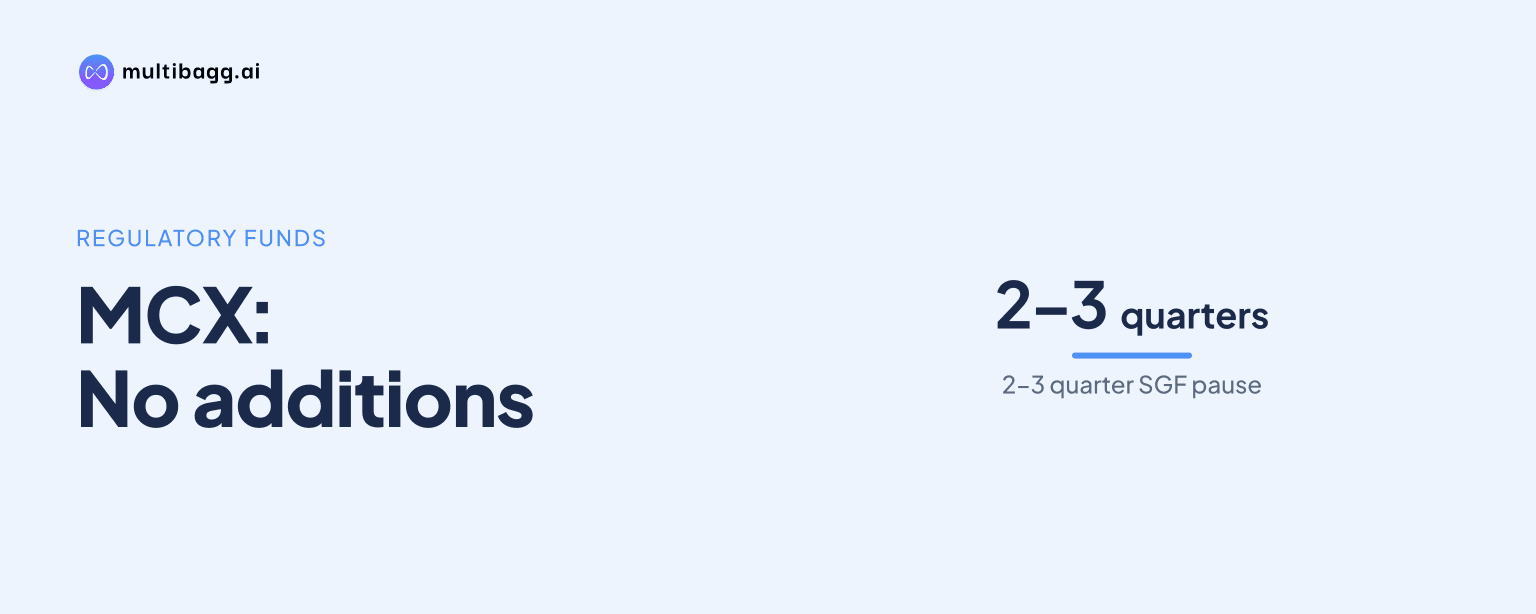
MCX said its existing settlement guarantee fund should cover requirements for a few quarters after SEBI’s August 2026 circular cut the Z-score used in the calculation from 10 to five, reducing Q2 regulatory-fund contributions and contributing to higher profit in the quarter.
Know Multi Commodity Exchange of India inside out
Results, valuation, peers and who's buying, in one view.
What changed in MCX’s settlement guarantee fund requirement?
SEBI’s August 2026 circular reduced the Z-score used in MCX’s settlement guarantee fund, or SGF, calculation from 10 to five, lowering the required fund amount. Management said the circular rationalised the SGF calculation and resulted in a significant reduction in the contribution required under the earlier method.
The SGF is a regulatory resource for settlement obligations rather than a discretionary operating reserve. MCX said contributions made up to Q2 are sufficient under the revised calculation, so it does not foresee a further SGF investment over the coming few quarters. The change reduces the amount required under the formula, but does not mean MCX has stopped reviewing its settlement-risk requirement.
Why did MCX’s regulatory costs fall in Q2?
MCX said Q2 regulatory costs were lower because it did not need to make an SGF contribution after the August 2026 change. Chandresh Shah said the lower SGF requirement was the reason contributions to statutory and regulatory funds appeared lower in Q2, while the existing SGF balance provided a temporary buffer.
Management also clarified that Q2 regulatory-fund cost was not zero. The contribution reported in the quarter covered other required items, including the Investor Protection Fund, or IPF, and the Investor Services Fund, or ISF, alongside other regulatory payments. The remaining Q2 regulatory-cost line therefore cannot be treated as a continuing SGF charge.
The lower SGF contribution had a direct effect on reported Q2 profit, according to Shah. In a separate response on tax, he said MCXCCL made a tax provision and MCX re-evaluated its annual effective tax rate following the SEBI circular; the effect was recorded in Q2, while the effective tax rate for H1 was close to 25%.
Management said it expects the effective tax rate going forward to be closer to 25%, but that comment addressed tax rather than the duration of the SGF buffer. The Q2 profit effect therefore had two disclosed elements: reduced SGF contribution and a year-to-date tax-rate reassessment. Neither statement establishes a fixed quarterly profit benefit beyond the period in which the fund buffer remains available.
How long can MCX avoid new SGF contributions?
MCX expects to avoid additional SGF contributions for a few quarters, not for future years. When asked whether the balance-sheet SGF could be sufficient indefinitely, Praveena Rai said management could not make that claim and described the likely buffer as perhaps two or three quarters, while stressing that the exact duration was difficult to determine.
That wording is more limited than a permanent cost reset. Rai said MCX expects any restarted contribution to be more optimised than it was in the past, reflecting the Z-score reduction from 10 to five. However, she did not provide a quarterly SGF expense target, a minimum balance target or a date for when contributions would resume.
An analyst calculated regulatory cost at about 3.3% of transaction income and compared it with a typical 8% provision. Shah replied that the current Q2 contribution did not include an SGF portion because it represented IPF, ISF and other regulatory payments. MCX therefore did not endorse 3% to 3.5% as a new recurring SGF-cost range.
Got a follow-up? Ask IRIS
What will determine MCX’s future SGF requirement?
MCX said open interest is one input to SGF requirements, but it is not the only one. Shah described the calculation as complex, with several parameters affecting the required fund amount, meaning a single open-interest threshold cannot determine when MCX’s existing balance will cease to be sufficient.
MCX said it reviews the SGF requirement every quarter and every year. That process means trading conditions and the inputs in the regulatory calculation can affect the timing of renewed contributions, even though the revised Z-score method currently gives MCX a buffer for a couple of quarters.
The disclosure also separates SGF requirements from other business activity. In Q2, management said participation was growing across retail and proprietary segments, but that the proportional contribution of those participant groups had not changed following the Reserve Bank of India circular that took effect in July. MCX did not link that participant mix directly to a forecast of SGF funding needs.
Why are MCX’s technology and licence costs rising while regulatory costs decline?
MCX said technology costs are increasing because capacity was significantly enhanced over the last few months, while SGF costs fell because of the August 2026 formula revision. The exchange said it had nearly doubled capacity, and the resulting maintenance, infrastructure and other running expenses are operating costs rather than one-time capital expenditure.
Management said these technology costs are recurring as MCX plans for growth and continues capacity-management work. It did not provide a single run-rate figure because capacity is assessed through several measures, including monthly and daily volume capability, performance optimisation and infrastructure expansion. That makes the cost trend different from the Q2 SGF reduction, which arose from a specific regulatory calculation change.
Product licence fees also rose for a different reason. Shah said the cost is linked to turnover and relates to crude pricing licensed from CME, so it would be largely proportional to business volumes. The comparison across cost lines is clear: higher technology spending reflects enhanced capacity, higher licence fees track crude-related turnover, and lower regulatory cost in Q2 reflects the absence of an SGF contribution.
Conclusion
MCX’s main regulatory-cost change is temporary relief from incremental SGF funding after SEBI reduced the calculation’s Z-score from 10 to five in August 2026. The effect lowered Q2 contributions to statutory and regulatory funds and increased profit, while other costs moved in the opposite direction as capacity expansion and turnover-linked crude pricing increased technology and licence expenses.
The next point to watch is MCX’s quarterly and annual SGF review, because management indicated a buffer of perhaps two or three quarters rather than future years. Management has not disclosed the point at which SGF contributions will restart or a target recurring contribution, though it expects future contributions to be more optimised than under the earlier calculation.