










Meta Infotech H1 revenue falls 57% while EBITDA margin rises
Key highlights
- Meta Infotech reported H1 FY27 revenue of Rs 89.5 crore, down 57% from Rs 210 crore in H1 FY26.
- Meta Infotech's H1 FY27 EBITDA margin rose to 8.7% from 7.5% in H1 FY26 and 3.8% in H2 FY26.
- Services represented about 29% of Meta Infotech's current revenue mix, compared with a historical 15%.
- Meta Infotech's order book was Rs 92.7 crore as of September 2026, with services comprising about 40% to 45% of current business orders.
powered by IRIS
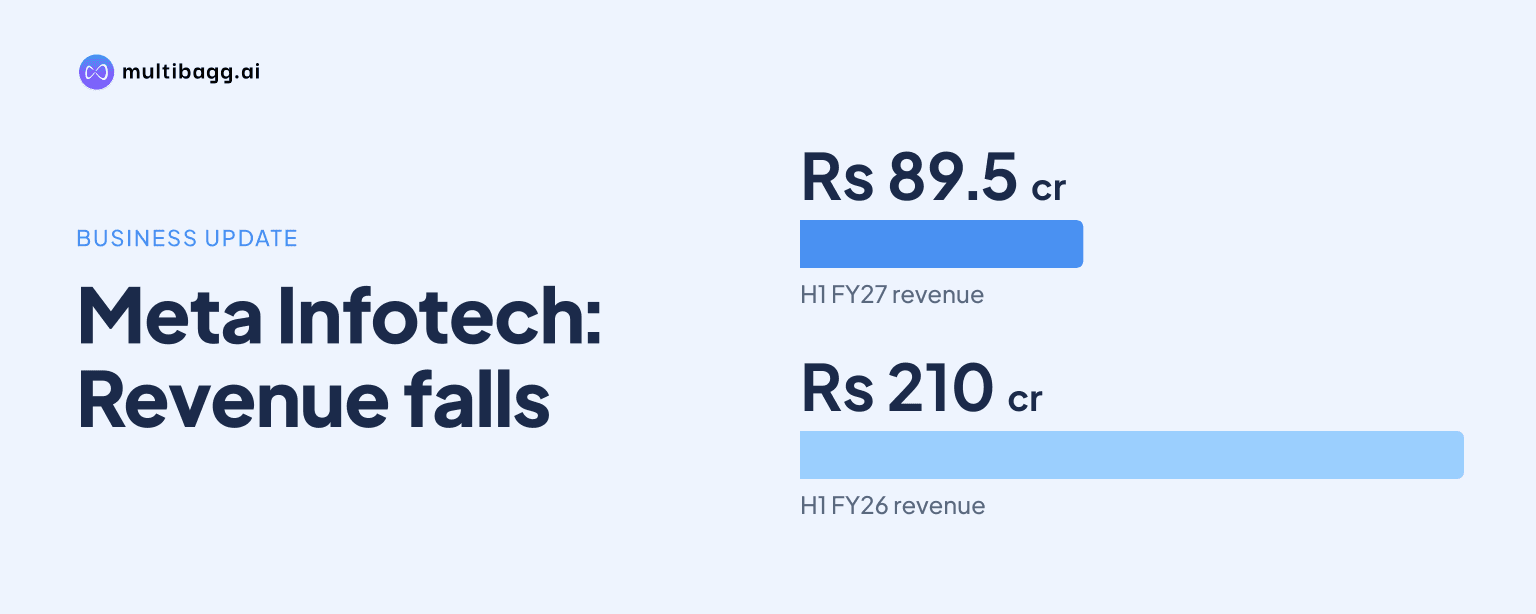
Meta Infotech Limited reported H1 FY27 revenue of Rs 89.5 crore, down 57% year on year after it discontinued lower-margin product sales to a leading banking client, while EBITDA margin rose to 8.7% from 7.5%. Management said it retained the client relationship through cybersecurity services.
Know Meta Infotech inside out
Results, valuation, peers and who's buying, in one view.
Why did Meta Infotech's H1 FY27 revenue fall 57%?
Meta Infotech's revenue fell because it deliberately stopped certain low-margin product sales to a leading banking client as part of its services-led strategy. Revenue from operations for the half year ended September 30, 2026 was Rs 89.5 crore, compared with Rs 210 crore in H1 FY26, producing the 57% year-on-year decline.
Meta Infotech said the decision did not end its relationship with the client, because it continues to provide cybersecurity services to that bank. Management described the discontinued business as lower-margin product sales and said the company is prioritising higher-value cybersecurity services and profitable opportunities over product-led revenue.
The year-on-year decline contrasts with the immediately preceding half-year trend. H1 FY27 revenue of Rs 89.5 crore was 49% above Rs 59.9 crore in H2 FY26, indicating a recovery from the prior six months even though revenue remained below the Rs 210 crore reported in H1 FY26.
How did Meta Infotech's profitability change in H1 FY27?
Meta Infotech's absolute EBITDA and profit after tax declined from H1 FY26, but both EBITDA and PAT margins increased. EBITDA, or earnings before interest, tax, depreciation and amortisation, was Rs 7.8 crore in H1 FY27 versus Rs 15.8 crore a year earlier, while the EBITDA margin rose 1.2 percentage points to 8.7%.
The sequential movement was different. EBITDA increased from Rs 2.3 crore in H2 FY26 to Rs 7.8 crore in H1 FY27, and the margin increased from 3.8% to 8.7%. Management attributed the 4.9-percentage-point margin increase to the removal of lower-margin product revenue and a greater focus on higher-margin cybersecurity services.
PAT was Rs 4.9 crore in H1 FY27, compared with Rs 10.4 crore in H1 FY26, while PAT margin increased to 5.4% from 5%. PAT also rose from Rs 40 lakh in H2 FY26, showing a sequential improvement alongside the recovery in revenue and EBITDA during the latest half year.
Meta Infotech did not provide an EBITDA-margin target for FY27. The reported numbers therefore show the immediate trade-off in its strategy: lower revenue, EBITDA and PAT than a year earlier, alongside higher operating and net-profit margins.
Got a follow-up? Ask IRIS
How is Meta Infotech changing its revenue mix?
Meta Infotech is increasing the role of services after historically deriving about 85% of revenue from products and 15% from services. Management said the current mix is about 71% products and 29% services, lifting the services share by about 14 percentage points from the earlier composition.
Meta Infotech plans to pursue vendor-linked, niche cybersecurity solutions rather than broad security consulting. Management said consulting work is often a one-time process with many participants, whereas its preferred model is product-based services; it also said the company does not sell firewall products.
The order book was Rs 92.7 crore as of September 2026, and management said services represented about 40% to 45% of current business orders. That compares with a historical services component of roughly 15% to 20%, although management acknowledged that the total order book was below historical levels.
Recurring revenue is central to the proposed model. Meta Infotech said product contracts normally run for three to five years and managed-service or sustenance work is a second recurring stream; it serves more than 30 customers in that work and typically seeks contract increases of 8% to 10% on renewal.
What is Meta Infotech doing to support services growth?
Meta Infotech is expanding from one Mumbai location and two vendors before its initial public offering to five Indian locations and a broader vendor network. The company named Bangalore, Chennai, Hyderabad and Delhi as additional domestic markets, added three vendors and 12 clients in H1 FY27, and said Gulf operations form a sixth location.
Management said Meta Infotech has added about 10 vendors since the initial public offering, including eight beyond its original two-vendor base. It said vendor selection requires technical analysis and commitment, and added that the company was in the process of signing with one of the largest system integrators in the United States, without naming the partner or giving a completion date.
Customer concentration is also part of the expansion plan. Management said one client had historically accounted for about 30% to 45% of revenue, but Meta Infotech is targeting 50 accounts in Mumbai that it expects to generate about 80% of business, alongside 15 accounts in each of Bangalore, Chennai, Hyderabad and Delhi.
Conclusion
Meta Infotech's H1 FY27 results reflect a deliberate change in commercial mix rather than a simple sales decline. Revenue fell 57% to Rs 89.5 crore after lower-margin bank product sales were discontinued, but EBITDA margin rose to 8.7%, services reached about 29% of the revenue mix and services represented about 40% to 45% of current business orders.
The next H2 FY27 results will indicate whether the higher-services mix can support growth in absolute earnings as well as margins. Investors can watch conversion of the Rs 92.7 crore order book, contributions from the 12 H1 FY27 client additions and three vendors, and management's stated target of FY29 PAT at four times FY26 PAT.