










Meta Infotech H1FY27 revenue fell 57% as gross margin rose
Key highlights
- Meta Infotech reported H1FY27 revenue of Rs 89.5 crore, down 57% year on year.
- Meta Infotech’s H1FY27 gross margin rose to 32.2% from 16.8% in H1FY26.
- Meta Infotech reported an order book of Rs 92.7 crore as of September 30, 2026.
- Meta Infotech added 12 clients and onboarded three vendors during H1FY27.
powered by IRIS
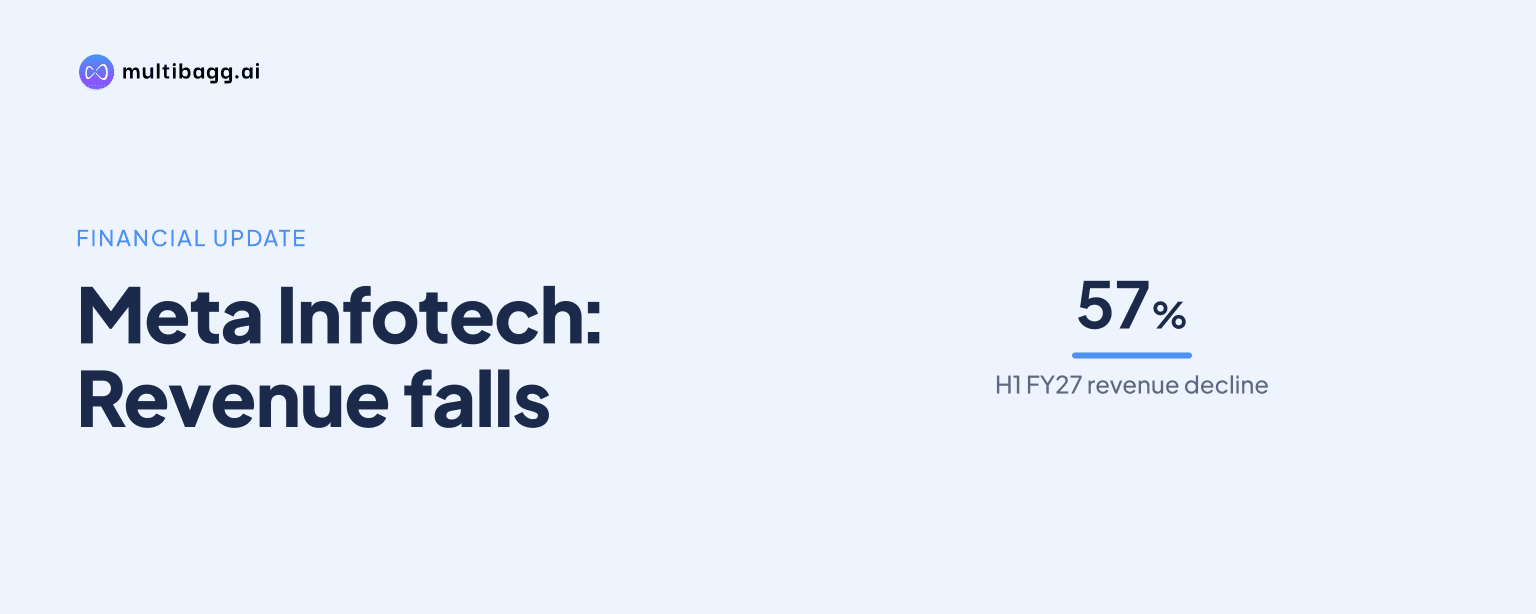
Meta Infotech reported H1FY27 revenue of Rs 89.5 crore, down 57% year on year, after discontinuing product sales to a leading banking client, while gross margin increased to 32.2% from 16.8%. The figures show the immediate revenue cost of a services-led sales mix, even as unit economics improved.
Know Meta Infotech inside out
Results, valuation, peers and who's buying, in one view.
Why did Meta Infotech’s H1FY27 revenue fall?
Meta Infotech’s revenue fell because it stopped product sales to a leading banking client to protect margins, while retaining its cybersecurity partnership with that client through services. Revenue from operations was Rs 89.5 crore in H1FY27, compared with Rs 210.1 crore in H1FY26, a 57% decline reported by the company. Management described the change as a conscious move toward higher-value cybersecurity services rather than lower-margin product-led revenue.
The half-year decline followed Meta Infotech’s highest reported annual revenue of Rs 270 crore in FY26, compared with Rs 218.8 crore in FY25. That annual expansion was therefore not carried into H1FY27, when the company reset the sales mix. The presentation does not quantify the discontinued banking-client product revenue separately, so the exact contribution of that customer to the Rs 120.6 crore year-on-year revenue reduction is not disclosed.
Did Meta Infotech’s margins improve after the sales shift?
Yes, Meta Infotech’s gross margin increased to 32.2% in H1FY27 from 16.8% in H1FY26, even though gross profit declined in absolute terms. Gross profit was Rs 28.8 crore, down 18% from Rs 35.2 crore a year earlier, but the smaller decline than the 57% revenue contraction produced the higher margin. The company attributes that improvement to the transition toward higher-margin cybersecurity services and an emphasis on revenue quality.
The cost lines reflect a smaller product business. Purchases of stock in trade fell to Rs 40.8 crore in H1FY27 from Rs 193.7 crore in H1FY26, while changes in inventories were Rs 19.9 crore versus negative Rs 18.8 crore. Employee expenses increased to Rs 14.3 crore from Rs 11.2 crore, and other expenses declined to Rs 6.7 crore from Rs 8.3 crore. These reported movements accompanied the mix change, although the presentation does not isolate the margin effect of each individual cost line.
How did Meta Infotech’s operating and net profit compare?
Meta Infotech’s operating and net profits declined year on year in H1FY27 despite the higher gross margin. Earnings before interest, tax, depreciation and amortisation, or EBITDA, were Rs 7.8 crore, down 50% from Rs 15.8 crore, while EBITDA margin rose to 8.7% from 7.5%. Profit before tax was Rs 6.5 crore versus Rs 14 crore, and profit after tax, or PAT, was Rs 4.9 crore, down 53% from Rs 10.4 crore.
The sequential comparison was more favourable than the year-on-year one. Against H2FY26, when revenue was Rs 59.9 crore, H1FY27 revenue increased 49% to Rs 89.5 crore and gross profit rose 42% from Rs 20.3 crore to Rs 28.8 crore. EBITDA increased from Rs 2.3 crore in H2FY26 to Rs 7.8 crore, while PAT moved from Rs 0.4 crore to Rs 4.9 crore. Gross margin was 34% in H2FY26, compared with 32% on the rounded H1FY27 presentation basis.
Got a follow-up? Ask IRIS
What evidence supports Meta Infotech’s services-led strategy?
Meta Infotech had an order book of Rs 92.7 crore as of September 30, 2026, and added 12 new clients during H1FY27. The company said the lower order book reflected its strategic choice to pursue higher-margin, value-added services and profitable growth. Banking represented 36% of the order book, followed by capital markets at 23%, non-banking financial companies at 21%, and other sectors at 20%.
The company also onboarded three new vendors, which management said broadened its ability to provide integrated cybersecurity solutions. Meta Infotech expects better operating efficiencies and margins as those partnerships mature and volumes scale, which is a management expectation rather than a reported result. Its newer capabilities include micro segmentation, which divides a network into isolated segments, and identity and access management, designed to manage digital identities and access controls.
How has Meta Infotech’s financial position changed by September 2026?
Meta Infotech’s total assets were Rs 101.2 crore at September 2026, down from Rs 128.6 crore at March 2026, alongside lower current assets. Inventories declined to Rs 1.9 crore from Rs 21.8 crore, trade receivables fell to Rs 41.8 crore from Rs 56.3 crore, and cash and cash equivalents were Rs 2.4 crore compared with Rs 2.5 crore. The inventory movement is consistent with the lower product-sales activity described for H1FY27.
Total liabilities declined to Rs 101.2 crore at September 2026 from Rs 128.6 crore at March 2026, while shareholders’ funds increased to Rs 78.2 crore from Rs 73.3 crore. Current liabilities fell to Rs 21.1 crore from Rs 53.6 crore, including trade payables of Rs 9.2 crore versus Rs 39.5 crore. Short-term borrowings decreased to Rs 6 crore from Rs 8.5 crore, and long-term borrowings remained nil at both March 2026 and September 2026.
Conclusion
Meta Infotech’s H1FY27 results show the trade-off in its strategy: revenue fell 57% to Rs 89.5 crore and PAT fell 53% to Rs 4.9 crore, but gross margin rose to 32.2% from 16.8%. The company reduced product-sales exposure in a major banking relationship while retaining the related services partnership, with lower purchases of stock and inventories accompanying that change.
The next indicators are whether the Rs 92.7 crore order book at September 30, 2026 converts into services revenue and whether the 12 H1FY27 client additions and three new vendor relationships scale. Management’s stated plan is to expand high-value cybersecurity services, develop newer geographies including Chennai, Bengaluru, Hyderabad and Delhi, and seek improved efficiencies as vendor volumes mature.