










Polyplex Q2 EBITDA jumps 137% despite 6% volume fall
Key highlights
- Polyplex reported Q2 FY 26-27 normalized EBITDA of Rs 327 crore, up 137% year on year.
- Q2 FY 26-27 revenue rose 29% to Rs 2,320 crore while all-film sales volume fell 6% to 88.5 KMT.
- Polyplex reported H1 FY 26-27 normalized EBITDA of Rs 689 crore, up 113%, on revenue of Rs 4,569 crore.
- Polyplex recorded an unrealized foreign-exchange gain of Rs 4.60 crore in Q2 FY 26-27 after a Rs 39.69 crore loss in Q1 FY 26-27.
powered by IRIS
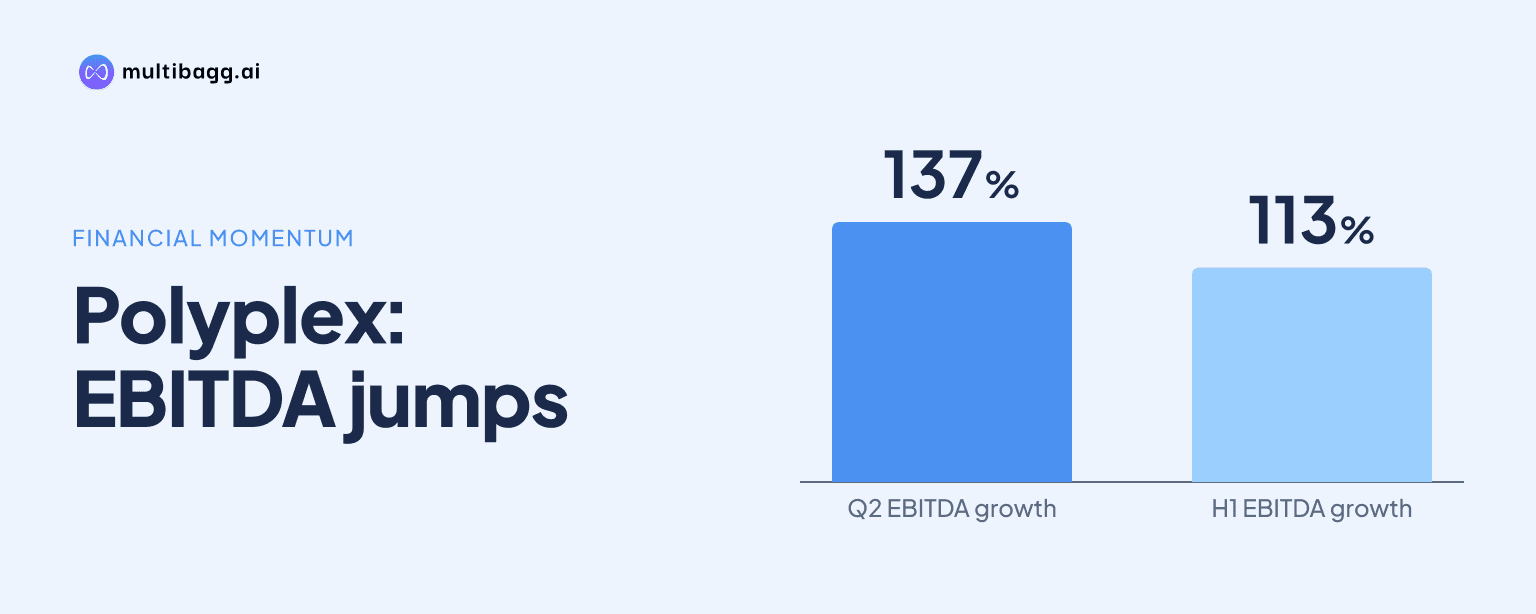
Polyplex reported normalized earnings before interest, tax, depreciation and amortisation (EBITDA) of Rs 327 crore in Q2 FY 26-27, up 137% year on year, although all-film sales volume fell 6% to 88.5 thousand metric tonnes (KMT). A 29% rise in sales revenue to Rs 2,320 crore, driven principally by improved realisations, underpinned the earnings recovery.
Know Polyplex Corporation inside out
Results, valuation, peers and who's buying, in one view.
How did Polyplex's Q2 FY 26-27 earnings change?
Polyplex's normalized EBITDA more than doubled year on year to Rs 327 crore in Q2 FY 26-27, while sales revenue increased 29% to Rs 2,320 crore. Profit after tax (PAT) before minority interest was Rs 180 crore, an increase of Rs 146 crore from Q2 FY 25-26, and earnings per share rose by Rs 24.06 to Rs 31.93.
The annual profit increase did not reflect higher film shipments. All-film sales volume of 88.5 KMT was 6% below Q2 FY 25-26 and 3% below Q1 FY 26-27. In contrast, revenue rose 3% sequentially, while normalized EBITDA declined 9% from Q1 FY 26-27, separating the strong year-on-year comparison from the quarter-on-quarter trend.
Polyplex also reported a 14% normalized EBITDA margin and 14% normalized return on capital employed (ROCE) in Q2 FY 26-27. The presentation defines normalized EBITDA as EBITDA excluding unrealized foreign-exchange gains or losses on long-term loans, while normalized ROCE excludes the same foreign-exchange effect from earnings before interest and tax and excludes cash and cash equivalents from capital employed.
Why did Polyplex's revenue rise while film volume fell?
Polyplex said improved sales realisations were the primary reason revenue rose 29% year on year to Rs 2,320 crore despite the 6% decline in volume to 88.5 KMT. Management attributed improved realisations to higher raw-material costs and precautionary as well as opportunistic buying amid geopolitical uncertainties.
Tariff changes also supported the margin outcome in Q2 FY 26-27, particularly in the US Distribution business. Polyplex said the withdrawal of reciprocal tariffs had an overall positive margin effect, partly offset by the introduction of Section 301 tariffs of 10% and 12.5%. The presentation further identified the continued focus on DPAC and specialty films as support for overall margin resilience.
The contrast across the operating measures is material. Revenue increased 29% and normalized EBITDA increased 137% year on year, while all-film volume declined 6%. On the sequential comparison, revenue still increased 3%, but normalized EBITDA fell 9%, indicating that higher realisations did not fully offset quarterly pressure from volumes, costs and value addition.
What caused Polyplex's EBITDA to decline from Q1 FY 26-27?
Polyplex's normalized EBITDA declined 9% sequentially to Rs 327 crore because lower volume and value-addition-rate variances in Thin PET and OPP films outweighed selected offsets. The Q2 FY 26-27 EBITDA bridge also identified lower contribution from other films and chips, fixed costs and inventory effects as adverse items, while other variable costs and other income provided offsets.
Management attributed lower quarter-on-quarter film volume mainly to a planned shutdown at the Indonesia plant. It also said the value-addition rate was affected by higher raw-material costs, partly offset by improved selling prices. These factors explain why Q2 revenue was 3% higher than Q1 FY 26-27 while normalized EBITDA was 9% lower.
Foreign-exchange movements affected reported earnings but not normalized EBITDA when they related to unrealized long-term-loan effects. Polyplex recorded an unrealized foreign-exchange gain of Rs 4.60 crore in Q2 FY 26-27, compared with an unrealized loss of Rs 39.69 crore in Q1 FY 26-27 and a loss of Rs 12.67 crore in Q2 FY 25-26. PAT before minority interest nevertheless increased by Rs 9 crore sequentially to Rs 180 crore.
Got a follow-up? Ask IRIS
What does Polyplex's H1 FY 26-27 performance show?
Polyplex reported H1 FY 26-27 sales revenue of Rs 4,569 crore, up 30% year on year, and normalized EBITDA of Rs 689 crore, up 113%. The half-year result extended the Q2 pattern because all-film volume declined 3% to 180 KMT even as revenue and normalized earnings increased.
PAT before minority interest for H1 FY 26-27 was Rs 351 crore, up Rs 377 crore from H1 FY 25-26, while earnings per share increased by Rs 59.21 to Rs 60.93. Polyplex reported a 15% normalized EBITDA margin and 15% normalized ROCE for the first half, compared with the respective 14% measures reported for Q2 FY 26-27.
The presentation identified higher fixed costs in the half year from annual salary increments, consolidation of expenses from the new entity Polyplex DiPiPrint Private Limited and increased stores and spares expenses. Those cost items accompanied the 30% revenue increase and 113% normalized EBITDA increase, rather than changing the stated reason for higher net sales, which remained improved realisations.
The foreign-exchange comparison was also less adverse in H1 FY 26-27. Polyplex recorded an unrealized foreign-exchange loss of Rs 35.09 crore in year-to-date FY 26-27, compared with a Rs 169.09 crore loss in year-to-date FY 25-26, both from restating foreign-currency long-term loans. This item is excluded from the company’s normalized EBITDA measure.
What should readers watch after Polyplex's Q2 result?
Polyplex's Q2 result shows that improved selling prices, tariff-related effects and the DPAC and specialty-film mix supported earnings despite lower shipments. The central comparison is between the 137% rise in normalized EBITDA to Rs 327 crore and the 6% fall in Q2 all-film volume to 88.5 KMT, alongside the 113% H1 EBITDA increase to Rs 689 crore despite a 3% volume decline.
Management's disclosed operational issue to watch is the planned Indonesia shutdown, which it cited as the main reason for lower Q2 volume. Polyplex's timeline also lists a PET film line, two metallizers and one holography project in India for 2027, followed by a specialty BOPP film line in Thailand in 2028; their execution is the stated future capacity plan relevant to product mix and volumes.
Conclusion
Polyplex delivered a year-on-year Q2 earnings recovery through higher realisations, favourable tariff effects in US Distribution and its DPAC and specialty-film focus, rather than through greater film volume. Revenue rose 29% to Rs 2,320 crore and normalized EBITDA rose 137% to Rs 327 crore, while all-film volume declined 6% to 88.5 KMT.
The next issue to watch is whether volumes recover after the planned Indonesia shutdown, which management identified as a Q2 constraint. The presentation also discloses India projects scheduled for 2027 and a specialty BOPP line in Thailand scheduled for 2028, making execution of those capacity additions a relevant future development.