










Polyplex D-PAC EBITDA reached $55 million annualised in H1FY27
Key highlights
- Polyplex reported $55 million of D-PAC EBITDA in the H1FY27 Annualised column.
- Polyplex standard EBITDA was positive $17 million in H1FY27 Annualised after negative $22 million in FY26.
- Polyplex D-PAC volume rose from 92 KMT in FY23 to 108 KMT in FY26.
- Polyplex reported incremental D-PAC EBITDA of $0.91 per kilogram in H1FY27 Annualised versus $0.81 per kilogram in FY26.
powered by IRIS
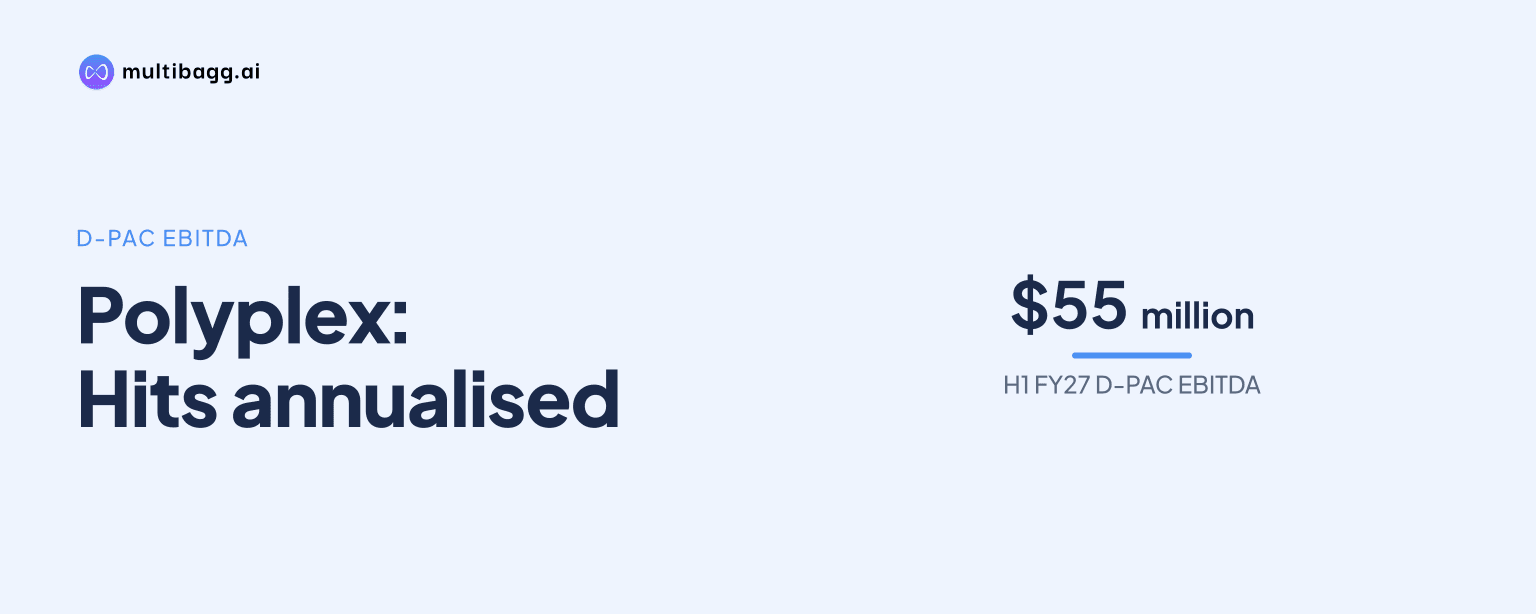
Polyplex reported $55 million of D-PAC EBITDA in its H1FY27 Annualised column, while standard EBITDA was positive at $17 million after negative $22 million in FY26. The figures show differentiated products remained the larger reported earnings contributor, with D-PAC EBITDA exceeding standard EBITDA by $38 million in the H1FY27 Annualised column.
Know Polyplex Corporation inside out
Results, valuation, peers and who's buying, in one view.
What did Polyplex report for D-PAC and standard EBITDA?
Polyplex reported $55 million of D-PAC EBITDA and $17 million of standard EBITDA in the H1FY27 Annualised column. EBITDA means earnings before interest, tax, depreciation and amortisation. The presentation does not provide a total EBITDA figure for that final column, so the two segment figures should not be treated as a reported total.
D-PAC EBITDA was positive in every full year shown, at $85 million in FY23, $83 million in FY24, $95 million in FY25 and $87 million in FY26. Standard EBITDA changed more sharply, moving from positive $47 million in FY23 to negative $22 million in FY24, negative $6 million in FY25 and negative $22 million in FY26 before the positive $17 million H1FY27 Annualised result.
The comparison indicates that D-PAC was the larger EBITDA contributor in FY24, FY25 and FY26, when standard films recorded negative EBITDA. In FY26, D-PAC EBITDA of $87 million was set against negative standard EBITDA of $22 million; the H1FY27 Annualised column shows a positive standard result without changing D-PAC's position as the larger disclosed contributor.
How did Polyplex D-PAC volumes change?
Polyplex reported D-PAC volume of 60 thousand metric tonnes, or KMT, in the H1FY27 Annualised column, following 108 KMT in FY26. D-PAC volume increased through the four full years displayed, from 92 KMT in FY23 to 94 KMT in FY24, 104 KMT in FY25 and 108 KMT in FY26.
Standard-film volume fell from 268 KMT in FY23 to 244 KMT in FY24 and 239 KMT in FY25, then rose to 263 KMT in FY26. The H1FY27 Annualised column shows standard volume of 120 KMT. Polyplex does not disclose total volume for the H1FY27 Annualised column.
D-PAC volume rose by 16 KMT between FY23 and FY26, while total volume increased by 11 KMT over the same period. Standard volume was 5 KMT below its FY23 level in FY26 despite the recovery from FY25. Management describes its strategy as continually adding differentiated products that effectively replace older and standard products.
Got a follow-up? Ask IRIS
What does Polyplex classify as D-PAC?
Polyplex defines D-PAC as differentiated product, application or customer. A differentiated product can have limited competition or features that create added customer value, while a differentiated customer can involve stringent quality requirements, long qualification timelines or significant trial costs.
A differentiated application is a specific use for a standard product that may need minor modification and may not be widely known in the market. Polyplex says D-PAC can produce sustained higher contribution than the relevant standard product, pricing stability and high entry barriers; these are management's stated portfolio characteristics rather than a forecast of future pricing or margins.
Polyplex reported incremental D-PAC EBITDA of $0.93 per kilogram in FY23, $0.89 per kilogram in FY24, $0.91 per kilogram in FY25, $0.81 per kilogram in FY26 and $0.91 per kilogram in H1FY27 Annualised. The company defines incremental D-PAC EBITDA as contribution over standard products after additional raw-material, productivity, wastage and conversion costs.
Polyplex's illustration uses a standard-film price of 100, a D-PAC price of 200 and additional costs of 30 to produce an incremental margin of 70. That mechanism explains why the measure is not simply the difference between selling prices: it deducts the additional costs associated with producing differentiated films.
Which Polyplex products and capabilities support D-PAC?
Polyplex says it diversified beyond Sarafil standard and specialty base films over the past 10 to 15 years through Saracote, Saralam and Saraprint downstream products. Saracote includes silicone-coated polyethylene terephthalate, or PET, and polypropylene, or PP, films for pressure-sensitive materials, including labels, tapes, roofing shingles and peel-and-stick underlayment.
Saralam is Polyplex's extrusion-coated film range for thermal lamination applications including documents, identity cards, carton lamination and wide-format commercial films. Saraprint is a non-tearable polyester film for digital-print uses including photo albums, promotional and customised printing, mini-offset printing and labels. The presentation does not assign revenue or EBITDA figures to these individual brands.
Polyplex operates across India, Thailand, Turkey, the United States and Indonesia, with total PET resin capacity of 495,200 metric tonnes per annum and total base-film capacity, including upcoming capacity, of 503,837 metric tonnes per annum. Management says captive resin production at all film manufacturing locations supports specialty-resin development, supply security and protection of proprietary compositions.
The capacity table lists 119,150 metric tonnes of metallising capacity, 6,000 metric tonnes of holography capacity and 1,990 million square metres of coating capacity. Management says downstream capabilities can enable customised and more technical products, while chemical recycling and direct melt casting support specialty-product development, quality and energy management.
Conclusion
Polyplex's disclosed figures show D-PAC remained its larger reported earnings contributor in the H1FY27 Annualised column, at $55 million of EBITDA versus $17 million for standard films. The FY23-to-FY26 volume trend also shows D-PAC rising from 92 KMT to 108 KMT while standard volume ended FY26 below its FY23 level.
The next development to watch is management's plan to add differentiated products, continue investing in downstream assets and use the recent PDPL acquisition to drive D-PAC sales. The presentation does not disclose a timetable, sales target, purchase consideration or expected EBITDA contribution for PDPL, and it does not show whether positive standard EBITDA continues beyond H1FY27 Annualised.