










Polyplex thin-BOPET utilisation reached 89% in H1 FY27
Key highlights
- Polyplex reported 89% annualised thin-BOPET utilisation in H1 FY27, up from 87% in FY26.
- Polyplex displayed a 54% thin-BOPET industry utilisation estimate alongside FY26, based on internal estimates.
- Thin-BOPET production was 126 thousand metric tonnes in H1 FY27 and 248 thousand metric tonnes in FY26.
- The Americas contributed 33% of Polyplex H1 FY27 revenue, followed by Other Asia at 27%.
powered by IRIS
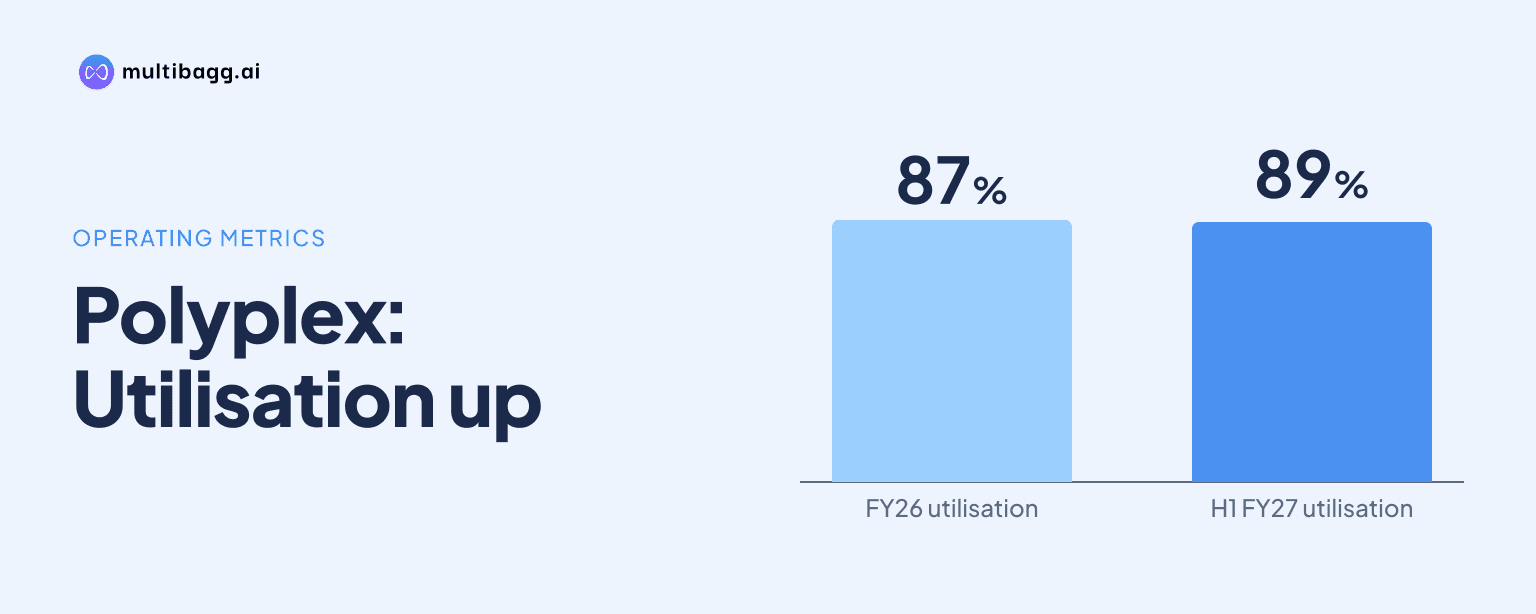
Polyplex reported 89% annualised utilisation of thin biaxially oriented polyethylene terephthalate, or BOPET, film capacity in H1 FY27, up from 87% in FY26. Its presentation placed this result beside a 54% industry utilisation estimate shown for FY26, creating a displayed 35-percentage-point gap, although the two series use different reporting calendars.
Know Polyplex Corporation inside out
Results, valuation, peers and who's buying, in one view.
How did Polyplex’s thin-BOPET utilisation compare with the industry?
Polyplex’s thin-BOPET capacity utilisation factor, or CUF, was 89% in H1 FY27 on an annualised basis, compared with 87% in FY26. The industry CUF displayed by Polyplex was 54% alongside FY26, down from 59% alongside FY25, while the presentation describes the market backdrop as global over-capacity.
The comparison is not a same-period measure. Polyplex says its CUF is calculated using extant capacity and reported by financial year, while the industry CUF is an internal estimate reported by calendar year. The presentation does not provide an industry CUF for H1 FY27, so 54% is the latest industry estimate shown next to Polyplex’s 89% annualised result.
Across FY20 to FY26, Polyplex’s CUF declined by 13 percentage points, from 100% to 87%, whereas the industry estimate fell by 29 percentage points, from 83% to 54%. Polyplex was above the industry figure in every full-year comparison displayed, even though both measures moved below their FY20 levels.
What production trend supported Polyplex’s utilisation?
Polyplex produced 126 thousand metric tonnes, or KMT, of thin BOPET in H1 FY27, while FY26 production was 248 KMT. The H1 FY27 output figure is paired with an annualised 89% CUF, but the presentation does not state a full-year FY27 production forecast.
FY26 production increased by 22 KMT from 226 KMT in FY25, while CUF declined by 9 percentage points from 96% to 87%. That combination shows higher output measured against a larger extant capacity base, consistent with Polyplex’s stated use of debottlenecking existing assets.
Production had been relatively stable before FY26, at 203 KMT in FY20, 229 KMT in FY21, 232 KMT in FY22, 231 KMT in FY23 and 230 KMT in FY24. Over FY20 to FY24, Polyplex’s CUF eased from 100% to 98%, while the displayed industry measure fell from 83% to 67%.
Why does Polyplex say it can maintain higher plant loading?
Polyplex attributes its utilisation to customer access in key demand centres, multi-location manufacturing and a higher, increasing proportion of specialty films. Its H1 FY27 revenue mix was 33% Americas, 27% Other Asia, 18% Europe, 18% India and 5% rest of world, providing exposure across several regional markets.
Polyplex also cites its ability to move material between regions according to local conditions, supported by sales and distribution infrastructure with local warehousing. The company reported about 2,925 customers in about 85 countries, while its top 10 film customers accounted for 26% of FY26 turnover.
Packaging represented 65% of FY26 turnover and industrial applications represented 35%. Polyplex also identifies in-house downstream businesses with varying market conditions as a support for plant loading, although it does not quantify the contribution of individual products or segments to the 89% H1 FY27 CUF.
Got a follow-up? Ask IRIS
What operating actions does Polyplex link to utilisation?
Polyplex links plant loading to continuous-improvement programmes covering productivity, wastage, freight, packing, energy conservation and inventory management. The company says benefits from these programmes have accrued over several years and that incremental benefits are expected, alongside work on reliability, throughput and debottlenecking.
Its asset configuration assigns large contemporary assets to standard products and repurposes older lines for specialty films. Polyplex also describes a minimum asset base at each manufacturing location of two base-film lines, a resin plant and downstream capabilities, which it says provides economies of scale.
Polyplex says new investments are structured around near-shore and on-shore manufacturing to benefit from logistics and trade-duty differentials. It further identifies domestic availability, quick turnaround and flexibility for smaller orders as features that can address local sourcing requirements from consumer packaged goods companies and original equipment manufacturers.
What does the 89% utilisation result show?
The 89% annualised H1 FY27 figure shows a 2-percentage-point recovery from FY26’s 87% CUF despite the global over-capacity conditions cited by Polyplex. The displayed 35-percentage-point difference versus the 54% industry estimate is the central operating comparison, but it should be read with the financial-year versus calendar-year methodology difference.
Polyplex has not returned to the 96% CUF reported in FY25 or the 98% to 100% range reported from FY20 through FY24. The presentation also does not disclose thin-BOPET pricing, margins or full-year FY27 production, so CUF is an operating measure rather than a disclosed earnings or cash-generation measure.
Conclusion
Polyplex’s utilisation record indicates that its thin-BOPET plants remained more heavily loaded than the industry estimate presented alongside them as both series declined from FY20 levels. The company attributes that difference to regional reach, specialty films, customer breadth, downstream activities and productivity efforts rather than to a single product or market.
The next operating indicators are whether Polyplex sustains the 89% annualised H1 FY27 CUF while continuing debottlenecking and reliability work, and whether its specialty-film mix expands. Management also disclosed plans to chemically recycle and reuse BOPET film-line lumps in the film line as part of its sustainability programme.