










Polyplex scales recycled PET films to 100% PCR worldwide
Key highlights
- Polyplex offers Sarafil rPET films with 30%, 70%, 90% and 100% PCR content.
- Ecoblue has 49,200 tonnes per annum of rPET capacity and 10,500 tonnes per annum of polyolefin capacity in Thailand.
- Ecoblue began operations in 2013 and produces rPET, rPP and rHDPE resins.
- Polyplex says Sarafil rPET films are manufactured in India, Thailand, Turkey and the USA.
powered by IRIS
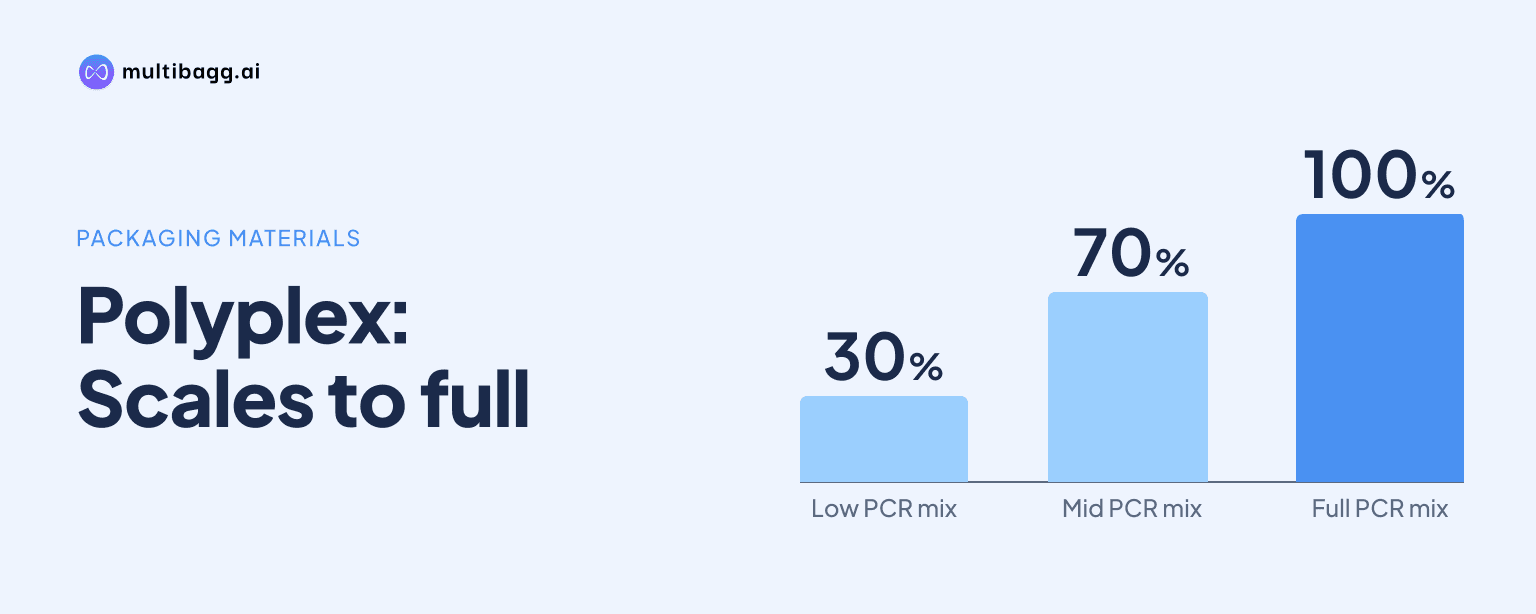
Polyplex offers Sarafil recycled polyethylene terephthalate, or rPET, films containing 30% to 100% post-consumer recycled, or PCR, content, while its Ecoblue operation has 49,200 tonnes per annum of rPET recycling capacity in Thailand. The presentation positions the film range and Ecoblue’s resin output as delivered elements of Polyplex’s sustainability programme.
Know Polyplex Corporation inside out
Results, valuation, peers and who's buying, in one view.
What recycled PET film specifications does Polyplex offer?
Polyplex offers Sarafil rPET films with 30%, 70%, 90% and 100% PCR content. The range is available in transparent, metallized and white formats, providing grades from partial recycled content through to a 100% PCR option. Polyplex lists these films among sustainable products that have already been delivered.
The difference between the 30% and 100% grades is 70 percentage points of PCR content. Polyplex says the Sarafil range has the same properties as virgin PET and uses glycolysis, a chemical-recycling process. The presentation does not disclose sales volume, customer uptake or production volume for any of the four PCR-content grades.
Polyplex says Sarafil rPET films are manufactured in India, Thailand, Turkey and the USA. It states that the products comply with relevant US Food and Drug Administration, or FDA, European Union food-safety and recycling requirements, while PCR-content verification follows ISO 14021:2016. The presentation does not identify the specific certification held by each manufacturing location.
How much recycling capacity does Ecoblue operate?
Ecoblue has current recycling capacity of 49,200 tonnes per annum for rPET and 10,500 tonnes per annum for polyolefins, both in Thailand. Its listed rPET capacity is therefore 38,700 tonnes per annum higher than its polyolefin capacity, making PET the larger of Ecoblue’s two capacity segments.
Ecoblue began operations in 2013 and works with film-based process waste as well as post-consumer plastic waste. Polyplex says the operation handles PET and polyolefin waste streams and produces rPET resin, recycled polypropylene, or rPP, resin, and recycled high-density polyethylene, or rHDPE, resin. The 59,700 tonnes per annum combined capacity is a calculation from the two segments disclosed in the presentation.
Polyplex describes Ecoblue as the only recycler in its region to develop food-grade products across rPET, rHDPE and rPP for different applications. It also says Ecoblue was the first in Thailand to produce food-grade rPET resin for bottles. However, the presentation does not divide the 49,200 tonnes per annum rPET capacity between food-grade resin and other rPET output.
Which recycling products and applications does Polyplex identify?
Polyplex identifies rPET resin for bottles, BOPET film and high-quality fibre as applications intended to replace virgin material. Ecoblue marks rPET for bottles and BOPET film as US FDA approved. BOPET means biaxially oriented polyethylene terephthalate, a film product that Polyplex also lists in its broader sustainable-products portfolio.
For recycled polyolefins, Ecoblue lists rPP copolymer with high impact and clear rPP homopolymer for injection moulding and filaments. Recycled HDPE for bottles is still under development, which distinguishes it from the rPET bottle and BOPET-film applications marked as US FDA approved. The presentation provides no commercial volume or launch date for the recycled HDPE bottle application.
The wider sustainable-products list includes mono-PET structures, high-barrier metallized films positioned as foil replacements, heavy-metal-free BOPET film and chlorine-free transparent barrier products positioned as alternatives to polyvinylidene chloride. Polyplex also lists source reduction through downgauging and internal recycling, showing that its stated programme includes material reduction as well as recycled-content products.
Ecoblue lists Strap2Strap, patented metallized-BOPET-film recycling, Circular Liner and Laminate solutions for streams described as “unrecyclable materials.” It also works with ocean-bound plastics through marketplace platforms and says such plastics are certified. The presentation does not disclose capacity, revenue or volumes for these individual recycling solutions.
Got a follow-up? Ask IRIS
What approvals and recycling mechanisms does Polyplex disclose?
Polyplex lists US FDA, European Food Safety Authority, or EFSA, and Thai FDA approvals for Ecoblue, alongside Global Recycled Standard, or GRS, certification for rPET, rPP and recycled polyethylene. These approvals and certifications relate to Ecoblue’s recycled-resin product range; the presentation does not quantify the output covered by each approval.
Sarafil rPET films use glycolysis, which Polyplex calls a chemical-recycling process, whereas Ecoblue’s facility uses post-consumer bottles and containers made from PET and olefins as feedstock with wash lines. These are distinct mechanisms: glycolysis is identified with the Sarafil rPET-film offer, while the wash-line facility is described under the Ecoblue initiative.
Polyplex says most countries now permit recycled PET in food-contact applications and describes this as a growth opportunity. That statement is management’s market view rather than a disclosed forecast. The presentation provides no country-by-country regulatory list, demand forecast or timetable for food-contact market expansion.
What is Polyplex planning next in recycling?
Polyplex’s stated sustainability agenda includes increasing post-consumer and post-industrial recycling capacity, developing new products, eliminating scrap sales, collaborating with industry participants and advancing the Ecoblue initiative. In product development, it plans to promote rPET in packaging and industrial uses and to develop products that enable conversion to mono-PET structures.
Under its scrap-sales objective, Polyplex says it intends to recycle BOPP and ethylene-vinyl acetate thermal films. It also plans to chemically recycle and reuse BOPET film-line lumps in the film line. These internal recovery measures concern manufacturing-film material and are separate from Ecoblue’s disclosed 49,200 tonnes per annum rPET capacity.
Polyplex says it is working with industry associations, consumer packaged goods companies, original equipment manufacturers, converters and research organisations to develop viable solutions. The presentation does not give a date for BOPET-lump chemical recycling, a capital-spending figure, or a future capacity target above Ecoblue’s current rPET and polyolefin capacities.
Conclusion
Polyplex’s disclosed recycling strategy combines a Sarafil film range reaching 100% PCR content with Ecoblue’s 49,200 tonnes per annum rPET capacity and 10,500 tonnes per annum polyolefin capacity in Thailand. The product set spans bottles, BOPET film, fibre, rPP applications and selected film streams that Ecoblue describes as difficult to recycle.
The next items to watch are Polyplex’s plans to recycle BOPP, ethylene-vinyl acetate thermal films and BOPET line lumps, along with any update on additional post-consumer or post-industrial recycling capacity. Management has also identified mono-PET development and food-contact rPET adoption as opportunities, but the presentation gives no deadline or capacity-expansion target.