










Polyplex says Middle East margin gains may normalize
Key highlights
- Polyplex showed normalized EBITDA of US$38 million in Q1 26-27 and US$34 million in Q2 26-27.
- Polyplex says global oversupply and softer oil prices make Middle East-related margin expansion and stock gains uncertain.
- Polyplex has US$88 million of projects under implementation, including a US$56 million India BOPET line planned for Q4 26-27.
- Polyplex showed normalized EBITDA of US$14 million in both Q3 25-26 and Q4 25-26.
powered by IRIS
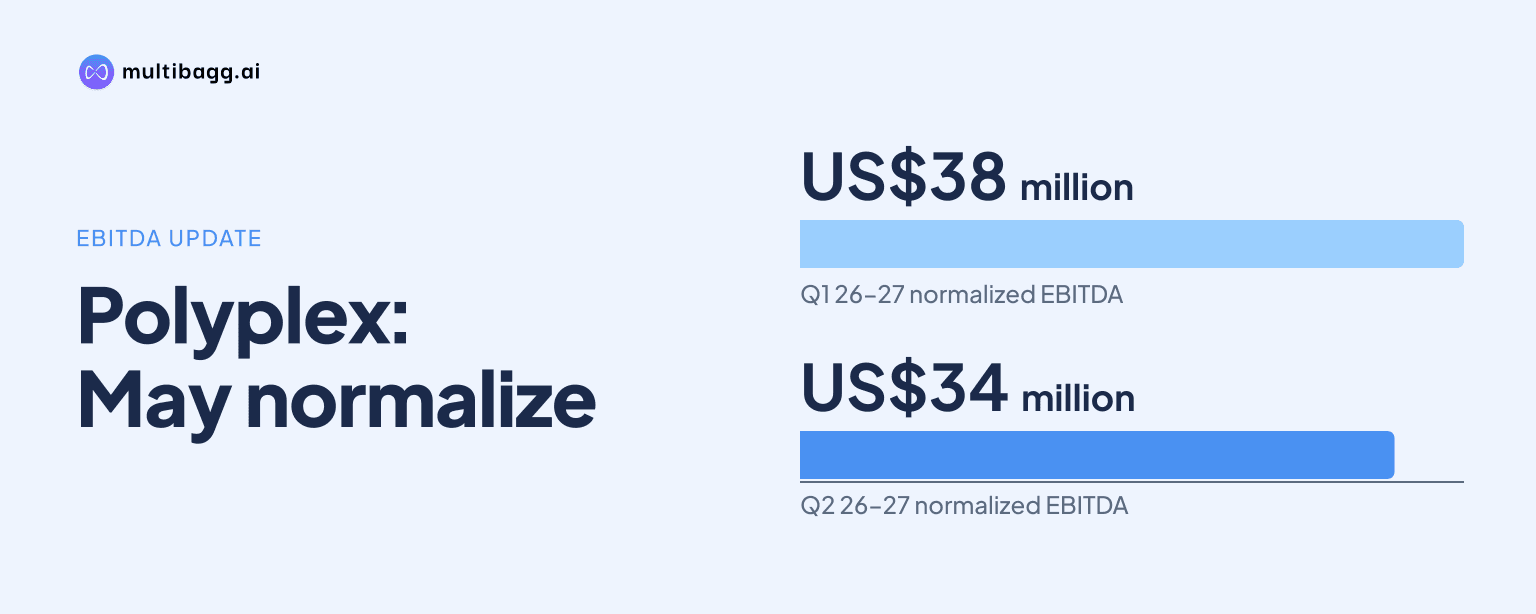
Polyplex Corporation Limited says Middle East-related margin expansion and stock gains may normalize, despite normalized EBITDA of US$38 million in Q1 26-27 and US$34 million in Q2 26-27. Management cites prevailing global oversupply, efforts toward resolving the Middle East crisis and softening oil prices as factors that could change the conditions behind recent gains.
Know Polyplex Corporation inside out
Results, valuation, peers and who's buying, in one view.
Why could Polyplex’s Middle East margin gains normalize?
Polyplex says the sustainability of margin expansion and stock gains from the Middle East situation is uncertain because global oversupply persists and oil prices have softened. The company identifies the geopolitical situation as a short- to medium-term driver of both higher selling-price realizations and supply-chain disruption, rather than as a permanent change in industry conditions.
The presentation describes heightened input-cost volatility and supply-chain uncertainty as the principal headwinds during the crisis. At the same time, it identifies improved selling-price realizations, reflecting higher input costs and market volatility, as the tailwind behind the margin trajectory. If those conditions stabilize, Polyplex says profitability may normalize.
Management also links the uncertainty to developments following the U.S. midterm elections, which it says resulted in efforts toward resolution of the Middle East crisis. The company does not provide a numerical estimate of the potential effect of softer oil prices or crisis resolution on Q3 26-27 earnings, but explicitly states that the recent trends may not be sustainable.
How did Polyplex’s normalized EBITDA change before Q3 26-27?
Polyplex’s normalized earnings before interest, tax, depreciation and amortisation, or EBITDA, rose to US$38 million in Q1 26-27 and then declined to US$34 million in Q2 26-27. The US$4 million sequential decline still left Q2 26-27 above every quarterly figure shown for 25-26, when normalized EBITDA ranged from US$14 million to US$22 million.
The period comparison shows a change from US$22 million in Q1 25-26 to US$38 million in Q1 26-27, an increase of US$16 million. Q2 26-27 was US$12 million above Q2 25-26. The Q1 26-27 result was also above the US$24 million high shown in the earlier quarterly series, recorded in Q1 24-25.
Polyplex’s Q3 26-27 guidance page does not show a numerical normalized EBITDA figure for that quarter. Instead, management provides qualitative expectations about Middle East-related conditions, the U.S. facility ramp-up, portfolio expansion and higher DPAC sales, while cautioning that its forward-looking statements are subject to significant uncertainty.
What operating measures did Polyplex use during the crisis?
Polyplex says its global diversification, agile procurement, proactive inventory control and integrated operations supported continuity during the Middle East disruption. Its stated mechanism was to use a wide geographic presence and global sourcing network to reduce dependence on any one region and secure critical raw-material volumes quickly.
The company says it deliberately pre-built inventory reserves to outlast longer logistical lead times and supply-chain uncertainty. That inventory policy was intended to manage disruption rather than to create a recurring earnings source, which is relevant to management’s warning that the associated stock gains and margin expansion could normalize as market conditions stabilize.
Integrated manufacturing operations are another element of the response described by Polyplex. Management says the setup allows it to absorb and manage disruptions more effectively, while its procurement network can respond to changes in raw-material availability. The presentation does not quantify inventory levels, sourcing savings or the margin contribution from these mechanisms.
Got a follow-up? Ask IRIS
What could support Polyplex’s margins beyond Middle East conditions?
Polyplex says incremental volumes from the continued ramp-up of its U.S. facility, portfolio expansion and higher DPAC sales are expected to support margins. The presentation does not define DPAC or quantify the anticipated sales increase, but identifies these factors separately from the higher selling-price realizations associated with Middle East market volatility.
Management also expects relative stability in the tariff regime, particularly under Section 301, to provide better visibility for its U.S. distribution business. This is presented as an expectation about operating visibility, not as a revenue or EBITDA target, and it remains alongside exposure to foreign exchange, raw-material prices and market dynamics.
The company has US$88 million of investments under implementation that it says are intended to expand its product portfolio, increase the share of speciality films and support industrial applications. The investment plan includes a US$56 million new BOPET film line in India and US$7 million of metallizers in India, both with likely start-up in Q4 26-27.
A US$10 million coater in Turkey commenced in October 2026, according to the presentation. Polyplex also lists a US$15 million speciality BOPP film line in Thailand for likely start-up in Q4 27-28. Management says the Thailand line is intended to augment the portfolio and capitalize on increasing demand for specialty films.
What risks qualify Polyplex’s Q3 26-27 outlook?
Polyplex says its Q3 26-27 forward-looking statements reflect expectations based on assumptions current as of the presentation date and are subject to significant risks and uncertainties. It specifically says it does not make a representation, warranty or prediction that anticipated results will be achieved.
The listed variables include fluctuations in foreign exchange rates, changes in key raw-material prices, changes in market dynamics and the impact of consolidating subsidiaries. The company also identifies unexpected production downtime from machinery breakdown as a risk, which could affect operations independently of Middle East pricing or supply-chain conditions.
Unforeseen delays in project start-up are another stated risk, with particular relevance to the US$56 million India BOPET line and US$7 million India metallizer projects planned for Q4 26-27. The US$15 million Thailand speciality BOPP line has a later likely start-up of Q4 27-28, extending execution risk beyond the near-term guidance period.
The central issue for Q3 26-27 is therefore the interaction between oil prices, oversupply and selling-price realizations. Polyplex says its diversification and cost discipline can help it navigate volatility, but it does not claim that these measures remove the risks from changing market prices, raw-material costs or geopolitical developments.
Conclusion
Polyplex’s normalized EBITDA of US$38 million in Q1 26-27 and US$34 million in Q2 26-27 exceeded the US$14 million to US$22 million quarterly range shown for 25-26. However, management directly cautions that Middle East-related margin expansion and stock gains may normalize if the crisis eases, oil prices soften and global oversupply continues to influence market conditions.
The next disclosures to watch are progress in the U.S. facility ramp-up, portfolio expansion, DPAC sales and the tariff environment under Section 301. Project execution is also material: Polyplex lists Q4 26-27 start-up for its US$56 million India BOPET line and US$7 million metallizer projects, while the US$15 million Thailand speciality BOPP line is planned for Q4 27-28.