










Polyplex says China BOPET additions may be delayed by oversupply
Key highlights
- Thin BOPET films account for 80% of global BOPET film demand, according to Polyplex.
- Polyplex expects global thin BOPET demand to grow 5% to 6% annually.
- Expected global thin PET film capacity growth is 7.1%, versus 4.0% for capacity outside China.
- Packaging represents an estimated 60% to 70% of global BOPET film volume.
powered by IRIS
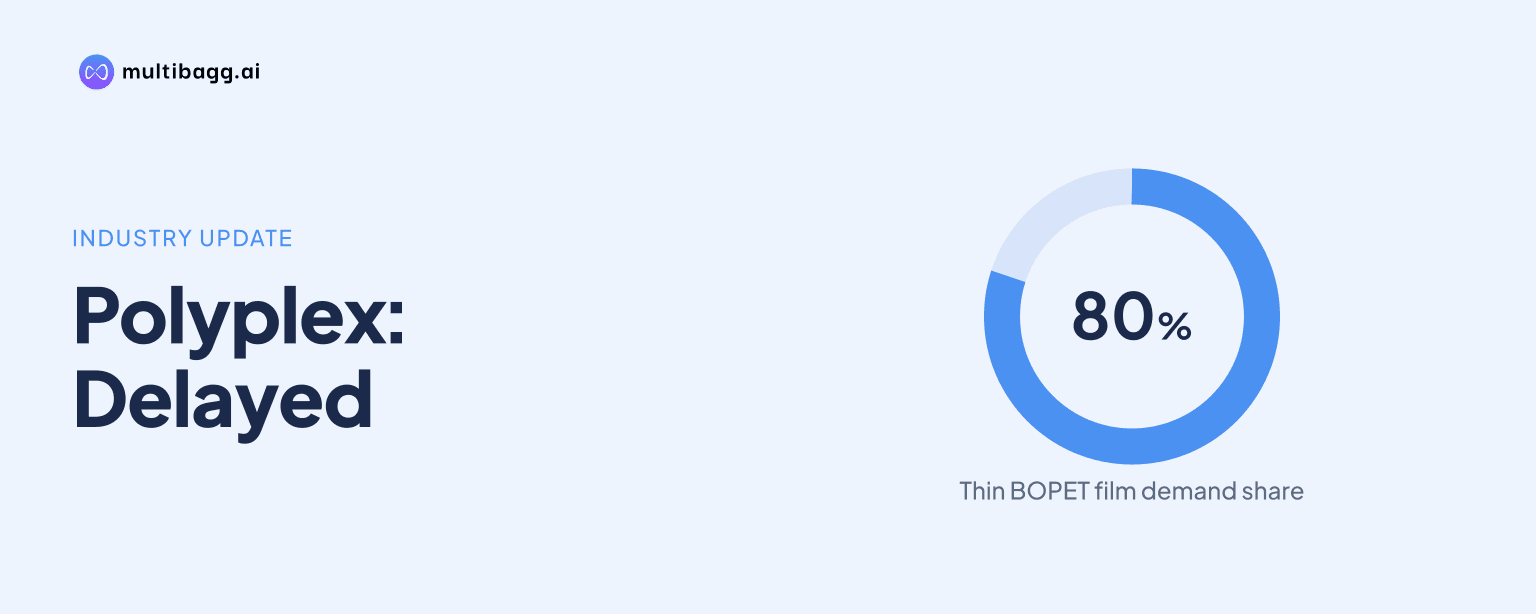
Polyplex Corporation Limited says prevailing overcapacity in China may delay or cancel planned biaxially oriented polyethylene terephthalate, or BOPET, film projects, even as global thin BOPET demand is expected to grow 5% to 6% annually. Thin films account for 80% of global BOPET demand, while global thin polyethylene terephthalate capacity is projected to grow at a 7.1% compound annual growth rate.
Know Polyplex Corporation inside out
Results, valuation, peers and who's buying, in one view.
Why does Polyplex expect Chinese BOPET projects to be delayed?
Polyplex expects possible delays or cancellations because most upcoming thin BOPET capacity scheduled for commissioning is concentrated in China, where prevailing market conditions include overcapacity. The presentation does not quantify the number of projects at risk, but identifies existing excess supply and the concentration of announced additions in China as reasons that some projects may not proceed on their original timetable.
The expected capacity outlook shows a 7.1% compound annual growth rate, or CAGR, for global thin polyethylene terephthalate, or PET, film capacity, compared with 4.0% for capacity excluding China. This 3.1-percentage-point gap shows that Chinese projects account for a larger share of planned global expansion, although Polyplex says prevailing oversupply could alter the timing or completion of several lines.
Many recently added or announced Chinese lines are expected to supply non-packaging applications, including optical films, release liners and other specialty segments. This mix means not every announced line would directly add capacity to packaging-grade film, a relevant distinction because packaging represents an estimated 60% to 70% of global BOPET film volume.
How fast is thin BOPET film demand expected to grow?
Polyplex expects global thin BOPET film demand to grow 5% to 6% annually, and says thin films account for 80% of worldwide BOPET film demand. Its demand chart covers 2011 to 2030E, with estimates from 2027E through 2030E, and presents thin films as the fastest-growing part of the global BOPET market.
Asia, particularly India, is expected to support demand through domestic consumption and expanding end-use applications, while demand in Western markets has been relatively muted by reciprocal-tariff uncertainty and geopolitical risks. Packaging, estimated at 60% to 70% of global BOPET volume, is supported by a shift from rigid to flexible formats and from loose to packaged products.
Polyplex also identifies electrical and electronics applications as a growth area, primarily in South Korea and China. The company cites machine-direction polyester, or MDPE, films, organic light-emitting diode, or OLED, displays, aluminium-related applications and autonomous-vehicle electronics, while noting that photovoltaic-film demand has slowed as solar manufacturers adopt glass-on-glass panels.
Will Chinese BOPET capacity affect markets outside China?
Polyplex expects the effect of new Chinese capacity to remain largely within China, with some influence on Southeast Asian, or SEA, markets. Chinese producers mainly serve domestic demand and selected export destinations with standard-grade products, while trade barriers, established supplier relationships and regional buyers’ quality perceptions are cited as limits on their SEA penetration.
Excluding China, Polyplex says global capacity-utilisation factors, or CUF, remain stable and show lower volatility between peaks and troughs. The company expects rationalisation and underutilisation of older, less efficient lines to improve overall utilisation rates in the medium term as cost structures shift, but it does not disclose a CUF target or a date for that potential improvement.
The industry outlook also identifies deglobalisation, protectionism and a preference for local and regional sourcing as influences on capacity deployment and trade flows. These factors could affect the reach of Chinese standard-grade supply alongside the stated concentration of new capacity in China and the 4.0% CAGR projected for capacity outside China.
Got a follow-up? Ask IRIS
How is Polyplex positioned for regional BOPET imbalances?
Polyplex says its manufacturing presence across key demand centres enables it to serve major geographies and maintain high CUF levels. Management links this global manufacturing and sales structure to its ability to manage regional supply-demand imbalances, logistics challenges and trade barriers, including recent reciprocal tariffs in the United States.
The company’s operating model includes specialty and higher-value-added products alongside commodity film. Polyplex says raw-material prices are generally passed through to customers with a varying lag, making pricing principally a function of demand and supply, while integrated manufacturing, productivity measures and a competitive cost structure support its cost position.
Recent and ongoing capital expenditure on line upgrades is intended to enable optimal utilisation of existing assets. Polyplex also says its distributed manufacturing and sales network, together with long-standing supplier relationships, kept raw-material sourcing largely uninterrupted during the ongoing Middle East crisis and had minimal impact on operations.
What does Polyplex’s margin history show about industry cycles?
Polyplex reported normalised earnings before interest, tax, depreciation and amortisation, or EBITDA, of $0.40 per kilogram in H1FY27, compared with $0.18 per kilogram in FY26. The H1FY27 measure also exceeded the $0.26 per kilogram reported in FY25, though the presentation does not provide a full-year FY27 projection.
The company’s consolidated all-films value addition was $0.97 per kilogram in Q2 2026-27, compared with $0.22 per kilogram for China value addition over indexed raw material on 12-micron film. Polyplex says the gap between its gross margin and Chinese players’ gross margin widens significantly during industry troughs, while Chinese players’ margins briefly rose in the second half of 2021 because of supply constraints caused by logistics disruption and an energy crisis.
Conclusion
Polyplex’s outlook combines 5% to 6% expected annual thin BOPET demand growth with an uneven capacity picture: global thin PET capacity is projected to grow at a 7.1% CAGR, versus 4.0% excluding China. Management therefore identifies Chinese overcapacity and the concentration of planned projects there, rather than broad demand weakness, as the main reasons some additions may be delayed or cancelled.
The next issues to watch are whether Chinese projects are commissioned as planned, whether older and less efficient lines are rationalised, and whether CUF outside China remains stable. Polyplex’s disclosed response is ongoing capital expenditure on line upgrades and a focus on specialty and higher-value-added products, while protectionism, local sourcing preferences and SEA market conditions may continue to influence trade flows.